Introduction
In today’s manufacturing landscape, traditional 3-axis CNC machining frequently encounters challenges such as multiple setup requirements, insufficient accuracy, and delivery delays. For highly complex components like aerospace parts, these inefficiencies can extend production cycles by more than 30%. The root cause lies in equipment limitations and non-optimized processes, where conventional solutions fail to facilitate multi-angle machining from a single setup, leading to increased costs and reduced efficiency.
This article will introduce 5-Axis CNC Machining Services as a transformative solution, leveraging high-speed capabilities and integrated production to achieve superior precision and significant time savings, with its advantages substantiated by authoritative research. The following sections will provide an in-depth analysis of how 5-axis technology is revolutionizing manufacturing workflows.
What are 5-Axis CNC Machining Services? Why are They More Efficient than Traditional 3-Axis?
5-Axis CNC Machining Services represent an advanced form of computer-controlled machining that adds two rotational axes (typically A and C) to the standard X, Y, and Z linear axes. This multi-degree-of-freedom movement is the core technological principle that enables the complete machining of complex geometries in a single setup.
The Transformative Advantages of 5-Axis over 3-Axis Machining
The limitations of 3-axis technology become apparent when machining complex parts. Its linear movement in three perpendicular directions necessitates multiple re-fixturing operations for components with intricate contours or multiple faces. 5 axis milling machines fundamentally change this dynamic by enabling multi-angle machining in a single setup.
Eliminating Multiple Setups for Enhanced Accuracy
Each re-fixturing in 3-axis machining introduces potential positioning errors, which accumulate and compromise the final part’s accuracy. The single-clamping capability of 5-axis technology drastically reduces these datum errors, directly improving dimensional consistency and part quality.
Unlocking Complex Geometries with Single Setup
By allowing the workpiece to be manipulated relative to the cutting tool, 5-axis machines can access up to five faces in one operation. This not only saves time but also enables the production of highly complex geometries that would be impractical or impossible to create efficiently on 3-axis equipment.
Quantifiable Gains in Efficiency and Precision
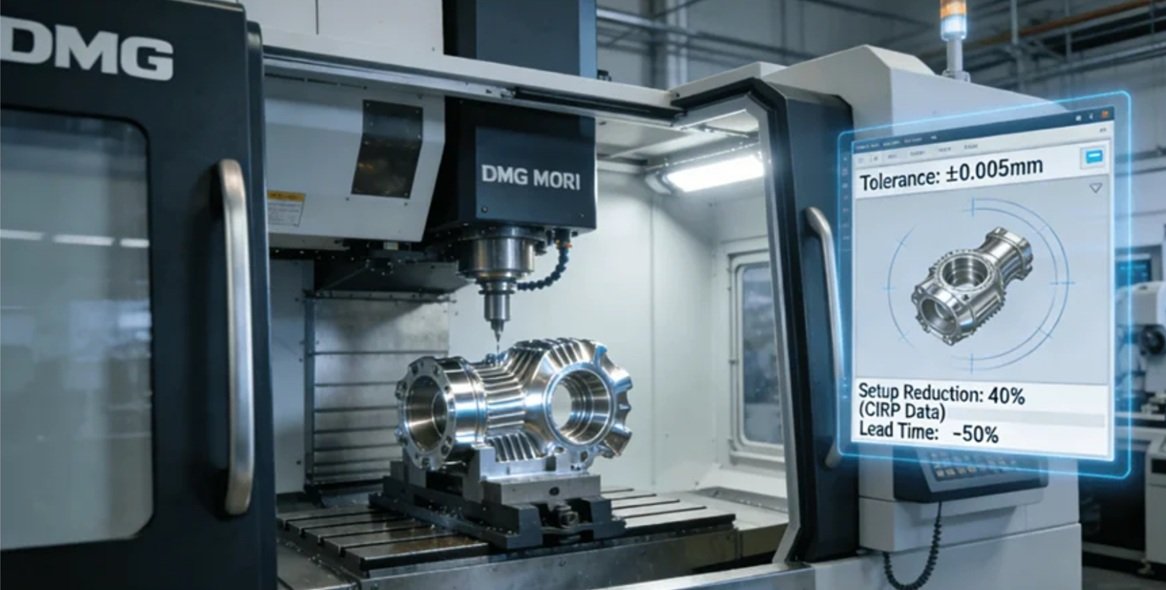
Research from the International Academy for Production Engineering (CIRP) substantiates the efficiency benefits, indicating that adopting CNC Machining Services with 5-axis capabilities can reduce setup times by an average of 40%. This translates directly into shorter production cycles and lower labor costs. In terms of precision, the single-setup approach inherently eliminates errors from repeated repositioning, allowing for tighter and more consistent tolerances critical for high-tech industries like aerospace and medical devices.
The Synergistic Benefits of High-Speed Machining
Modern 5-axis machining is often combined with high-speed cutting (HSC) technology. High-speed spindles working in concert with simultaneous multi-axis movement enable faster feed rates, lower cutting forces, and optimized tool paths. This not only boosts efficiency but also results in less tool wear and superior surface finishes due to reduced heat and vibration. For clients seeking a comprehensive solution, integrated high-speed 5-Axis CNC Machining Services are key to achieving rapid, high-quality part delivery. Learn more about the advantages of our 5-Axis CNC Machining Services for complex parts.
How Does 5-Axis High-Speed CNC Machining Optimize Complex Part Manufacturing?
The challenges associated with complex part machining, such as for impellers, engine blocks, or aerospace brackets, are effectively addressed by 5 axis high speed CNC machining. The combination of a high-speed spindle and synchronized multi-axis motion maintains an optimal cutting angle, effectively dampening vibrations and ensuring exceptional surface quality and dimensional stability even for thin-walled or intricate features.
A relevant case study saw an aerospace component supplier utilize this technology to reduce the production time for a complex titanium bracket from 10 days to just 5 days, doubling efficiency. This aligns with trends highlighted in reports from the European Committee for the Co-operation of the Machine Tool Industries (CECIMO), which identify multi-axis high-speed machining as a dominant global trend. The technology’s adaptability to various materials is a key advantage, particularly for aluminum, where excellent chip evacuation and high-speed characteristics enable faster and more precise machining of complex parts, laying a efficient foundation for Custom Part Manufacturing.
How Can Quick Quote CNC Machining Reduce Total Project Cost?
Accurate and rapid cost assessment at the project initiation stage is the first step in controlling the total cost. Traditional manufacturing quotation processes are often protracted, involving back-and-forth communication about drawings, processes, and materials, leading to decision-making delays. A modern quick quote CNC machining system revolutionizes this through digital tools.
The Workflow of a Rapid Quotation System
Digital Tools and Real-Time Cost Analysis
Clients can simply upload a 3D CAD model (e.g., STEP format) online. An intelligent quoting engine then automatically analyzes the part’s geometric complexity, required material volume, estimated machining time, and post-processing needs, generating a transparent and detailed quote within minutes or up to 24 hours. This immediacy allows engineers to perform cost-driven design optimization (DFM) early in the design phase.
A Revolution in Procurement Efficiency
Rapid cost feedback accelerates project approval and procurement, enabling businesses to respond more agilely to market changes and supporting an On-Demand Production model. Practical examples show that clients using such systems can reduce hidden procurement management costs by an average of 15%.
Cost-Saving Strategies in the Production Process
Cost savings extend beyond the quoting stage into the production phase. Professional providers of 5 axis CNC service utilize software to optimize tool paths,minimize non-cutting movements, and maximize material utilization. Coupled with flexible low-volume production, this avoids the expensive tooling investments required for traditional mass production. All processes are governed by stringent certifications like ISO 9001, ensuring the reliability of every Precision Engineering Components and preventing cost overruns from rework or scrap.Explore our capabilities in 5 axis CNC service for your custom projects.
What are the Key Advantages of Aluminum 5-Axis CNC Machining? Which Industries is it Suitable For?
Aluminum is a preferred material in high-end manufacturing due to its excellent strength-to-weight ratio, good thermal and electrical conductivity, and corrosion resistance. aluminum 5-axis CNC machining combines these inherent material advantages with advanced processing technology to unlock even greater potential.
The 5-axis approach allows for machining with shorter tools at optimal angles, significantly increasing rigidity and cutting speeds. This results in exceptional dimensional accuracy (tolerances as tight as ±0.005mm) and superior surface finishes, often reducing or eliminating the need for secondary polishing. This technique is particularly suitable for aluminum parts with complex curves, deep cavities, or subtle undercuts. Data from CECIMO shows a consistent growth in the application rate of aluminum on 5-axis machining centers.
Key application industries include:
Aerospace: Manufacturing lightweight structural components, brackets, and control system parts.
Automotive: Producing prototypes, high-performance engine components, and lightweight chassis parts.
Consumer Electronics: Fabricating precision housings, heat sinks, and internal structures.
For these sectors, aluminum 5-axis CNC machining is not only a method for volume production but also a core component of Rapid Prototyping Solutions, significantly accelerating product development from design validation to market launch, making it an ideal choice for users seeking the effectiveness of the best 5 axis CNC.
What Standards Should Be Considered When Selecting the Best 5-Axis CNC Service Provider?
Choosing a reliable partner is critical to project success. When evaluating providers of the best5 axis CNC services, the following core standards should be comprehensively assessed.
| Evaluation Dimension | Key Indicators and Explanation |
| Equipment and Technology | Review the brand, model, quantity, and age of their 5 axis milling machines. Advanced control systems (e.g., Heidenhain, Siemens) and high-speed spindles are guarantees of precision and efficiency. |
| Certifications and Quality Systems | Certifications are the cornerstone of quality reliability. Prioritize suppliers with ISO 9001 (Quality Management), ISO 14001 (Environmental Management), IATF 16949 (Automotive), and the stringent AS9100D (Aerospace). CIRP research also correlates robust quality systems with lower defect rates. |
| Engineering Support and Case Studies | Assess whether their engineering team can provide effective Design for Manufacturability (DFM) advice. Request to see past successful customer case studies or samples, particularly in complex part machining. |
| Delivery Capability and Flexibility | Confirm their ability to support On-Demand Production from single prototypes to small/medium batches, and evaluate their supply chain stability and standard lead times. |
| Comprehensive Service Offering | A superior provider of CNC Machining Services should offer a one-stop shop from rapid quoting, multi-material processing, precision inspection, to surface treatment and assembly. |
Conclusion
In summary, 5-axis CNC machining services are fundamentally transforming the paradigm of complex part manufacturing through their integrated advantages of multi-axis movement, high-speed operation, and single-setup processing. They deliver significant improvements in precision and efficiency, while digital rapid quoting systems and strict quality certifications ensure reliability and total cost control. Whether for cutting-edge R&D or optimizing existing production lines, this technology represents the future of manufacturing competitiveness.
If you are facing manufacturing bottlenecks or seeking more cost-effective solutions, immediately consult with a professional 5-axis CNC machining service provider to obtain a customized solution and instant quote for your project. Leverage the full advantages of 5-axis technology to drastically shorten your product delivery time.
Author Biography
This article was authored by an industry expert with extensive experience in precision manufacturing. The expert’s team, which includes the certified professionals at JS Precision, possesses decades of combined experience and adheres to international standards including ISO 14001 (Environmental Management), ISO 9001 (Quality Management), IATF 16949 (Automotive), and AS9100D (Aerospace), dedicated to providing global clients with high-quality, reliable engineering solutions.
FAQs
Q1: What is the minimum tolerance achievable with 5-axis CNC machining?
A: 5-axis CNC machining can achieve tolerances as tight as ±0.005mm, making it suitable for high-precision assemblies like aerospace components, where consistency is ensured through high-speed cutting and advanced control systems.
Q2: What files are typically needed for a quick quote CNC machining?
A: For the most accurate quote, clients should provide 3D CAD files such as STEP or STL format. The system automatically analyzes the geometry and material to provide a detailed quote, simplifying the procurement process.
Q3: What are the advantages of aluminum 5-axis machining compared to other materials?
A: Aluminum offers lightweight properties, high strength, and excellent machinability. 5-axis technology optimizes the machining of complex shapes, reducing production time, and is particularly suited for rapid prototyping and batch production.
Q4: Do 5-axis CNC services support low-volume production?
A: Yes, 5-axis CNC services are inherently flexible and support economical low-volume and custom production runs, seamlessly bridging the gap from prototype validation to full-scale production.
Q5: How can the quality reliability of a 5-axis CNC service provider be verified?
A: It is advisable to check the supplier’s certifications (e.g., AS9100D), review case studies and client testimonials, and request sample parts for testing to ensure compliance with industry standards.