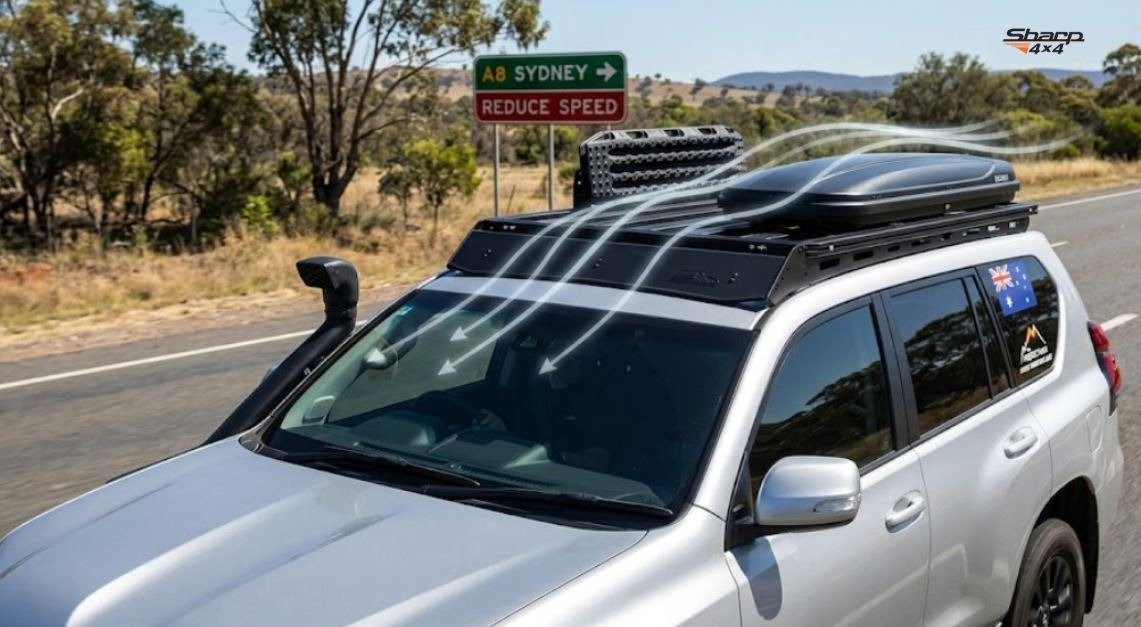
Nothing feels better than packing up your camper and going out on the open highway for a long weekend away from it all, whether it is across the Nullarbor or down the coast for some surfing. The extra storage provided by modern gear makes all the difference in the world. One of the benefits is that you have got all this extra storage space, making life much easier!
But then, once you hit the highway, many drivers discover a “fly in the ointment.” The annoying sound of either high-pitched wind whistling down through your roof rack or a deep rumbling sound residing just above your vehicle as you travel at speed is a common problem. For most enthusiasts, roof rack noise & wind drag are the rite of passage, but they can be eliminated from your travel experience.
If you can understand what causes these sounds and how to eliminate them, it will really change your driving experience by eliminating all those constant roof rack wind noise distractions and giving you a relaxing trip instead of a noise endurance test.
Wind noise generated by your roof rack occurs because of how wind interacts with the shape of your roof rack. As air flows over and around the bars of your roof rack, it creates a vortex (i.e., small whirlpools) of air. These are usually referred to as shear layers, and they produce the aforementioned droning and whistle sounds.
If the vortices created by the bars vibrate at their corresponding frequencies, you will produce the Aeolian tones famous for generating harmonic whistles. Although the sound produced can be considered only a mild annoyance, this type of turbulence creates wind drag that helps to impede your vehicle’s aerodynamics.
Excessive wind drag will cause your engine to have to continue working at a greater than normal amount of effort to maintain its speed, ultimately creating an increase in fuel consumption at the fuel station.
Aerodynamics and Design Choices
The design of the racks you choose when purchasing roof rack systems plays a significant part in determining how much noise they will create while on the road. Square-edge bars are commonly known for producing high levels of crossbar noise due to their inability to allow air to flow smoothly over them. Today, modern roof rack systems have evolved towards an aerodynamic shape (similar to an aircraft wing), which allows air to flow over the system with little interference.
If you are still experiencing excessive noise with your current system, you may want to try installing a roof rack fairing. The fairing is an angled piece of plastic or aluminium that mounts to the front of your system, therefore deflecting air up and over the top of your gear between the rack and your vehicle roof.
Roof platforms have become an extremely popular alternative to traditional crossbar racks for people carrying heavier loads or using more permanent racks. Typically, roof platform racks are one complete unit that is low profile. Therefore, they have the capability of providing superior airflow management compared to using multiple, disconnected crossbars and attaching pieces to the same roof platform.
By minimising the height of your vehicle as much as possible, the buffeting effect that occurs when wind gusts catch the underside of your equipment will significantly decrease.
Professional Solutions for a Quieter Ride
If you have attempted to rectify the noise issues in your 4WD cabin using do-it-yourself methods but are still experiencing noise after that, it may be wise to consult a reputable 4WD equipment supplier or other reputable sources of off-road equipment. Many times, the noise problems arise from either a poorly fitted product or one that is not correctly matched to the contour of your particular vehicle.
By consulting the off-road specialists, you will be able to ascertain whether your product is mounted too far forward or if there are holes between your mounting brackets that are catching air like a flute.
Trusted ones like the Australian off-road accessories supplier Sharp 4×4, have a big number of regular customers who come for the off-road parts, and almost every time customers are assisted with proper installation, which will remedy their noise problems with the given product. Sometimes, just adding an infill strip into the accessory channel of your bars, using rubber material, will cure the whistle produced by your roof rack.
The touring build experts generally recommend that you examine your entire vehicle as a complete system. For example, if you install a bull bar or bonnet protector, air will pass differently across the roof depending on the combination of parts utilised, potentially exacerbating or solving noise issues.
Frequently Asked Questions
What causes roof rack whistling?
Wind creates vibrating air cycles around the bars, often solved by adding rubber infill strips or adjusting their position.
Does a roof rack fairing reduce noise?
Yes, a fairing deflects air over your equipment to prevent wind from catching under the rack and creating drag.
Will a roof platform be quieter than bars?
Most modern roof platforms feature a low-profile, integrated design that slices through the air more cleanly than standard crossbars.
How much does wind drag affect fuel consumption?
A poorly fitted rack can increase fuel use significantly, but choosing aerodynamic shapes helps maintain better efficiency on the highway.
Efficiency and Long-Term Savings
In addition to acoustic improvements, reducing wind drag saves money at the fuel pump. With increasing fuel prices constantly in the news, any efficiency improvements add up. Slight modifications in your loading or design of your roof rack create an increase in fuel use, especially when the wind is blowing against you while driving at highway speeds.
Investing in quality roof platforms and having them fitted by the experienced installation team is the best way to ensure the aerodynamic performance of your vehicle.
A journey ought to renew rather than exhaust. When the cabin stays calm, conversation slips through effortlessly. Rather than constant noises pressing in, the passengers can have a conversation, reflect in peace, or enjoy the silence. With a gentle engine murmur, the driver remains at ease too. Scenes beyond the glass blend into moments instead of mere noise distractions.
Unsure of where to begin? Take help from experts with customised advice based on your unique vehicle type and model. With the right equipment and some aerodynamic adjustments, you can leave the noise to the birds and have a peaceful trip through the beautiful Australian countryside.
Starting from scratch and feeling unsure? Reaching out to a specialist 4WD equipment provider can guide you with tailored suggestions suited to your specific make and model. When equipped properly, along with minor tweaks for aerodynamics, outside noise is left to the birds, leaving behind a peaceful trip across the beautiful Aussie countryside.