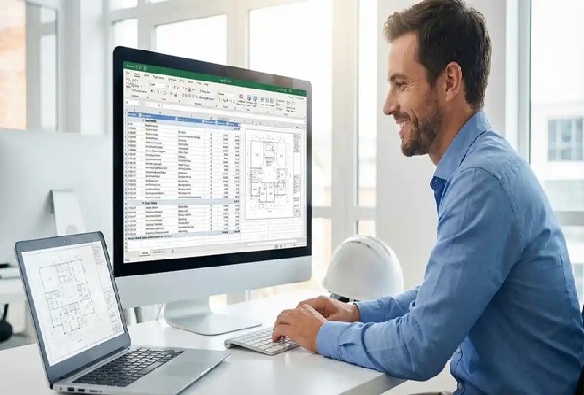
Residential contractors across the United States and Canada are under more pricing pressure than ever. Lumber and material costs shift month to month, labor rates vary by region, and clients expect fast, professional quotes before they’ll commit to a project. For builders still relying on spreadsheets, sticky notes, or memory to price a job, that pressure often shows up as underbids, missed line items, and margins that quietly disappear somewhere between the estimate and the final invoice.
This is why more residential builders, remodelers, and general contractors are turning to purpose-built Construction Estimating Software to price jobs accurately and win more work without the guesswork. Below, we’ll break down what this software actually does, why it matters specifically for residential construction in the US and Canada, and how the right platform connects estimating to everything else that happens on a job.
Why Manual Estimating Falls Short in Residential Construction
Every contractor knows the traditional workflow: pull measurements from a plan set, cross-reference a supplier price sheet from three months ago, add labor based on gut feel, and hope the total holds up once the job actually starts. This approach worked when material prices were stable and jobs were simple. It doesn’t hold up well anymore.
Volatile Material Costs
Framing lumber, roofing, insulation, and finish materials have all seen significant price swings in recent years. A price sheet that’s even a few weeks old can throw an entire estimate off by thousands of dollars, especially on larger remodels or new builds.
Regional Labor and Supply Differences
A framing crew in Ontario doesn’t cost the same as one in Texas. Permit requirements, code compliance, and even material availability differ by state, province, and municipality. Generic estimating templates or national average pricing tools rarely reflect what a job will actually cost in a specific market.
Time Lost to Manual Takeoffs
Measuring a plan set by hand, then manually transferring those numbers into a spreadsheet, is slow and error-prone. A missed wall length or miscounted window can mean a client is quoted a price the contractor can’t actually deliver profitably.
What Modern Construction Estimating Software Actually Does
Good estimating software doesn’t just replace a spreadsheet with a nicer interface. It connects real-time cost data, digital measurement tools, and proposal generation into a single workflow.
Real-Time, Localized Cost Data
Rather than relying on generic national averages, platforms with built-in cost databases update material and labor pricing automatically based on the contractor’s actual market. This means an estimate reflects what materials and crews genuinely cost right now, not what they cost when a price sheet was last printed.
Digital Takeoffs From Uploaded Plans
Instead of measuring plans by hand, builders can upload project drawings directly into the software and calculate areas, lengths, and quantities digitally. Those numbers feed straight into the estimate, cutting out a major source of manual error and saving hours per job.
Estimates That Become the Whole Project
The real value shows up when an estimate doesn’t just sit in a folder. In a connected platform, that same estimate can convert directly into a client-facing proposal, a project schedule, and a live budget, so nothing has to be re-entered or re-calculated three separate times.
From Estimate to Payment: Why Connected Software Beats Standalone Tools
Many contractors still use one tool to estimate, another to send proposals, and a third (often just email or paper checks) to collect payment. Every handoff between tools is a place where information gets lost, delayed, or miscommunicated with the client.
This is where the idea of Construction Intelligence comes in: using connected, real-time data across estimating, proposals, scheduling, and payments so a builder always knows where a job stands financially, not just at bid time, but throughout the entire project. When a client approves a change order or signs off on an upgrade package, that information should immediately reflect in the budget and the next payment milestone, without a contractor manually reconciling three different systems.
Platforms like Bolster are built specifically for this residential workflow. Bolster is an all-in-one construction management platform for builders and contractors across North America that replaces spreadsheets and paper with digital tools for every stage of a job, from the first estimate through final payment. That includes AutoCost for localized, auto-updating material and labor pricing, Takeoff for digital plan measurements, and branded Presentations that turn a static PDF quote into an interactive proposal a client can review, ask questions on, and approve online.
Once a proposal is approved, tools like Approvals handle e-signatures digitally, and Payments collects progress-based deposits tied to project milestones, so funds move directly to the contractor without chasing checks. For builders who want a deeper look at how these pieces fit together for their specific trade, the Bolster Learning Hub offers guides built specifically for residential contractors in the US and Canada.
Handling Scope Changes Without Losing Money
One of the biggest profit leaks in residential construction is unpriced scope creep. A client asks for “just one small change” mid-project, and if it isn’t documented, priced, and signed off, that work often goes unpaid. Digital change order workflows solve this by letting contractors document the change, price the extra work, and get a client signature before work continues, keeping both parties protected.
FAQ: Construction Estimating Software for Residential Builders
What is construction estimating software? Construction estimating software is a digital tool that lets residential builders create detailed, line-item project estimates using real-time material and labor costs, rather than relying on spreadsheets or outdated price sheets. The best platforms let estimates convert directly into proposals, schedules, and live project budgets, so the numbers stay accurate from the first quote through project completion.
How is this different from a generic spreadsheet template? A spreadsheet only holds whatever numbers a contractor manually enters. Purpose-built estimating software pulls in localized, auto-updating material and labor costs (often called AutoCost), supports digital takeoffs directly from uploaded plans, and connects the estimate to downstream steps like client proposals and payment collection, eliminating repetitive manual entry and reducing pricing errors.
Does construction estimating software work for both the USA and Canada? Yes, provided the platform supports localized pricing for both countries. Material costs, labor rates, and even measurement conventions can differ significantly between US states and Canadian provinces, so contractors should choose software built to reflect actual regional costs rather than one relying on generic national averages.
Ready to Price Jobs With Confidence?
Underbidding a job doesn’t just hurt one project’s margin, it chips away at a contractor’s ability to grow. If your estimates aren’t backed by real-time, localized cost data connected to the rest of your workflow, you’re leaving money and time on the table with every quote you send.
See how Bolster brings estimating, proposals, scheduling, and payments into one connected platform built specifically for residential builders. Book a demo today and find out how much faster and more accurately you could be pricing your next job.