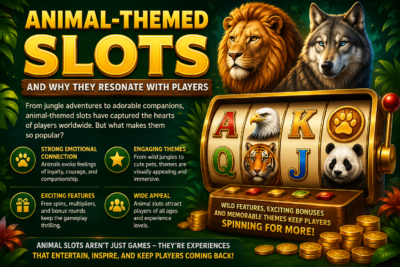
Sort any large game catalog by theme, and one category swallows the others. Wolves, buffalo, big cats, fish, pandas, birds of prey, and an entire aquarium’s worth of underwater titles crowd out mythology, fruit, ancient history, and everything else studios have tried. This is not a coincidence of taste. Animal themes solve several distinct problems for game designers at once, and the fact that players like them is only the most visible of those solutions.
The Most Crowded Shelf in the Catalog
The scale of it becomes obvious the moment you filter for it. Browse the theme tags at Online Casino Yep or any comparably sized library, and the wildlife tag returns more results than most players will work through in a year.
Studios release into that crowd anyway, which tells you the category has not saturated. Every provider maintains at least one animal franchise, usually several, and new entries appear monthly without visibly cannibalizing the old ones.
Recognition Without Translation
The commercial logic starts with distribution. A game shipping to dozens of markets simultaneously has to work without explanation, and that requirement eliminates a great deal of possible subject matter.
- Animals need no translation, since a tiger reads as powerful in every language a game gets localized into.
- No licensing fee is attached, unlike film, music, or television tie-ins.
- The imagery clears advertising standards easily, avoiding the adult or aspirational themes that draw regulatory attention.
- Cultural associations arrive pre-loaded, with certain species carrying connotations of luck, wealth, or strength across multiple traditions.
- The subject matter suits every art style, from photorealistic to cartoon, without feeling wrong.
There is a deeper explanation, too. The biophilia hypothesis, proposed by biologist E.O. Wilson in the 1980s, holds that humans possess an innate tendency to attend to other living things. Whether or not the theory holds in full, the attentional pull it describes is exactly what a game designer needs from a symbol that must be recognized in a fifth of a second.
The Paytable Explains Itself
The second advantage is structural rather than cultural. Slot symbols need a value hierarchy, and players must grasp it instantly without consulting anything.
Animals provide that hierarchy for free. Nobody has to be told that the apex predator pays more than the songbird, and that intuition holds across every audience. The mapping below shows how consistently the convention has settled.
| Archetype | What players read into it | Mechanic it tends to power |
| Apex predator | Highest value, rare appearance | Top-tier symbol, expanding wilds |
| Herd animal | Volume and repetition | Ways-to-win systems, stacked symbols |
| Aquatic species | Collection and retrieval | Hold-and-spin, symbol collection |
| Bird | Movement and arrival | Free spin triggers, symbol transformation |
| Small mammal | Low value, frequent | Base game filler, cascade fodder |
The middle row is the most commercially significant. A herd is a natural fit for systems that reward many identical symbols landing together, which is why one of the most successful franchises in the format’s history is built around a stampede.
Sound design follows the same shortcut. A roar, a splash, or a wingbeat communicates outcome without a single word of interface text, and audio cues that need no localization are worth as much to a studio shipping globally as artwork that needs none.
Why Studios Keep Returning
Familiar mechanics attached to familiar creatures also make promotion straightforward. Free spin campaigns need titles that need no explanation, which is why animal slots appear so often in the promotions listed under Bonuses Casino rather than obscure experimental releases.
Recognition compounds. A player who enjoyed one wolf title will open the next one, and studios build sequels accordingly, iterating on mechanics while keeping the creature that earned the audience. The result is a category that behaves less like a theme and more like a set of long-running series, each with its own conventions that returning players already understand.
A Worked Example
Consider the Wild Panda slot, an Aristocrat title that has stayed in circulation far longer than most releases of its era. It runs five reels across a hundred paylines, and its free spins trigger has players spelling out the animal’s name across the reels before pandas arrive as wilds.
That design decision is the whole argument in miniature. The theme is not decoration applied to a finished game; it supplies the trigger, the reward symbol, the sound design, and the reason a player recognizes the title on a crowded page months later.
What the Theme Cannot Tell You
One caution belongs alongside all of this. Artwork has no relationship whatsoever to a game’s mathematics, and a beloved creature on the reels says nothing about return percentage, volatility, or hit frequency.
Two titles sharing an identical theme can behave completely differently once the spins start, so the panda that charmed you and the panda that suits your bankroll are not necessarily the same game. Enjoy the menagerie, then open the info panel before deciding which of them is worth an evening.