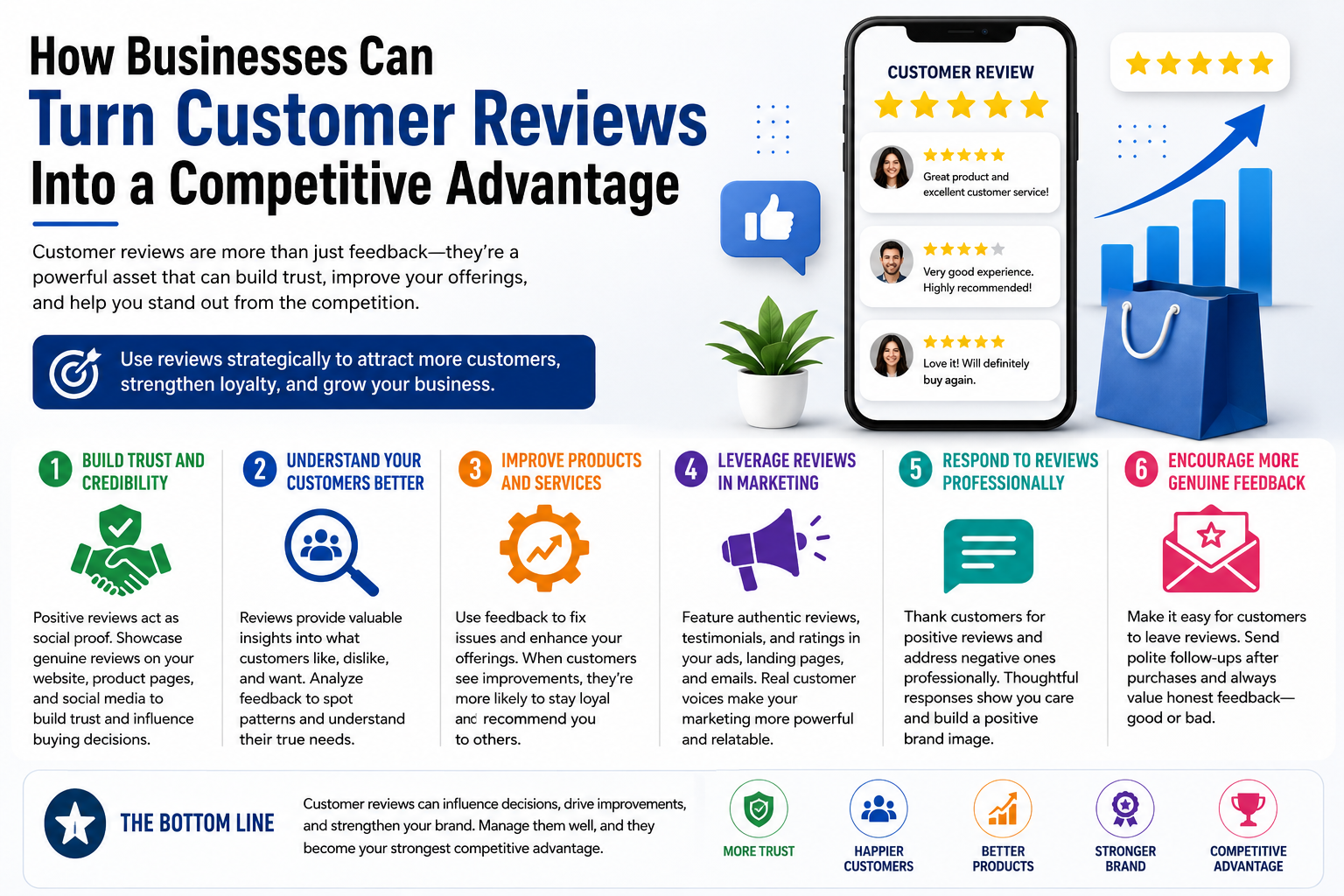
Customer reviews have become one of the first places people look before spending money with a business. A few comments can influence a purchase faster than a polished advertisement ever could. When shoppers see genuine experiences from other customers, they get a clearer idea of what they can expect.
For businesses, this creates an opportunity that goes beyond collecting five-star ratings. Reviews can reveal what customers appreciate, where service falls short, and what competitors may be missing. Used properly, that information can help a company make smarter decisions and gain an edge in a crowded market.
Strong Reviews Can Strengthen Business Reputation
A strong business reputation rarely appears overnight. It is built through repeated customer experiences, and reviews give those experiences a public voice. When people consistently mention helpful service, reliable products, or quick support, new customers have a reason to feel more comfortable choosing that company.
The opposite can happen too. Repeated complaints about slow responses or poor product quality can push potential buyers toward another option. That makes review management more than a marketing task. It becomes part of how a business understands its position in the market.
Businesses should read reviews regularly instead of checking them only when a problem appears. A simple review audit can reveal patterns that are easy to miss during everyday operations.
Find What Customers Actually Value
Customer feedback can tell a company what people remember after a purchase. Maybe customers love the speed of delivery. Perhaps they keep mentioning an employee who went out of their way to solve a problem. In another case, buyers might appreciate how easy the website is to use.
These details can guide future marketing.
Suppose a local service company discovers that customers repeatedly praise its same-day response time. That feature deserves more attention in advertising and website copy. If customers keep talking about transparent pricing, the business can make that benefit easier to see before someone contacts the company.
We think this is where reviews become especially useful. They provide language that comes directly from buyers, not from a marketing meeting.
Turn Negative Reviews Into Business Improvements
Negative reviews can sting. Nobody enjoys reading that a customer had a frustrating experience. Still, ignoring those comments can cost a business more than responding to them ever will.
A complaint may point to a recurring problem. If several customers mention late deliveries, the company needs to examine its delivery process. If buyers complain about confusing instructions, the product information may need a rewrite.
Not every complaint will be fair, either. Some customers will simply be unhappy with an issue outside the company’s control. The trick is to look for repeated patterns rather than reacting emotionally to every comment.
A useful approach is simple: identify the issue, investigate what caused it, then decide what can realistically change. That turns feedback into action.
Respond to Reviews Like a Real Person
Customers can usually tell when a response sounds copied and pasted. Generic replies make a business look distant, even when the original review is positive.
A better response acknowledges the customer’s actual experience. If someone praises a staff member, mention that person. If a customer raises a specific problem, address the issue without becoming defensive.
For negative reviews, a calm response can sometimes change how future readers view the situation. The original complaint remains visible, but so does the company’s willingness to listen.
Keep responses clear. Avoid turning every reply into a sales pitch. Nobody wants to read an advertisement underneath a complaint.
Use Reviews to Study Competitors
Reviews can also reveal opportunities that competitors have left open.
Businesses can examine what customers complain about when reviewing competing companies. Maybe buyers dislike complicated booking processes. Perhaps support is difficult to reach. Maybe competitors receive praise for pricing but poor comments about delivery.
Those observations can help a company decide where it can offer something better.
For example, if customers repeatedly complain that competitors take three days to answer support requests, a business that responds within a few hours has a strong selling point. It can mention that benefit on its website and in sales conversations.
This is not about copying another company. It is about paying attention to what customers are already saying.
Bring Customer Language Into Marketing
Reviews contain phrases customers naturally use when describing their experiences. Those phrases can make marketing copy sound more believable.
Imagine customers repeatedly describe a product as “easy to set up.” That wording may perform better than a complicated phrase created by a marketing team. The same applies to service pages, product descriptions, FAQs, and email campaigns.
Businesses should never twist customer comments or make claims that reviews do not support. Instead, they can identify common themes and use them honestly.
A review can also answer questions future buyers have before they ask. If several customers mention installation time, packaging, comfort, or after-sales support, those subjects can become useful website content.
Build a Review Process That Keeps Working
Collecting reviews should not depend on luck. Businesses can create a simple process that encourages customers to share feedback after a purchase or completed service.
Timing matters. Asking immediately may not give customers enough time to judge the product. Waiting too long can mean they forget about the experience. A well-timed email or message can make the request feel natural.
Businesses should also make the process easy. A complicated form with several steps can kill the moment. One clear request and a direct review link is usually enough.
The goal is not to pressure customers into positive ratings. Honest feedback is far more useful because it shows what the company is doing well and where work is still needed.
Make Reviews Part of Regular Decision-Making
Reviews should not sit inside a marketing dashboard and gather dust. Managers can bring customer feedback into regular business discussions and use it when making practical decisions.
Product teams can review complaints before changing features. Customer service managers can spot repeated support issues. Marketing teams can identify language customers already trust. Sales teams can learn which benefits matter most to buyers.
Maybe one review changes nothing. Fifty similar reviews are another story.
When businesses treat customer feedback as useful market information, reviews become much more than ratings on a profile page. They can guide improvements, sharpen messaging, expose weaknesses, and reveal opportunities competitors have overlooked.
That is where the real competitive advantage appears. A business that listens closely can often move faster because its customers are already telling it what needs attention.