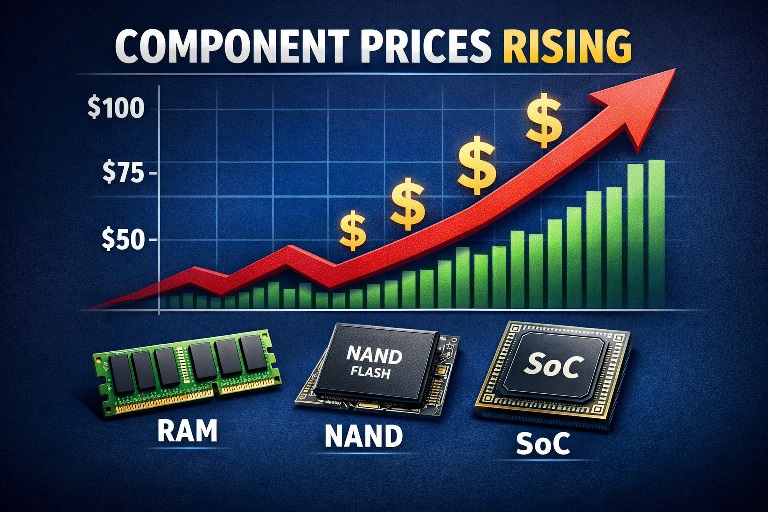
For years, consumers in the United States became accustomed to getting more technology for their money. Smartphones became more capable, laptops became thinner and faster, televisions grew larger, and components such as memory and storage generally became cheaper over time.
That trend is facing new pressure in 2026.
A combination of higher component costs, changing trade policies, supply chain adjustments, and strong demand for AI hardware is making the economics of consumer electronics more complicated. Recent reports indicate that manufacturers and retailers are already dealing with higher memory costs, while the US is also considering additional tariffs that could affect semiconductor based products such as laptops and gaming consoles.
For consumers, the result could be higher prices across several technology categories.
Why Are Electronics Becoming More Expensive?
There is no single reason behind the changing price of electronics.
Modern devices depend on extremely complicated international supply chains. A smartphone or laptop may be designed in one country, use processors manufactured somewhere else, contain memory from another supplier, and be assembled in a completely different region.
Any increase in the cost of one part of that chain can eventually affect the final retail price.
Tariffs are another factor.
When imported components or finished products become more expensive because of tariffs, manufacturers have several choices. They can absorb the additional expense, reduce their margins, renegotiate with suppliers, change production locations, or pass some of the cost on to consumers.
The exact outcome depends on the product and company.
Memory Costs Are Becoming a Major Issue
One of the less obvious reasons behind rising electronics prices is the cost of memory.
Demand for artificial intelligence infrastructure has created enormous requirements for advanced memory and computing hardware. Major technology companies are purchasing large quantities of memory and other components for data centers, which can put pressure on supplies available to consumer electronics manufacturers.
This phenomenon has increasingly been described as “chipflation.”
Higher memory costs can affect far more than computers. Smartphones, tablets, laptops, gaming consoles, cloud services, and other electronics all depend on various types of memory and storage.
That means a change in component pricing can eventually appear on store shelves.
AI Is Changing the Hardware Market
Artificial intelligence is also reshaping the technology industry.
AI workloads require powerful processors, graphics hardware, memory, and specialized accelerators. Demand from large technology companies has therefore created a market where some components are being prioritized for data centers and AI systems.
At the same time, consumer devices are becoming more dependent on AI.
Modern smartphones increasingly include dedicated neural processing hardware. Laptops are being marketed with dedicated AI capabilities, while smart home devices and other electronics are gaining local AI features.
This creates a situation where the same broader semiconductor ecosystem is supporting both consumer products and rapidly expanding AI infrastructure.
Tariffs Could Put Additional Pressure on Prices
Trade policy is another major variable.
The US administration is currently considering a new round of semiconductor tariffs that could potentially extend beyond chips to products that use them, including laptops, gaming consoles, and data center servers. The exact structure has not been finalized, so consumers should not treat every reported proposal as a confirmed future price increase.
This uncertainty itself can create problems.
Companies need to make purchasing and manufacturing decisions months in advance. If they do not know what import costs will look like later in the year, they may become more conservative with inventory or pricing.
That can make the electronics market less predictable.
Smartphones Could Be Affected
Smartphones are among the most complicated consumer electronics products.
A modern smartphone contains processors, memory, displays, cameras, batteries, wireless components, sensors, and many other parts sourced through global supply chains.
Higher component costs can therefore affect several areas simultaneously.
Consumers may see manufacturers maintain existing prices while reducing promotions, or they may see outright price increases on new models.
Budget smartphones could be particularly sensitive because manufacturers have less room to absorb additional costs without affecting already narrow margins.
Premium devices may have more flexibility, although their high component costs mean they are not immune.
Laptops and Tablets Face Similar Challenges
Computers are also exposed to changing component prices.
Laptops depend heavily on processors, memory, storage, displays, batteries, and other semiconductor components. AI capable laptops add another layer because newer processors increasingly include dedicated neural processing capabilities.
Industry estimates have previously suggested that tariffs could create significant increases in the retail prices of laptops and tablets. The exact impact depends heavily on which products are affected and how companies adjust their supply chains.
For consumers, this means buying decisions may become more important.
Someone who needs a new laptop for school or work may want to compare current prices carefully rather than assuming that waiting will automatically result in a better deal.
Gaming Hardware Could Become More Expensive
Gaming consoles are another category worth watching.
Consoles contain processors, memory, storage, wireless components, power systems, and other electronics that depend on global manufacturing networks.
The gaming industry has already experienced several pricing changes in recent years.
If semiconductor or import costs increase further, console manufacturers could face additional pressure.
Accessories may also be affected because controllers, headsets, storage devices, and other gaming products depend on many of the same international supply chains.
Retailers Are Trying to Manage the Situation
Retailers are caught between manufacturers and consumers.
If suppliers increase wholesale prices, retailers must decide whether to absorb those increases or pass them along.
Recent results from Best Buy show the complexity of the current market. The company raised its annual sales outlook, helped by demand for AI powered gadgets, while also reporting pressure from higher fuel and memory costs.
This suggests that demand for technology has not disappeared.
Consumers are still interested in new products, particularly AI enabled devices and emerging categories such as smart glasses and 3D printers.
However, rising costs can make consumers more selective.
Why Budget Electronics Could Be Hit Hardest
Higher prices do not affect every product in the same way.
Premium devices often have larger margins, allowing manufacturers to absorb some additional costs.
Budget products operate differently.
When a device already sells at a low price, even a relatively small increase in manufacturing costs can have a noticeable effect on profitability.
Manufacturers may respond by increasing prices, reducing specifications, offering fewer accessories, or introducing new models at slightly higher prices.
This could make the affordable electronics market particularly interesting over the next few years.
Consumers May Start Keeping Devices Longer
One possible consequence of higher electronics prices is longer replacement cycles.
If a new smartphone or laptop becomes significantly more expensive, consumers may decide to keep their existing devices for another year.
This is not necessarily a bad thing.
Modern smartphones and computers can remain perfectly capable for several years, particularly when manufacturers provide long term software and security updates.
A longer replacement cycle can also encourage consumers to take better care of their devices and prioritize repairability.
Used and Refurbished Electronics Could Become More Attractive
A higher price for new products can make refurbished devices more appealing.
A two year old flagship smartphone may offer enough performance for most users while costing considerably less than a new premium model.
The same applies to laptops, tablets, gaming consoles, and other electronics.
However, buyers should pay attention to battery condition, warranty coverage, software support, storage capacity, and the reputation of the seller.
A low purchase price does not necessarily represent good value if the device requires expensive repairs shortly afterward.
How Consumers Can Save Money
Consumers do not have to stop buying electronics altogether.
Instead, purchasing strategy becomes more important.
One of the simplest approaches is to compare prices across multiple retailers before making a purchase.
Timing also matters. Seasonal promotions, product launches, clearance sales, and holiday discounts can create significant differences between the normal retail price and the price consumers actually pay.
It can also be useful to avoid buying unnecessary upgrades.
If a current phone still performs well, replacing it simply because a newer model exists may not provide enough practical benefit to justify the expense.
Should You Buy Electronics Now?
There is no universal answer.
If you genuinely need a new laptop, smartphone, or gaming device, waiting indefinitely for prices to fall could backfire if component costs continue increasing.
On the other hand, buying something purely because you are worried about possible future price increases is not always sensible.
Consumers should compare current prices, available discounts, product specifications, and their actual needs.
The most important point is to avoid making a purchase based entirely on headlines.
Trade policies and component prices can change quickly.
What This Means for the Future of Consumer Technology
The electronics industry is entering an interesting period.
For decades, falling component costs and manufacturing efficiency helped make advanced technology increasingly affordable.
AI is now creating a new source of demand for computing resources, while governments are simultaneously trying to reshape semiconductor manufacturing and international supply chains.
That combination could make future electronics pricing less predictable.
Manufacturers may increasingly diversify production across multiple countries, invest in domestic facilities, redesign products around alternative components, or negotiate longer term supply agreements.
These changes will take time.
Final Thoughts
Electronics prices in the United States are being influenced by several forces at the same time. Rising memory costs, strong AI demand, changing supply chains, and potential semiconductor tariffs are all creating additional uncertainty for manufacturers and consumers.
The important thing is that not every product will experience the same impact.
Some companies may absorb higher costs. Others may adjust specifications, reduce promotions, or increase retail prices. The eventual result will depend on component availability, trade policy, manufacturing locations, and consumer demand.
For buyers, the smartest approach is to focus on value rather than simply chasing the newest device. Compare prices, consider refurbished options, look for meaningful discounts, and replace electronics when the upgrade provides a genuine benefit.
For readers who want to keep track of technology news, hardware developments, smartphone reviews, and the latest consumer electronics trends, Root-nation.com is a useful resource for following how the technology market continues to evolve.
The electronics industry is unlikely to stop innovating. AI, faster processors, improved displays, smarter devices, and new form factors will continue to arrive. The bigger question is how much consumers will have to pay for those improvements.