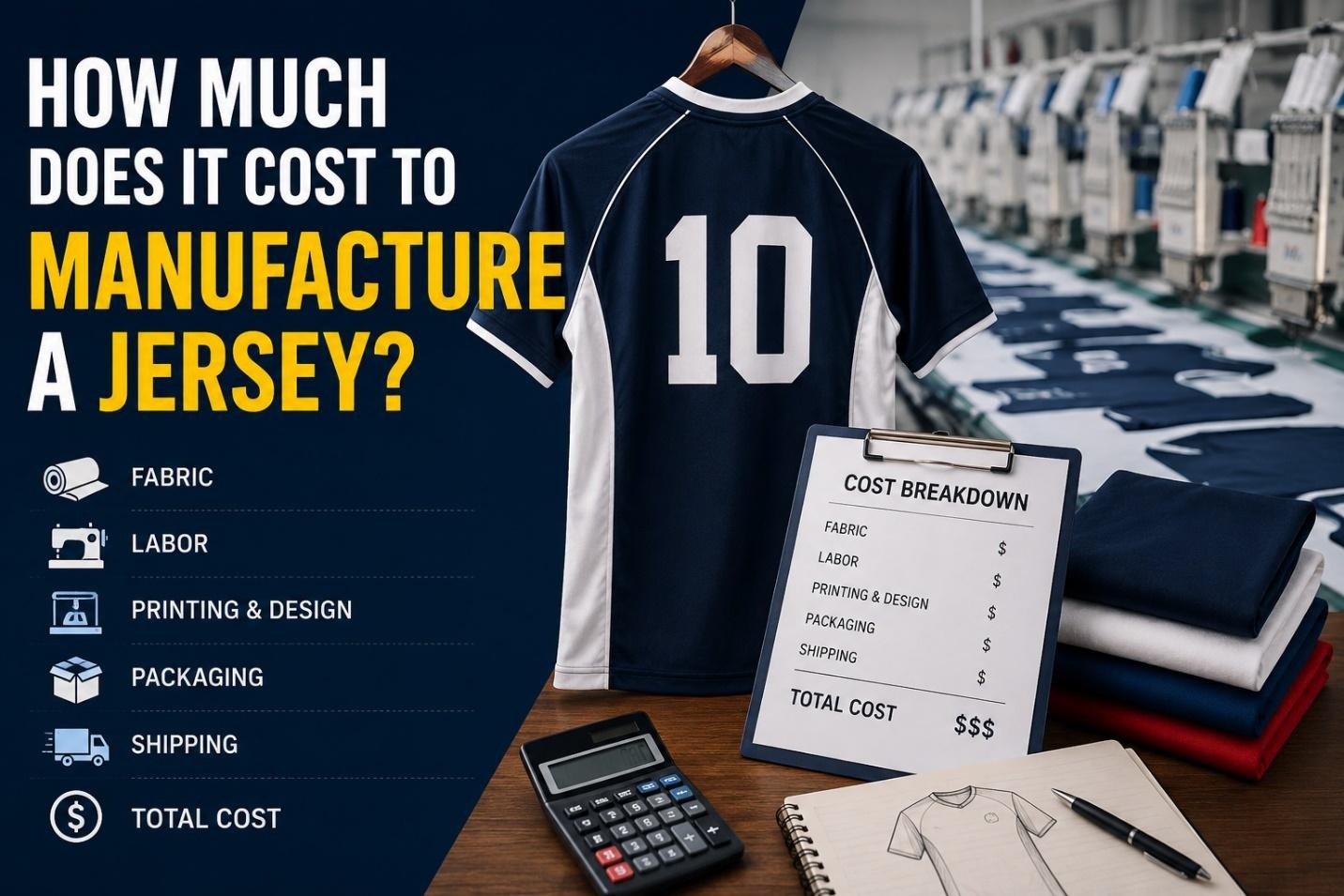
Manufacturing a jersey can cost anywhere from $8 to $40+ per piece. However, the cost can vary according to various factors, including jersey type, fabrics, order quantity, customizations, decorations, private labeling, and the region or manufacturer’s location.
Bulk sports jerseys made with polyester fabric cost much less than fully customized jerseys with various personalizations and decorations and specialized materials.
Moreover, manufacturing in the USA may cost more than manufacturing and shipment in other countries due to inexpensive labor, resources, production solutions, accessible materials, and even currency fluctuations.
Also, smaller order quantities usually cost more because setup, development, prototyping, and production costs are spread across fewer pieces.
It is very important for sports clothing lines, sports teams, organizations, wholesalers, and clothing businesses to understand the cost factors before requesting price quotations for jerseys.
This guide explains the major expenses involved in jersey manufacturing, the elements that affect per-piece price, and the ways to reduce production costs without compromising quality.
The Cost to Manufacture a Jersey
As said in the above section, there are multiple factors that affect the costs of manufacturing a jersey. However, here is a general estimate indicating price ranges for a custom jersey:
| Jersey Type | Approximate Bulk Manufacturing Cost* |
| Custom team jersey | $10–$20 per piece |
| Sublimated sports jersey | $10–$18 per piece |
| Premium performance jersey | $15–$25+ per piece |
| Highly customized or specialty jersey | $20–$40+ per piece |
These are not fixed quotes but general estimates for bulk manufacturing.
Cost-Determining Factors of a Custom Jersey?
Several interconnected factors majorly influence the prices of jerseys. In fact, two similar jerseys may have a prominent cost difference because of their construction, fabrics, sizing, customizations, and order quantities.
- Jersey Fabric
Fabric is one of the most promising factors that make a jersey worth wearing, pricier, appealing,
and performance-focused. Jerseys made from performance-driven synthetic materials like polyester are moisture-wicking, durable, and comfortable. They have other properties, including color retention, freedom of movement, appealing texture, and ease of maintenance.
Some common fabric options for jerseys are the following:
- Polyester
- Polyester-spandex blends
- Interlock polyester
- Recycled polyester
- Mesh polyester
- Lightweight performance knits
- Specialty stretch fabrics
A premium stretch fabric enhances the flexibility, softness, breathability, and recycling content, whereas a standard polyester material counts as a more economical option.
Also, the GSM (grams per square meter) plays a vital role since a heavy fabric requires more material per product piece. GSM weight depends on the product’s application, construction, sports activities, and weather conditions.
- Jersey Design and Construction
A complex design is more expensive than a simple jersey with minimum personalizations. The construction of a simple jersey requires basic cut & sew, printing, and finishing, while a complex design requires attention to detail, an expensive fabric incorporation, design integration, and tough and expensive decorations.
Your jersey cost can be increased when it is designed to feature the following:
- Complex pattern pieces
- Various pockets for extra room
- Side panels
- Raglan sleeves,
- Custom cuffs
- Custom collars
- Mesh panels for enhanced breathability
- Decorative printing
- Reinforced seams
- Contrast inserts
- Customization and Printing
Customization and printing are significant factors that influence the cost of a jersey.
Manufacturers use different printing methods to decorate a jersey. Have a look at some methods:
Screen printing
Used for graphical applications, names, numbers, logos and a limited number of colors.
Sublimation printing
Used for sports jerseys made with polyester.
Heat transfer
Used for small-scale manufacturing, names, numbers, and logos.
Embroidery
Used for giving a jersey a premium look. It adds weight, making it not very suitable for every performance jersey.
Appliqué and sewn-on details
Commonly used for traditional sports and team uniforms.
4. Order Quantity
If the order quantity is massive, it will cost more compared to the minimum order quantity (MOQ). It means that the cost will definitely be higher if you are getting 1000 pieces manufactured with customization.
A manufacturing process includes certain fixed or semi-fixed expenses, for example, design development, pattern making, sampling, setup, and preparation. When these costs are distributed across more garments, the cost per jersey can decrease.
Let’s have a look at a simplified production structure:
- 50 pieces: Higher cost per jersey
- 100 pieces: Lower per-piece cost
- 250 pieces: More favorable production economics
- 500+ pieces: Potentially lower unit cost
- 1,000+ pieces: Greater opportunity for volume pricing
The product specification and manufacturer’s production process define the exact break-even point.
5. Custom Labels and Branding
Branding and custom labels make a jersey wholesome in terms of private labeling. They add a sense of uniqueness and recognition. If your jerseys have customized labels, it is very likely for your brand or team to get recognition in the sports apparel market.
Many brands require custom labels and tags. Here is what they should have:
- Woven labels
- Size labels
- Care labels
- Neck labels
- Tyvek labels
- Heat printed labels
- Custom Hangtags
- Custom packaging with logo and trademark placements
- Branded polybags
- Retail-ready packaging
- Custom boxes with your brand name, logo, and defining colors or patterns.
These labels add to the manufacturing cost due to individual prices of the labels and packaging. Also, custom packaging and labeling are significant for startups, established brands, sports teams, and organizations for better branding and growth.
6. Sampling and Product Development
Sampling is the pre-production jersey prototype that is offered to customers by their manufacturers to have a final look before bulk manufacturing.
Samples can include a few things, depending on the products.
- Reviewing the design
- Creating or adjusting the pattern
- Choosing the right fabric
- Producing a prototype/sample
- Applying labels or branding tags
- Checking measurements
- Making revisions
- Approving the final sample
The point of making a sample is to ensure there are no errors in the product. In simple words, to guarantee that the final bulk production is flawless. It is for customers to see if they require any specific changes in measurements, colors, patterns, fabric, or any other important component. Some manufacturers charge separately for the samples, whereas some add the cost to the bulk manufacturing.
7. Jersey Manufacturing Services and Production Location
Selecting the right jersey manufacturers is a game changer. You must find a supplier that offers reasonable and market-competitive pricing. A reliable sports apparel manufacturer usually has access to all the right fabrics, customization options, and production solutions at an affordable cost. However, if you choose a manufacturer that charges big for every single piece of work, it will disturb your budget.
The location where the jerseys are manufactured has a huge impact on the final cost.
The locations influence fabric availability, labor rates, production capacity, communication, resource costs, supply chains, energy costs, and some delivery times.
Jersey Manufacturing Quote BREAKDOWN?
Ask your manufacturer everything that is included in the production because all the things add cost to the final payment.
A professional quotation may account for some or all of the following:
- Fabric options
- Pattern making
- Cutting
- Sewing
- Printing
- Embroidery
- Labels
- Tags
- Packaging
- Quality inspection and assurance
- Sampling and revisions
- Shipping
- Duties or taxes, where applicable
How a Jersey Order Can Be Priced: An Exemplary Demonstration
This is an hypothetical situation for you to understand the prices quoted to you.
Imagine placing an order for 500 custom polyester jerseys.
Hypothetically, the manufacturer quotes:
- Jersey manufacturing: $11 per piece
- Custom labels and branding: $1 per piece
- Individual packaging: $0.50 per piece
The manufacturing subtotal would be:
500 × $12.50 = $6,250
Some taxes and duties, such as shipping and other applicable costs, would need to be applied separately unless the manufacturer already includes them in the given quote.
How to Reduce Jersey Manufacturing Costs
There are some easy ways to reduce the overall manufacturing costs. You need smart product development to maintain your budget and affordability.
- Place bulk orders to reduce the average cost per jersey since fixed manufacturing and setup costs are distributed across various units.
- Choose the fabrics suited to your jersey since not every jersey needs expensive fabrics.
- Overcome insignificant trims, cuts, prints, and complicated designs. This reduction can decrease the material consumption and labor work and, hence, your overall cost.
- Efficient decoration can be a major plus point in cost reduction. Many designs work well with heat transfer printing, screen printing, and embroidery. Moreover, customization methods like sublimation are an ideal choice for complex work like polyester performance jersey personalization.
- Inspect and finalize the design before bulk manufacturing. Make sure you are done with the changes at the sampling stage since applying changes to the bulk results in massive costs.
How Does a Low MOQ Increase the Cost of Jerseys?
A low MOQ is beneficial for new companies or startups since they are experimenting with product variations while saving their capital. However, a smaller quantity results in higher costs per piece since the supplier has to account for manufacturing setup, quality control, machinery, and several other costs.
What Should You Ask a Jersey Manufacturer Before Ordering?
Ask your manufacturer for clear information about:
- Minimum order quantity (MOQ)
- Fabric options, composition and GSM value
- Available colors
- Size range
- Customization options
- Printing methods
- Private labeling options and Packaging
- Sample manufacturing cost
- Sample turnaround time
- Bulk turnaround time
- Quality-control process
- Shipping options
- Payment terms
- Delivery options
- Refund or replacement policy
Ask your manufacturer if there are any hidden charges or if the quoted prices included every product and service they mentioned.
Request a detailed specification and cost sheet to avoid misunderstanding and unnecessary conflict.
Conclusion
The cost of manufacturing a jersey depends on certain factors. Fabric, GSM, construction, customization, quantity, quality, branding, private labeling, prototyping, bulk manufacturing, shipment, delivery, and the location of the manufacturer. All these things play a significant role in fluctuating the overall prices of jerseys.
Providing your manufacturing partner with specification details like product type, material, custom artwork, measurements, your budget, quality, quantity, sizes, preferred customization methods, and packaging requirements can help in managing the production cost.
This way, you and the manufacturer will have a clear picture of what expenses are relevant and which production solutions will save the costs.