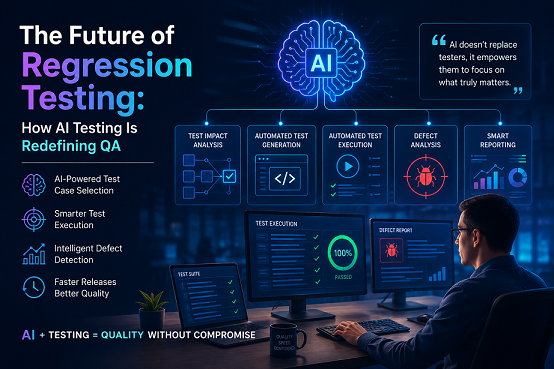
For decades, regression testing has run on the same basic promise: write a test once, run it forever, and trust that it will catch anything a new release breaks. In practice, that promise has always been shakier than it sounds. Applications change shape constantly: new UI elements, shifting APIs, faster release cycles, and each change is a small tax on a test suite that was never built to keep up with itself. Someone has to notice the breakage, figure out whether it’s a real bug or just a stale locator, and rewrite the script. Multiply that across thousands of test cases and dozens of releases a year, and it’s easy to see why so many automation programs quietly buckle under their own maintenance costs.
That’s the problem AI is now being asked to solve, and the shift is bigger than a new testing tool. It’s a rethink of what regression testing is for.
The maintenance trap that started it all
Ask most QA leads what kills their automation efforts, and the answer is rarely “we couldn’t write the tests.” It’s that the tests stopped being worth maintaining. Industry analysts have described this as a kind of ROI wall: automation initiatives deliver strong returns for the first year or two, then maintenance costs climb until they outpace the value the tests provide. A button moves, an ID changes, a workflow gets redesigned, and a test that took an hour to write takes an hour to fix, over and over, release after release.
The stakes for getting this wrong are real. Research from Tricentis has found that a large share of organizations lose well over a million dollars a year to poor software quality, and outages on critical systems can cost hundreds of thousands of dollars per hour. Regression testing exists specifically to prevent that kind of damage, which makes it ironic that the process meant to protect release velocity has so often become the thing slowing it down.
What AI actually changes
AI-driven testing attacks that maintenance trap from several directions at once, and it’s worth being specific about what’s actually new rather than treating “AI testing” as a buzzword.
Self-healing scripts are the most visible shift. Instead of a test failing outright when a button’s ID or position changes, AI models trained on the application’s structure recognize the element anyway and update the script automatically, flagging the change for a human to confirm rather than breaking the build. Autonomous test generation goes a step further, analyzing user behavior, code changes, and past defect patterns to write and prioritize new test cases without a human authoring every line. And predictive analysis is changing where testing effort goes in the first place: rather than running an entire regression suite on every build, AI models identify which areas of the codebase are statistically likely to break based on the size and location of a given change, letting teams run a focused, high-signal subset of tests instead of everything.
The result, when it works, is testing that scales with the pace of modern software delivery instead of fighting it. Surveys of quality engineering teams suggest the appetite for this is enormous ,a large majority of organizations are already piloting generative AI somewhere in their QA process, and most practitioners now consider AI fluency a core skill for the role, not a nice-to-have. Analyst forecasts point toward a majority of enterprises running AI-augmented testing within the next couple of years.
The gap between adoption and impact
None of this means AI has solved regression testing. The honest picture emerging from the field is a gap between experimentation and real impact: plenty of teams are generating more tests with AI, but far fewer have found that this actually improves release confidence. Generating tests faster doesn’t help if nobody has rethought which tests matter, and a suite that grows without a strategy behind it just accumulates a different kind of technical debt. Flaky tests remain a persistent drain on developer time, and teams juggling multiple automation frameworks often find that AI tooling adds another layer of complexity rather than removing one.
The teams getting real value tend to treat AI as a way to change what testers spend their time on, not just a faster version of the old workflow. Engineers move away from writing and rewriting brittle scripts and toward defining what “good” looks like, which user journeys matter most, which regressions are unacceptable, and where the product is actually fragile. This is showing up in how testing is done on real devices and real network conditions, too, since that’s where the gap between a passing test and an actual user complaint tends to open up. Platforms like HeadSpin, for instance, apply AI to performance and quality data gathered from real devices worldwide, helping teams catch regressions that only surface under real-world conditions rather than in a clean simulator.
Where this leaves QA
The role of the human tester isn’t disappearing; it’s moving up a level. Less time goes into maintaining locators and fixing broken assertions, and more goes into judgment calls: which risks are worth taking, which edge cases actually matter to users, and whether a “passing” build is genuinely ready to ship. With AI-based testing taking on more repetitive and data-driven testing tasks, quality engineering is increasingly measured less by pass/fail counts and more by outcomes like deployment frequency, change failure rate, and how quickly a team recovers when something does slip through.
Regression testing isn’t being replaced by AI so much as it’s being rebuilt around it. The organizations that treat this as an operational shift, rethinking process and ownership, not just installing a new tool, are the ones most likely to turn faster releases into more reliable ones, rather than just more of them.