The log moves before the cut is finished
Anyone who has run a portable sawmill through Australian hardwood has seen it happen. Halfway along a cut, the gap behind the blade starts to close, or the slab lifts away from the log with a crack. Nothing is wrong with the machine. The log is releasing stress it has carried since it was a standing tree, and how that stress is released decides whether the boards come off straight or bowed.
For landholders turning storm-fallen or cleared farm trees into useful timber, understanding this is the difference between a stack of usable boards and a pile of firewood. It also explains why an experienced operator spends as much time turning and checking the log on the sawmill bed as actually cutting it.
Why do eucalypt boards bend as they come off the log?
Trees grow under tension. As each new layer of wood forms under the bark, it tries to shrink along its length while the older wood inside resists. The outer layers end up pulling in tension and the core pushing in compression, like a bundle of stretched rubber bands wrapped around a stiff rod.
Many eucalypts carry especially high growth stresses. When a sawmill cuts a slab off one side, the tension on that side is released while the opposite side still pulls. The ends of the log bow away from the freshly cut face, and the next board cut from it follows that curve. Splits running in from the ends of freshly felled logs come from the same stresses.
Balancing the cuts
The practical answer is to open the log evenly rather than cutting boards off one face all the way through. Removing wood from opposite sides in turn lets the stresses release in balance, so the remaining log stays straighter. A typical sequence looks like this:
• Take a slab off the top face
• Rotate the log 180 degrees, cut the opposite face
• Turn it 90 degrees, cut the remaining two sides
• Saw boards from the squared centre
This produces a square cant from the middle of the log, which is stiffer and easier to cut accurately than a round log. Checking the cant for bow before each pass, and re-levelling it on the bed if it has moved, keeps board thickness consistent.
Choosing a sawing pattern for the job
Live sawing, where the log is cut straight through from one side to the other, is quick and wastes little timber, but it produces a mix of board types that can cup as they dry. Quarter sawing turns the log repeatedly so boards are cut with the growth rings running across their thickness. It takes longer and yields fewer wide boards, but those boards shrink more evenly and hold their shape better, which suits flooring, furniture and anything that needs to stay flat.
For fence rails, sheds and rough framing, live sawing is often good enough. For decking or joinery, the extra time spent turning the log on the sawmill usually pays off, since boards that stay flat save far more time later than the few extra cuts cost now.
Hidden metal in farm trees
Trees from paddocks, fence lines and old homesteads often contain nails, fencing staples or wire that the tree has grown around, sometimes deep inside. A bandsaw blade meeting steel is usually ruined instantly, and the impact can be dangerous. Looking for rust stains, old fence lines and bark scars, and checking suspect logs with a metal detector before milling timber from them, saves blades and time. Removing dirt and grit from the bark does the same, since soil dulls teeth quickly.
Bandsaw mill or chainsaw mill?
A chainsaw mill clamps a chainsaw to a guide frame and is carried to the log, which suits very large or remote trees. It is slower, uses more fuel and turns more of each log into sawdust because a chain cuts a far wider path than a thin band. A bandsaw mill moves a narrow blade on a carriage along a fixed track. It cuts faster with less waste and gives more even board thickness, provided the log fits within the machine’s capacity and can be brought to it.
Getting heavy logs onto the bed safely matters as much as the cutting. Ramps, cant hooks and log dogs that clamp the log firmly reduce the risk of a log rolling off the bed or shifting mid-cut.
Matching the mill to the timber
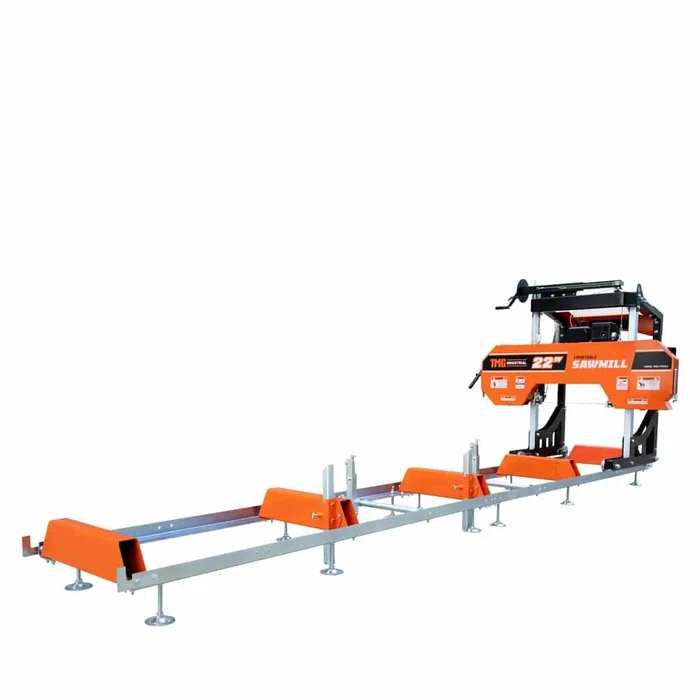
Most farm milling involves logs well under a metre across, cut to lengths that suit fencing, framing and outdoor projects. The Heavy Series mill from TMG Industrial handles logs up to 560 mm in diameter and 3.55 m long, cuts boards up to 502 mm wide and uses a 1.1 mm kerf blade driven by a 7 HP Kohler engine, a size that fits that kind of on-farm work well once the log has been opened in the right order.