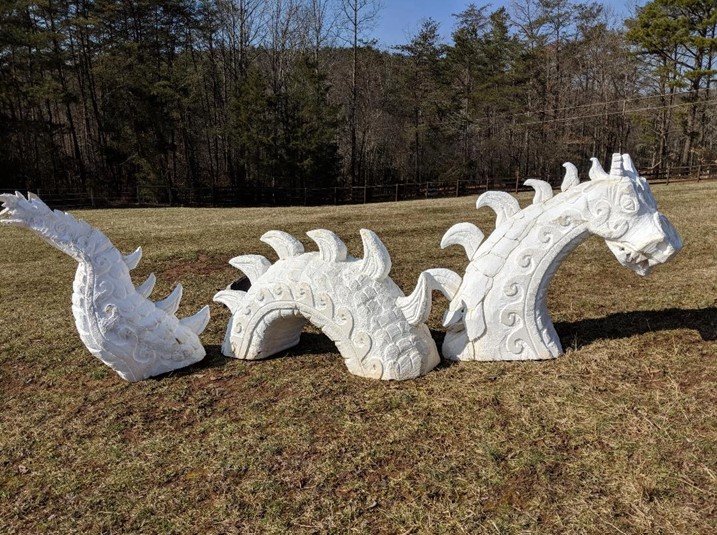
For decades, if you walked into the back of a scenic fabrication shop—the places that build parade floats, Broadway sets, and Las Vegas casino displays—you would be greeted by a singular, overwhelming sensory experience: the smell of burning plastic and a blizzard of white “snow.”
This was the domain of the foam sculptor. Armed with hot wires, electric carving knives, and rasps, these artisans would attack massive blocks of Expanded Polystyrene (EPS) foam, subtracting material until a dragon, a giant perfume bottle, or a oversized hamburger emerged. It was an art form, but it was also messy, labor-intensive, and inherently limited by the human hand.
Today, however, the snow is settling. A quiet industrial revolution is taking place in the world of visual merchandising and experiential marketing. The subtractive sculptor is being replaced—or rather, upgraded—by the additive engineer.
The question facing the industry is no longer “How fast can you carve this?” but “How big can you print this?”
The Problem with “Subtractive” Manufacturing
The traditional method of prop making is “subtractive.” You start with a giant block of material (usually foam) and cut away everything that isn’t the sculpture.
This process has three major flaws:
- Waste: To carve a round sphere from a square block, you throw away nearly 40% of the material. That waste ends up in landfills.
- Fragility: Foam is soft. To make it durable enough for a busy retail store or an outdoor festival, it must be coated in hard coats (polyurea) or fiberglass, which requires toxic chemicals and significant drying time.
- Geometry: There are shapes you simply cannot carve. You cannot carve a hollow, intricate lattice sphere with a hot wire. You cannot carve a perfect internal spiral. The tool physically cannot reach the inside without destroying the outside.
The “Hollow” Revolution
This is where large-format additive manufacturing changes the physics of the prop. Unlike a desktop 3D printer that lays down thin hair-like strands of plastic, industrial large-format machines dispense thick ribbons of gel-like polymer that cure instantly under UV light.
Because the material cures instantly, it defies gravity. It can print straight up into the air without needing support structures.
This allows designers to build things that were previously impossible: hollow objects.
Imagine a brand wants a 10-foot tall replica of their new soda bottle for a stadium activation.
- The Old Way: Carve it out of solid foam. It weighs 200 pounds. It is opaque. It generates four bags of trash.
- The New Way: Print it as a hollow shell. It weighs 50 pounds. Because it is hollow, you can put LED lights insideit, turning the entire prop into a glowing beacon. It generates zero waste because you only printed the shell.
Speed as the Ultimate Currency
In the world of retail and events, time is the only resource that matters. A movie studio might need a spaceship cockpit by Tuesday. A fashion brand might need twelve giant handbags for a window display in New York, London, and Tokyo by Friday.
Hand-carving is slow. It relies on the stamina of the artist. If the sculptor gets sick, the project stops.
Printing is relentless. A large-format machine can run 24/7, uncomplaining, building objects at a rate of inches per hour. It creates a workflow that is predictable. The digital file is approved, the button is pressed, and the object appears. This “digital inventory” allows brands to send a file to printers in three different countries simultaneously, ensuring that the window display in Tokyo looks exactly identical to the one in New York—a feat of consistency that hand-carving could never achieve.
The New Role of the Artisan
Does this mean the artist is extinct? Far from it.
The machine produces the “blank.” It creates the perfect geometry, the complex curves, and the structural integrity. But the soul of the object still comes from the finish.
The prop still needs to be sanded, painted, textured, and glazed. The difference is that the artist is no longer wasting their energy “roughing out” the block. They aren’t spending 8 hours sweating over a hot wire to get the basic shape. They are spending their time on the high-value finishing work—the weathering on the spaceship, the gloss on the giant lipstick.
Conclusion
We are witnessing the transition from the “sawdust era” to the “digital era” of scenic design. The ability to manipulate physical space with the same ease that we manipulate pixels on a screen is transforming how brands tell stories.
Whether it is a giant, glowing logo for a music festival or a complex architectural element for a hotel lobby, the constraints of “what is buildable” are evaporating. By leveraging technologies like ADV Imagine Large Format Industrial 3D Printing, designers are finally able to match the scale of their imagination with the scale of their production, creating a world where the only limit is the size of the print bed—and even that is getting bigger every day