
Constitutional Law is often regarded as the pinnacle of legal studies in Australia. It is the “Grundnorm” of our legal system, dictating the boundaries of Commonwealth and State powers, the separation of functions, and the protection of implied rights. However, for many students, the leap from understanding the Commonwealth of Australia Constitution Act 1900 to drafting a High Distinction (HD) level assignment can feel like crossing a legal minefield.
The complexity lies not just in the statutes, but in the evolving jurisprudence of the High Court. To succeed, one must master the art of characterisation, the nuances of section 51, and the rigorous application of judicial tests. If you are struggling to balance the intricacies of federalism with tight academic deadlines, seeking expert guidance from myassignmenthelp australia can provide the structural and analytical clarity needed to excel in these demanding units.
The Landscape of Australian Constitutional Law
Before diving into specific tips, it is essential to recognise that Australian Constitutional Law is distinct from other jurisdictions. Unlike the United States, we lack a formal Bill of Rights; instead, we rely on “implied freedoms” and the structural integrity of the Constitution. Whether you are tackling a problem question on the external affairs power (s 51(xxix)) or an essay on the Boilermakers’ case regarding judicial power, the following five strategies are your roadmap to academic success.
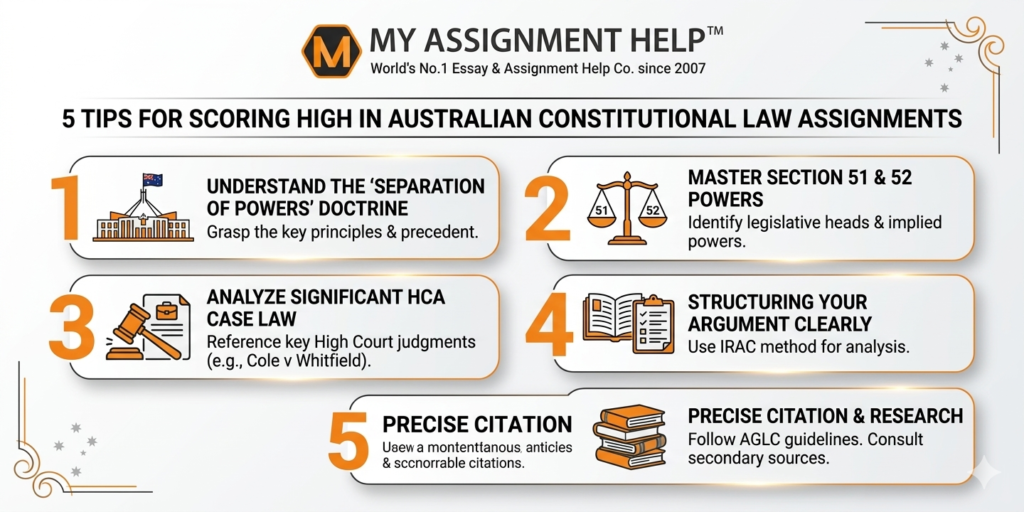
1. Master the Art of Characterisation
In any Constitutional Law problem, the first hurdle is “characterisation.” You must determine if a Commonwealth law actually falls within one of the “heads of power” listed in the Constitution (primarily sections 51 and 52).
- Direct vs. Incidental: Distinguish between the core of a power and its incidental scope. For instance, the taxation power (s 51(ii)) is broad, but it cannot be used as a “colourable” attempt to regulate matters entirely outside federal jurisdiction.
- The Dual Characterisation Rule: Remember that a law can be characterised in two ways. As established in Fairfax v Federal Commissioner of Taxation (1965), just because a law has a non-constitutional purpose (like environmental protection) doesn’t mean it isn’t valid under a constitutional head (like the taxation power).
2. Deep Dive into High Court Precedents
Your markers are looking for more than just a list of sections. They want to see how you apply the “ratio decidendi” of landmark cases. In Australian Constitutional Law, your analysis must be grounded in the shifting interpretations of the High Court.
- The Engineers’ Case (1920): This is the foundation of modern interpretation. Use it to explain why the Constitution should be read according to its natural language, rather than through the lens of “reserved state powers.”
- The Tasmanian Dam Case (1983): Vital for any discussion on the External Affairs power.
- McCloy v New South Wales (2015): Essential for applying the “proportionality test” regarding the implied freedom of political communication.
If navigating these dense judgements becomes overwhelming, professional law assignment help can assist in distilling complex case law into clear, persuasive legal arguments tailored to your specific assignment prompt.
3. Apply the Proportionality Test Rigorously
Recent High Court jurisprudence has leaned heavily on “structured proportionality.” When a law interferes with a constitutional limitation (like section 92’s freedom of interstate trade or the implied freedom of political communication), the court asks:
- Suitability: Is the law rationally connected to a legitimate objective?
- Necessity: Is there an alternative, less restrictive way to achieve that goal?
- Adequacy in Balance: Does the benefit of the law outweigh the restriction on the right?
In your assignment, don’t just state that a law is “fair.” Use these three specific steps to prove its validity or invalidity.
4. Adhere to the Australian Guide to Legal Citation (AGLC4)
In law, the format is as important as the content. In Australia, the AGLC4 is the gold standard. Failure to cite correctly is the fastest way to lose marks.
- Pinpoint Citations: Always include the specific page or paragraph number of a High Court judgement.
- Neutral Citations: Ensure you use the correct format for modern cases (e.g., Case Name [Year] HCA Number).
- Consistency: Ensure your bibliography and footnotes are perfectly aligned. High-level legal writing requires meticulous attention to detail.
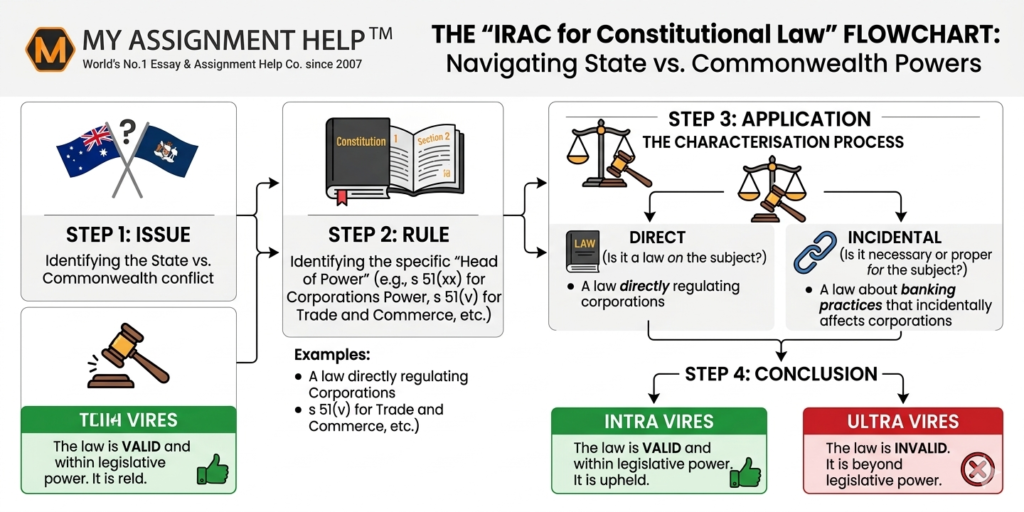
5. Structure Using IRAC (with a Constitutional Twist)
The IRAC (Issue, Rule, Application, Conclusion) method is standard, but for Constitutional Law, the “Application” phase must be more robust.
- Issue: Identify the specific section of the Constitution and the potential head of power.
- Rule: State the current High Court test (e.g., the WorkChoices test for the Corporations power).
- Application: This is where you gain the most marks. Compare the facts of your problem question to the facts of a decided case.
- Conclusion: Provide a definitive view on whether the law is intra vires (within power) or ultra vires (beyond power).
Key Takeaways for Students
- Focus on Power: Always identify which specific head of power under s 51 or s 52 is being invoked.
- Precedent is King: Quote the High Court, not textbooks. The Commonwealth Law Reports (CLR) are your best friend.
- State vs. Cth: Always check for inconsistencies under Section 109 if both State and Federal laws are mentioned.
- AGLC4 Compliance: Never submit a legal paper without double-checking footnote formatting.
FAQ Section
Q1: What is the most important section in the Australian Constitution?
A: While all sections matter, Section 51 is the most frequently tested as it lists the 40+ “heads of power” that allow the Commonwealth to make laws.
Q2: How do I handle “Implied Freedoms” in an assignment?
A: Start with the Lange v ABC test, updated by McCloy v NSW. Remember, these are not personal rights like in the US, but limitations on legislative power.
Q3: Is it okay to use secondary sources?
A: Yes, but sparingly. Use peer-reviewed journals from the Melbourne University Law Review or Sydney Law Review to support your analysis of primary sources (the Constitution and Case Law).
Author Bio
Dr. Helena Richardson is a Senior Academic Consultant at MyAssignmentHelp. With a Ph.D. in Constitutional Law from the University of Sydney and over 12 years of experience in legal practice and academia, Dr. Richardson specialises in helping students navigate the complexities of Federalism and High Court jurisprudence. She is a regular contributor to legal education forums across Australia.