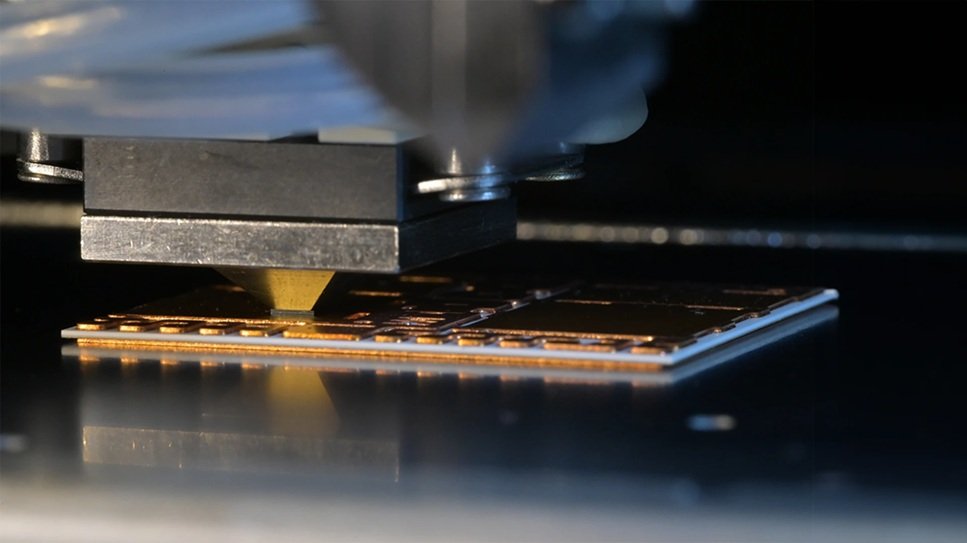
If you are exploring thermo compression bonding, you are probably dealing with a problem that refuses to be solved by traditional soldering.
Pitch is shrinking. Interconnect density is rising. Thermal budgets are tightening. And suddenly, the conventional reflow process that worked for years starts introducing stress, voids, or alignment issues that your application cannot tolerate.
Thermo compression bonding sits exactly in that tension point. It is not new. It is not experimental. But it becomes essential when electrical precision and mechanical integrity must coexist at microscopic scale.
Let us unpack what it really is and when it makes sense.
The Basic Principle: Heat, Pressure, and Controlled Diffusion
Thermo compression bonding is a solid-state interconnection process that joins two surfaces using a combination of elevated temperature and mechanical pressure.
Unlike conventional soldering, which relies on melting an alloy to create a joint, thermo compression bonding often works through:
- Metal diffusion between mating surfaces
- Plastic deformation under controlled force
- Intermetallic formation at the interface
The most common materials involved include gold-to-gold, copper-to-copper, or gold-to-copper interfaces. In many applications, no bulk melting occurs. Instead, atomic diffusion creates the bond.
That distinction matters.
Because when melting is removed from the equation, so are many of the side effects: uncontrolled flow, bridging, excessive thermal shock, and large-scale reflow dynamics.
Where It Shows Up
Thermo compression bonding is commonly used in:
- Advanced semiconductor packaging
- Flip-chip assemblies
- 3D IC stacking
- MEMS devices
- Microelectronic and optoelectronic components
- High-frequency RF modules
When interconnect pitch drops to tens of microns, solder begins to struggle. Surface tension alone is not precise enough. Alignment tolerance shrinks. Warpage becomes destructive.
Thermo compression bonding provides controlled alignment under force, maintaining geometric accuracy during the joining process.
It is less forgiving. But it is more precise.
Why Engineers Turn to It
There are three recurring reasons professionals move toward thermo compression bonding.
1. Finer Pitch Capability
As pad spacing tightens, the risk of bridging increases in molten processes. Solid-state diffusion bonding allows tighter layouts without sacrificing electrical isolation.
2. Improved Mechanical Strength
Because pressure is applied during bonding, the resulting joint often exhibits strong mechanical integrity and resistance to fatigue. In high-reliability environments, that matters.
3. Lower Thermal Impact on Surrounding Components
Although heat is used, it is typically localized and carefully controlled. Sensitive substrates and adjacent structures are less exposed to uncontrolled thermal cycling.
This is particularly critical in heterogeneous integration, where multiple materials with different coefficients of thermal expansion coexist in a single package.
The Engineering Variables That Matter
Thermo compression bonding is not simply “heat plus pressure.” It is a controlled equation.
Key parameters include:
- Bonding temperature
- Applied force
- Bonding time
- Surface cleanliness
- Metallization thickness
- Atmosphere control
Surface preparation is often the hidden determinant of success. Oxidation layers, contamination, or uneven metallization can compromise diffusion at the atomic level.
Precision alignment systems are equally critical. At micro-scale geometry, even minor misalignment can compromise yield.
This process demands repeatability. Not improvisation.
Tradeoffs and Constraints
Thermo compression bonding is not universally superior. It introduces its own challenges.
Equipment cost can be higher than traditional reflow systems. Throughput may be slower depending on bonding cycle requirements. Process optimization requires engineering discipline.
In high-volume consumer electronics, speed and cost sometimes favor solder-based approaches. In advanced packaging, aerospace, medical electronics, and high-frequency systems, reliability and precision often take priority.
The decision is contextual.
It depends on density requirements, reliability expectations, mechanical stress exposure, and performance margins.
Why It Matters More Now
Electronics are not getting simpler.
Devices are thinner. Chips are stacked. Signal speeds are climbing. Power density is increasing. Integration levels that were once theoretical are now production targets.
As vertical stacking and heterogeneous integration accelerate, interconnect technology becomes the limiting factor.
Thermo compression bonding addresses that bottleneck by enabling:
- Fine-pitch interconnects
- Strong mechanical coupling
- Reduced void formation
- Improved electrical performance at high frequencies
When margins shrink, control becomes everything.
And this process is fundamentally about control.
Precision Is a Process
Thermo compression bonding is not a marketing term. It is a response to physical constraints.
When solder stops scaling. When reliability cannot be compromised. When interconnect integrity defines system performance.
That is when this process enters the conversation.
It requires engineering rigor. Surface discipline. Parameter control. But in return, it offers structural and electrical precision that conventional methods struggle to match.
In advanced electronics, the bond is no longer just a connection.
It is architecture.
FAQs:
1. Is thermo compression bonding stronger than soldering?
In many applications, yes. Because the bond is formed through pressure and diffusion rather than bulk melting, joints can exhibit higher mechanical strength and improved fatigue resistance. However, performance depends heavily on process control and material compatibility.
2. Does thermo compression bonding require very high temperatures?
Temperatures are elevated but typically lower than full reflow melting in many cases, especially in gold-to-gold bonding. The exact temperature depends on material systems and desired diffusion characteristics.
3. Is this process suitable for high-volume manufacturing?
It can be, but scalability depends on equipment capability and cycle time optimization. Thermo compression bonding is widely used in advanced semiconductor packaging where precision outweighs maximum throughput.