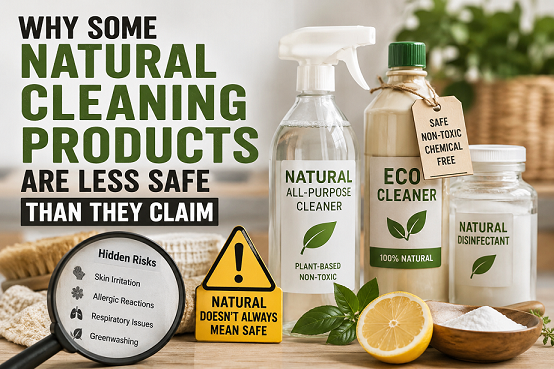
The natural cleaning products category has grown enormously in recent years, driven by legitimate consumer concern about the chemicals in conventional cleaning products and their effects on household health and environmental impact. This growth has been accompanied by marketing that isn’t always as straightforward as the products are assumed to be, and a category that started as a response to misleading conventional product claims has developed its own misleading claims worth examining carefully.
Not every product marketed as natural, green, or eco-friendly earns those labels in a meaningful way. Some contain ingredients that have their own health or safety concerns. Others work well for some applications but cause surface damage that isn’t disclosed. And the regulatory environment around these terms is loose enough that significant variation exists under the same general label.
Understanding what to actually look for when evaluating a natural cleaning product, beyond the marketing language, helps households make genuinely informed choices rather than trading one set of unexamined assumptions for another. CJS Cleaning Solutions uses products that have been evaluated on actual ingredient safety and performance rather than label language alone, and the criteria that guide those choices are worth sharing.
The Greenwashing Problem
Greenwashing refers to marketing that creates an impression of environmental or health responsibility that isn’t supported by what’s actually in the product. In the cleaning products category, this can take several forms: using nature-themed imagery and language without any actual certification or ingredient standard, highlighting one “green” ingredient while including others that are less clean, or using terms like “natural” and “non-toxic” that have no regulatory definition and therefore no accountability.
A product can be labeled natural while containing synthetic fragrances with undisclosed chemical compositions, petroleum-derived ingredients, or preservatives with documented health concerns. Without third-party certification from a credible body, label language about natural composition is essentially self-reported and unverified.
Essential Oils and the Sensitization Question
Many natural cleaning products use essential oils as both fragrance and active cleaning components. Certain essential oils have genuine antibacterial properties, tea tree oil being a well-documented example. However, essential oils are not inherently safe simply because they’re plant-derived.
Several essential oils are documented skin sensitizers that cause allergic reactions in a proportion of people exposed to them repeatedly, and the sensitization risk increases with frequency of exposure. Limonene, derived from citrus and used extensively in natural cleaning products, oxidizes in air to form compounds that are more sensitizing than the original ingredient. This doesn’t make essential oil products unusable, but it does mean that natural fragrance is not automatically safer than synthetic fragrance for every household member.
Boric Acid and Borax
Borax and boric acid appear frequently in DIY natural cleaning recipes and some commercial natural products as cleaning and pest control agents. Both have a generally benign reputation in the natural cleaning community, but both are also classified as reproductive toxins in the European Union based on evidence of developmental and reproductive effects in animal studies.
This doesn’t mean these ingredients should be treated the same as acutely hazardous substances. But it does mean that products containing them shouldn’t be treated as automatically safe because they’re marketed as natural, particularly for households with children or pregnant household members.
The Concentration Question for Concentrated Products
Some natural cleaning products are sold as highly concentrated formulas to be diluted before use. Concentrated products require more careful handling than ready-to-use formulas regardless of their ingredient profile. A concentrated citrus-based degreaser that’s appropriately diluted and used on suitable surfaces is one thing. The same product at full concentration causes skin and eye irritation that the diluted form doesn’t.
What Third-Party Certification Actually Means
EPA Safer Choice certification requires that every ingredient in a product meet specific safety criteria for human health and environmental impact, evaluated by the EPA rather than self-reported by the manufacturer. EWG Verified applies a similar third-party verification framework. These certifications provide actual accountability for ingredient claims in a way that “natural” and “green” label language doesn’t.
Checking for these certifications rather than relying on general label impressions is the most practical way to distinguish products that have actually been evaluated for safety from those that simply present well.
Matching Product Choice to Surface and Situation
Natural cleaning products vary widely in formulation and performance, and the right choice depends on matching the product to both the cleaning task and the surfaces involved. A plant-based surfactant cleaner that works beautifully for general surface cleaning may be completely inappropriate for natural stone due to pH considerations. A citrus-based degreaser that works well for kitchen grease may cause problems on surfaces sensitive to acidic ingredients.
CJS Cleaning Solutions evaluates cleaning products on actual formulation and demonstrated surface compatibility rather than marketing category, which is why the products used in professional cleaning consistently perform better and cause fewer surface problems than consumer products selected primarily on the basis of their natural marketing positioning.