Security lighting occupies an interesting position in the outdoor lighting category because it’s the application most homeowners consider first and the one most often implemented in ways that don’t actually deliver the security benefit they’re intended to provide. The motion-activated floodlight attached to the garage corner is a fixture most people recognize immediately. Whether it’s doing what people assume it’s doing is a different question with a less reassuring answer than most homeowners expect.
Understanding how security lighting actually affects criminal behavior, what characteristics make a lighting system genuinely effective from a security perspective, and how security lighting can be integrated with the rest of a property’s exterior lighting without creating an institutional appearance helps homeowners make better decisions about one of the most practically important outdoor lighting applications.
Astoria Lighting Co designs security lighting as an integrated component of exterior lighting systems rather than as a separate, utilitarian installation, which produces both better security outcomes and a more visually cohesive result.
What Research Actually Shows About Lighting and Crime
The relationship between lighting and crime deterrence is more nuanced than the simple assumption that light prevents crime. Research on this topic has produced findings that are worth understanding before making lighting decisions based on security as the primary motivation.
Consistent, well-distributed lighting has demonstrated crime reduction effects in several contexts, particularly in areas where improved visibility increases the perceived risk of detection for potential offenders. The operative factors are visibility and the perception that criminal activity will be observed, not simply the presence of light sources.
Motion-activated lights that switch on suddenly when triggered can actually serve as alerts for residents and neighbors, but they can also simply indicate where the triggering detection boundary is, which sophisticated intruders can work around. The sudden illumination they provide is visible both to residents inside the home and to the potential intruder outside, with the intruder having the advantage of knowing when the light triggered and why.
Consistent Illumination vs Motion Activation
Consistent, lower-level illumination throughout a property’s exterior often provides better security outcomes than high-intensity motion-activated lights with dark gaps between triggering events. A property that’s uniformly visible at moderate illumination levels after dark removes the dark zones that motion-triggered systems leave unlit between activations.
This doesn’t mean motion activation has no place in a security lighting approach. Motion-triggered lighting that alerts residents to activity in specific areas, particularly entry points and blind spots, supplements consistent illumination effectively. The limitation is relying entirely on motion activation without baseline illumination between triggered events.
The Importance of Eliminating Dark Zones
Professional security lighting assessment maps the dark zones on a property after dark, specifically the areas that existing lighting doesn’t reach and that therefore provide cover for unwanted activity. These dark zones are often adjacent to the brightly lit areas created by existing lights, since bright light sources create deep shadows in surrounding areas when nothing illuminates those surrounding spaces.
Eliminating dark zones requires a complete assessment of property coverage after dark rather than simply adding lights to areas that feel important. The areas that feel important, like the front entry and driveway, are typically already reasonably well lit. The areas that create security vulnerability are often the side yards, rear corners, and areas behind outbuildings that existing lighting never reaches.
Integration With Smart Control Systems
Security lighting that integrates with smart control systems provides capabilities beyond simple on/off operation. Scheduling that maintains appropriate illumination levels throughout the night without running at full intensity continuously reduces energy consumption while maintaining effective coverage. Integration with detection systems allows specific zones to increase intensity when activity is detected while maintaining baseline illumination everywhere else.
Remote monitoring through app-connected systems allows homeowners to check exterior lighting status and adjust operation from anywhere, which matters during travel periods when consistent lighting operation is particularly important.
Making Security and Aesthetics Work Together
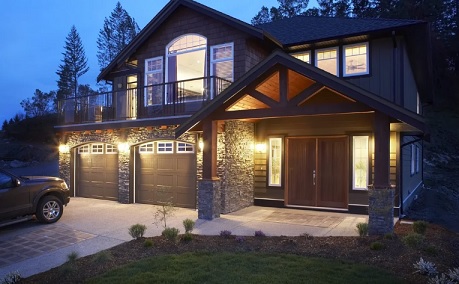
The most practical security lighting approach for residential properties integrates security function into an overall exterior lighting design rather than treating security as a separate utilitarian system added alongside existing aesthetic lighting. Well-designed landscape and architectural lighting that provides thorough property coverage after dark delivers security benefits as a natural consequence of the illumination it creates.
For homeowners concerned about security but also wanting a property that looks intentionally designed after dark rather than institutionally lit, this integrated approach is the solution. Astoria Lighting Co designs exterior lighting systems where security coverage and aesthetic quality reinforce rather than compromise each other, producing properties that look beautiful after dark while maintaining the consistent illumination that actually contributes to security.