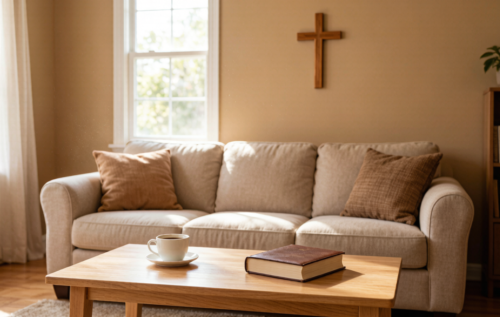
Most Christians spend a fair amount of time thinking about how to steward their finances, their time, and their talents. We hear sermons on tithing, read books on time management, and fill out spiritual gifts inventories. But how often do we stop to consider the physical space in which we live as something we are called to steward? The roof over our heads, the walls that surround our dinner table, the rooms where we pray, rest, and welcome others — these are not theologically neutral. They are part of the material world God has entrusted to us, and how we arrange them matters.
In Genesis, God placed Adam in a garden and gave him the task of tending and keeping it (Genesis 2:15). The Hebrew verbs used there — avad (to work, to serve) and shamar (to keep, to guard) — suggest that our first vocation was one of intentional care for a physical place. That calling did not expire when humanity left Eden. We are still people who inhabit spaces, and those spaces still require our thoughtful attention. Whether you live in a sprawling farmhouse, a modest apartment, or something in between, your home is a domain of stewardship.
Of course, thinking about home design theologically can feel abstract until you face a real, concrete decision — like whether to knock down a wall, where to put the kitchen island, or how to arrange the living room so it actually works for hosting a small group. This is where practical wisdom and good tools come in. A floor planner free can help you map out your space with precision before making permanent changes, which is simply a modern expression of the same careful planning that Proverbs commends: “The plans of the diligent lead surely to abundance, but everyone who is hasty comes only to poverty” (Proverbs 21:5, ESV). Thoughtful preparation honors the resources God has given us.
Home as a Place of Ministry
In the New Testament, the early church met almost exclusively in homes. Acts 2:46 describes believers “breaking bread in their homes” and sharing meals with glad and generous hearts. The home was not a retreat from the world but a base of operations for ministry. Romans 16:5 and Colossians 4:15 both mention churches that gathered in specific people’s houses. Priscilla and Aquila, that remarkable couple who mentored Apollos and partnered with Paul, ran their ministry out of their home (1 Corinthians 16:19).
This has real, practical implications for how we design our living spaces. If your home is going to be a place where people gather — for Bible study, for meals, for prayer, for difficult conversations over coffee — then your floor plan either serves that mission or works against it. An open living area that flows naturally from the kitchen to the seating area invites connection. A cramped, poorly lit space with no clear gathering point subtly discourages it. None of this is about wealth or square footage; it is about intentionality. Even a small apartment can be arranged to welcome people if the layout is thoughtfully considered.

Order, Beauty, and the Character of God
There is a persistent temptation in some Christian circles to treat aesthetics as frivolous — a luxury for those with too much time and money on their hands. But Scripture tells a different story. When God gave Moses instructions for the tabernacle, He did not merely specify the dimensions; He described the colors of the curtains, the craftsmanship of the lampstand, the embroidery on the priestly garments (Exodus 25–28). The first person in the Bible described as being “filled with the Spirit of God” is Bezalel, a craftsman and artist commissioned to make the tabernacle beautiful (Exodus 31:1–5). God cares about beauty because beauty reflects His character.
What does this mean for your living room? It means that choosing paint colors, arranging furniture, and thinking about how light falls across a room are not beneath our spiritual concern. They are small acts of cultivation — bringing a little more order out of chaos, a little more beauty into a fallen world. It is not about having an Instagram-worthy home or impressing guests with your design taste. It is about recognizing that the spaces where your family prays, reads Scripture, and practices hospitality are worth caring for with excellence and joy.
Practical Wisdom for the Christian Household
So how do we move from theological conviction to actual, practical decisions about our homes? Here are a few principles I have found helpful:
Start with function, not fashion. Before you think about what looks good, ask what your household actually needs. Do you host a small group regularly? You need flexible seating and clear sight lines. Do you have young children? Safety and durability matter more than delicate decor. Does someone in your home work remotely? A dedicated, quiet workspace is worth prioritizing. Let the actual rhythms of your family’s life — including your ministry life — drive the layout.
Plan before you purchase. One of the biggest mistakes people make is buying furniture or starting renovations without a coherent plan. You end up with a sofa that is too large for the room, a dining table that blocks the natural walking path, or expensive changes that do not actually solve the problem you were trying to fix. Taking the time to sketch out your floor plan, measure everything carefully, and test different arrangements before committing saves enormous amounts of money and frustration. It is the Proverbs 21:5 principle applied directly to your walls and furniture.
Making Design Decisions with Confidence
Once you have a solid floor plan in mind, the next challenge is deciding what the space should actually look like. Color palettes, furniture styles, lighting choices — for many of us, these decisions produce a kind of decision paralysis. We know what we like when we see it, but we struggle to articulate it, let alone execute it in our own homes.
This is an area where modern technology can genuinely serve as a helpful tool for Christian stewardship. A home design ai free platform can take a photo of your actual room and generate realistic renderings in different styles — modern, traditional, Scandinavian, and so on — giving you a concrete visual of what your space could look like before you spend a single dollar on paint or furniture. It removes the guesswork from a process that has historically been guided by intuition and expensive trial and error. For families trying to be wise stewards of limited resources, that is no small thing.
I want to be clear: there is nothing particularly spiritual about using an app to redesign your kitchen. But there is something deeply spiritual about treating every resource God has given you — including your living space, your money, and your time — with care and intentionality. If a tool helps you make better decisions, avoid costly mistakes, and create a home that more effectively serves your family and your ministry, then using it well is an act of faithfulness. Not because the tool itself is holy, but because the heart behind its use is oriented toward stewardship.
The Home That Points Beyond Itself
Ultimately, a Christian’s home should never be an end in itself. It is not a trophy to display or a fortress to retreat into. It is a waystation — a temporary dwelling that points toward a more permanent one. Jesus told His disciples, “In my Father’s house are many rooms… I go to prepare a place for you” (John 14:2). Every earthly home we design, renovate, and inhabit is a dim reflection of that truer home being prepared for us.
But that does not make our efforts here meaningless. Quite the opposite. The care we invest in our earthly dwellings — the intentional layouts, the welcoming spaces, the beauty we cultivate — can be a small foretaste of the care God is investing in our eternal dwelling. When we open our doors to neighbors, when we arrange our furniture so that conversation flows naturally, when we paint a wall a color that brings peace to a weary guest, we are participating in a very old and very sacred pattern. We are tending a garden. We are keeping a space. We are stewarding a small corner of God’s world, and that matters more than we often realize.