
Paul’s instruction that “everything should be done in a fitting and orderly way” (1 Corinthians 14:40) is usually applied to the conduct of worship services. It applies just as well to what happens in the closet down the hall: the cables, microphones, projectors, folding chairs, and coffee urns that every congregation accumulates and few congregations track.
Anyone who has served in ministry knows the pattern. The church buys equipment as needs arise – a projector when the old one dies, a headset mic for the Easter program, tables for the fellowship hall. Each purchase is an act of generosity. And then, gradually, the equipment scatters: a microphone in a youth leader’s car, a speaker at a member’s business, an extension cord that was last seen at the Harvest festival.
The losses are rarely dramatic and almost never dishonest. They are the ordinary result of shared property, volunteer turnover, and the absence of any record of who took what.
Stewardship includes the storeroom
Stewardship, in Christian teaching, is the careful management of what has been entrusted to us. Congregations apply this instinct to finances, buildings, and creation care – yet the storeroom often escapes attention entirely. A projector is a few thousand dollars. A sound board more. A youth ministry’s game equipment, the VBS supplies, the nativity set that comes out every December: together these represent years of sacrificial giving.
Caring for these things is not materialism. It is the opposite – a recognition that the money given by widows and pensioners and families on tight budgets deserves better than to be lost to a missing checklist.
The four questions every church should be able to answer
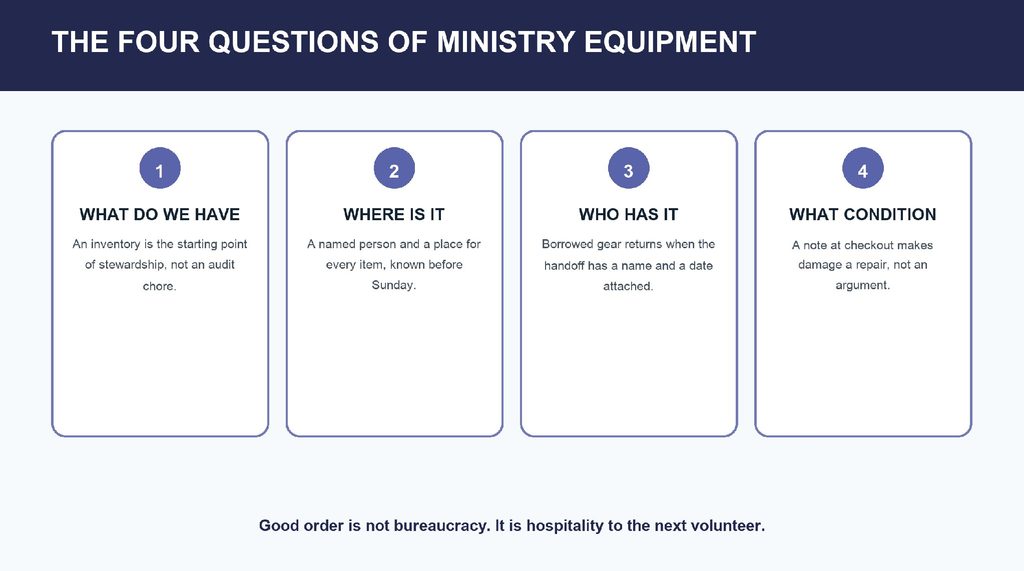
Equipment stewardship comes down to four questions: what do we have, where is it, who has it, and what condition is it in. Most churches can answer the first one roughly and the rest not at all. The goal is not a professional asset-management system; it is the ability to say, on a Saturday night, exactly where the portable PA is and who promised to bring it back.
Why sign-out sheets fail (and what works instead)
The traditional solution – a binder by the door – fails for the same reason in every congregation. The binder requires discipline at exactly the moment people are busiest, and volunteers, by definition, have other jobs. When checking out a projector takes longer than loading it into the car, the record-keeping loses.
The practical alternative is to make the record nearly effortless. QR-coded labels are quietly becoming the standard for exactly this problem: a volunteer scans the sticker on the item with their phone, the checkout is logged under their name, and the return is the same scan in reverse. Tools built for this – WhoHasGear is one example designed for shared equipment in small teams – turn a two-form, ask-the-trustee process into a five-second habit.WhoHasGear
Habits that outlast any one volunteer
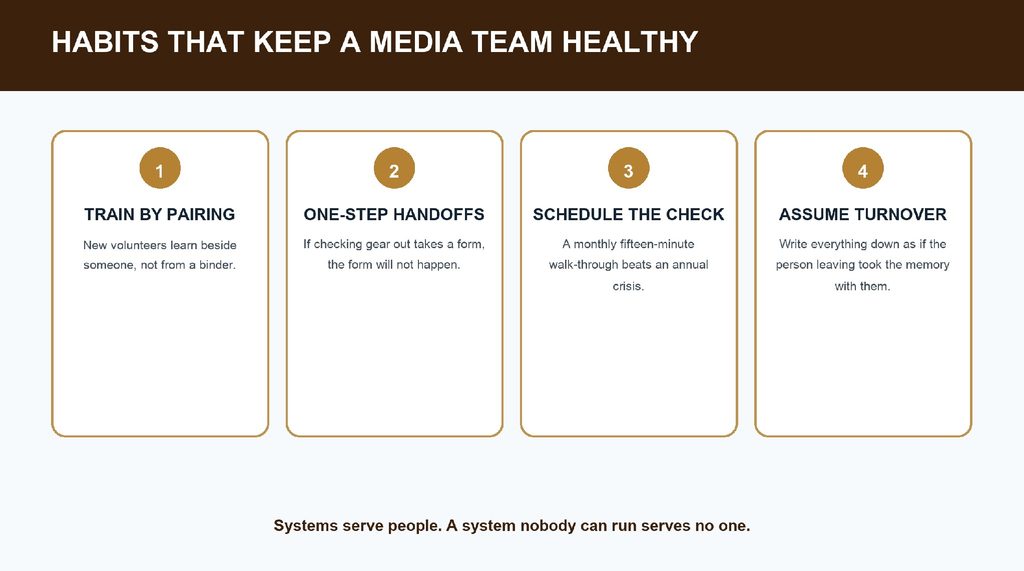
Tools help, but habits keep a system alive. Pair new volunteers with experienced ones rather than handing them a manual. Walk the building once a month with the inventory list; fifteen minutes catches most problems while they are still small. And write everything down as if the person who knows where everything is will move away next year – because eventually, they will.
Congregations that normalize this find a side benefit: new volunteers serve with confidence instead of anxiety. Nobody fears breaking a system that is simple, and nobody resents a checklist that respects their time.
Borrowed things and blessed things
Churches lend equipment constantly – to members, to funerals at other congregations, to community groups who use the hall. This generosity is right and should not be discouraged. It should be recorded. A loan with a name and a date attached is still a loan; it is simply one that is likely to come back.
The old hymn reminds us that all we have is borrowed from God. The gear in the closet deserves the same honest accounting we would give any other trust – tracked clearly, maintained faithfully, and returned in good order to serve the next need.
The practical takeaway
An orderly storeroom will not make a church more spiritual. But it removes a thousand small frictions from ministry: the Sunday morning scramble for cables, the argument about who lost the adapter, the budget line for replacing things that were never actually lost. Steward your equipment the way you steward everything else – deliberately, transparently, and with the next volunteer in mind.