For many couples, the wedding begins at the church they grew up in – the sanctuary where they were baptized, the pews that held their family for decades. A ceremony in a home congregation carries a weight that no rented venue can match. It also carries logistics that couples frequently underestimate, because a church is not just a building. It is a community with its own calendar, its own rules, and its own people to consider.
Start with the congregation, not the date
The first conversation is with the church office, not the caterer. Church calendars fill with services, funerals, and denominational events that take precedence over weddings, and popular congregations book wedding dates months – sometimes more than a year – ahead. Ask early, and ask about more than the date: which spaces are included, who unlocks the building, and whether a facility fee or sexton’s honorarium applies.
Couples who are not members should understand that many congregations limit weddings to members or regular attenders, or require a series of premarital sessions with the pastor. These policies are not obstacles to plan around; they are part of what makes a church wedding a church wedding.
The officiant and the service
Meet with the officiating pastor early and personally. Beyond the premarital counseling many pastors require, the meeting settles practical questions: which scripture readings are fitting, whether the couple writes their own vows, how long the service will run, and what the church’s theology expects the ceremony to declare. A wedding that means the world to the couple still needs to be a service the congregation can say “amen” to.
Music deserves the same conversation. Some churches restrict music to hymns; others welcome contemporary worship songs or classical pieces. Whatever the policy, coordinate with the music minister rather than surprising them with a program already at the printer.
Decorations, flowers, and the rules of the sanctuary
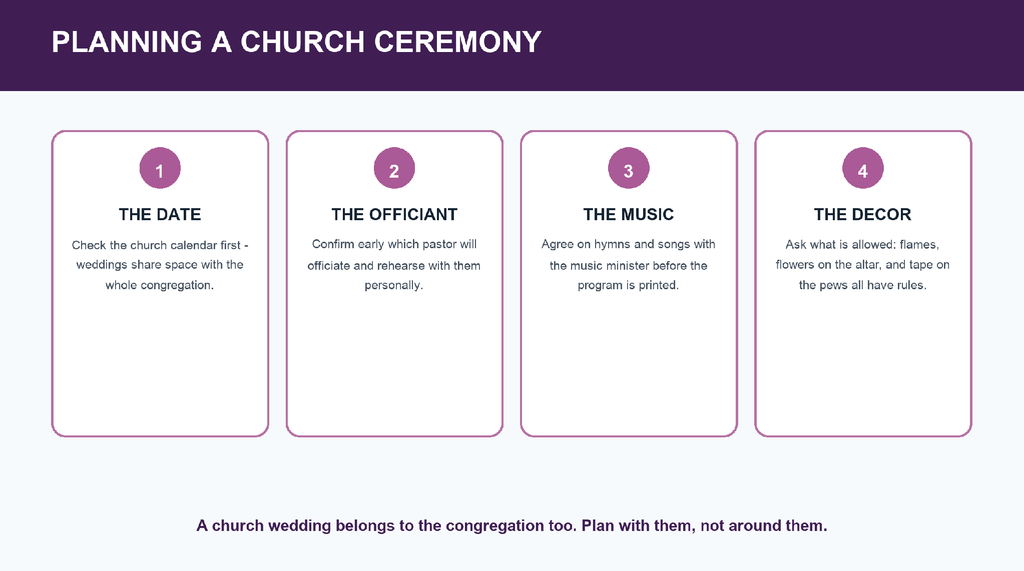
Every sanctuary has its unwritten rules, and the written ones. Open flames may be limited to the church’s own candles. Flowers may be kept off the altar table. Tape on hundred-year-old pews is usually forbidden; framers and pew clips are usually acceptable. Photographers should know where they may stand and whether they may move during the vows.
None of this limits a beautiful wedding. It simply means the couple’s vision should be shaped in conversation with the people who care for the building, ideally during a walkthrough before the rehearsal.
The photography question couples always leave too late
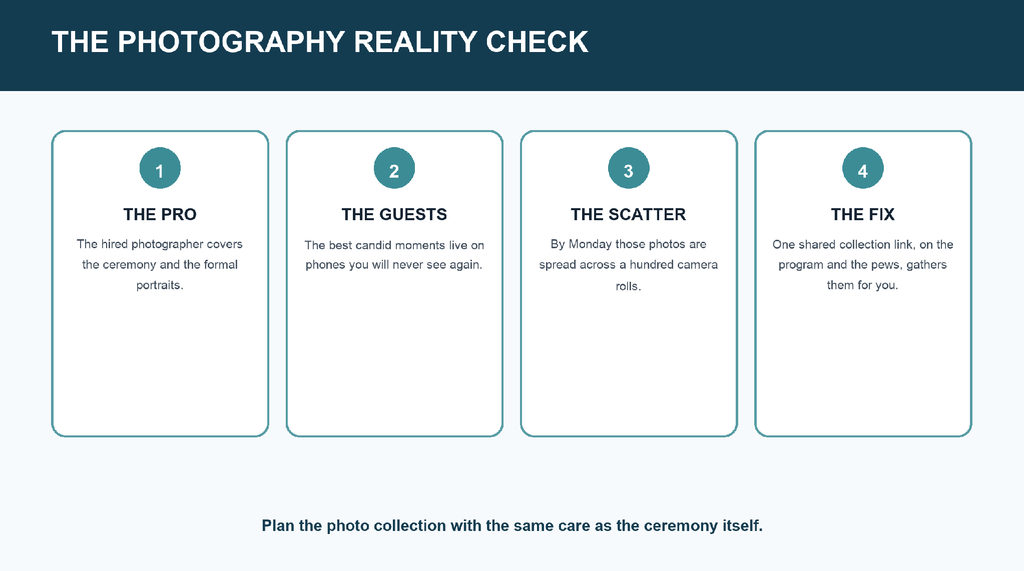
Professional photography covers perhaps three hours: the formals, the ceremony, the send-off. The rest of the day – the grandmother crying during the hymn, the college friends reunited in the back pew, the children chasing rice on the steps – happens on the phones of your guests. Those photos are often the most treasured, and by Monday they are scattered across a hundred camera rolls the couple will never see.
The solution is to collect guest photos as deliberately as you plan the music. A QR code or short link on the program and on pew cards – pointing to a shared collection such as VowSnaps, which gathers everything into one private gallery without asking guests to install an app or create an account – turns a hundred scattered cameras into one album. Print the instructions; do not rely on word of mouth. And have the officiant or coordinator mention it once at the rehearsal.VowSnaps
Honor the volunteers
A church wedding runs on people who are not paid to be there: the trustee who opens the building, the volunteer who runs sound for a ceremony instead of a service, the ladies’ group that sets up the reception. Thank them by name, feed them, and leave the building cleaner than you found it. How a couple treats the congregation’s volunteers is remembered long after the flowers wilt.
The practical takeaway
A church wedding succeeds on the same virtues as a marriage: early honesty, coordination, and gratitude. Book with the congregation early, plan the service with the pastor and the music minister, learn the sanctuary’s rules before decorating, and set up the guest-photo collection before the programs are printed. Do those things and the day will carry the one thing no venue can supply – the sense that the whole community witnessed and blessed it.