Knowing how to calculate watts from amps and volts is useful when you work with appliances, batteries, solar panels, chargers, generators, electrical circuits, or home wiring.
The basic calculation is simple:
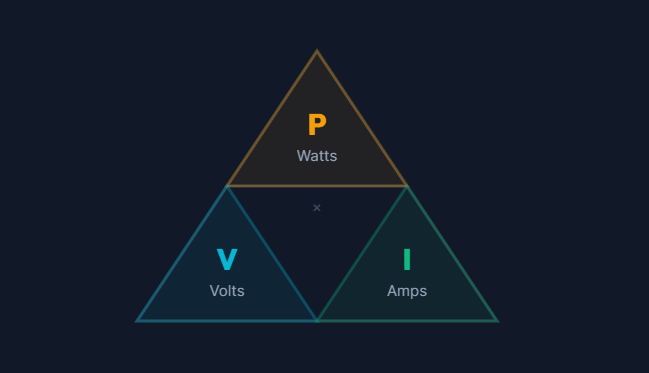
Watts = Volts × Amps
For example, if a device uses 5 amps at 12 volts, its power is:
12 × 5 = 60 watts
So, the device uses 60 watts of electrical power.
However, this basic formula works best with DC circuits and simple resistive AC loads. Some AC devices, such as motors and air conditioners, also require you to consider the power factor.
This guide explains each method with simple examples.
Quick Answer: How Do You Calculate Watts From Amps and Volts?
To calculate watts from amps and volts, multiply the voltage by the current.
Formula:
P = V × I
Where:
- P = Power in watts
- V = Voltage in volts
- I = Current in amps
Example
If you have:
- 120 volts
- 5 amps
Calculate:
120 × 5 = 600 watts
The electrical power is 600 watts.
Watts, Amps, and Volts Explained Simply
Before using the formula, it helps to understand what each electrical unit means.
| Unit | Symbol | What It Measures |
| Watts | W | Electrical power |
| Amps | A | Electrical current |
| Volts | V | Electrical voltage |
Think of electricity like water moving through a pipe.
Voltage acts like the pressure pushing the water.
Amps tell you how much electrical current flows.
Watts tell you how much electrical power the device uses or produces.
When voltage or current increases, electrical power can also increase.
Watts From Amps and Volts Formula
The main formula is:
Watts = Amps × Volts
You can also write it as:
W = A × V
This formula gives you the electrical power when you know both current and voltage.
Example 1: 12 Volts and 2 Amps
12V × 2A = 24W
Answer: 24 watts
Example 2: 24 Volts and 5 Amps
24V × 5A = 120W
Answer: 120 watts
Example 3: 120 Volts and 10 Amps
120V × 10A = 1,200W
Answer: 1,200 watts
Example 4: 240 Volts and 20 Amps
240V × 20A = 4,800W
Answer: 4,800 watts
How to Calculate Watts From Amps and Volts Step by Step
You only need three simple steps for a basic calculation.
Step 1: Find the Voltage
Look for the voltage rating on the appliance, charger, battery, power supply, or equipment label.
You may see values such as:
- 5V
- 12V
- 24V
- 110V
- 120V
- 230V
- 240V
Step 2: Find the Amps
Next, find the current rating.
It may appear as:
- 1A
- 2.5A
- 5A
- 10A
- 15A
Make sure the value is actually in amps.
If the device lists milliamps, convert them to amps first.
1,000 milliamps = 1 amp
For example:
500 mA = 0.5A
Step 3: Multiply Volts by Amps
Suppose a device operates at:
- 12 volts
- 3 amps
Multiply them:
12 × 3 = 36
The device uses 36 watts.
Amps and Volts to Watts Chart
Here are some quick examples.
| Volts | Amps | Watts |
| 5V | 1A | 5W |
| 5V | 2A | 10W |
| 12V | 1A | 12W |
| 12V | 2A | 24W |
| 12V | 5A | 60W |
| 24V | 2A | 48W |
| 24V | 5A | 120W |
| 48V | 10A | 480W |
| 120V | 5A | 600W |
| 120V | 10A | 1,200W |
| 120V | 15A | 1,800W |
| 120V | 20A | 2,400W |
| 230V | 10A | 2,300W |
| 240V | 10A | 2,400W |
| 240V | 20A | 4,800W |
| 240V | 30A | 7,200W |
These figures assume a power factor of 1 when AC power is involved.
How to Calculate Watts in a DC Circuit
DC means direct current.
You commonly find DC power in:
- Batteries
- Cars
- Solar systems
- USB devices
- LED systems
- Power banks
- Small electronics
For DC circuits, use:
Watts = Volts × Amps
Suppose a battery provides:
- 12 volts
- 8 amps
Calculate:
12 × 8 = 96 watts
The power is 96 watts.
Another DC Example
A USB charger provides:
- 5 volts
- 3 amps
Calculate:
5 × 3 = 15 watts
Its maximum output is 15 watts.
How to Calculate Watts for Single Phase AC
AC means alternating current. Homes and businesses commonly use AC electricity.
For a simple resistive load, you can often use:
Watts = Volts × Amps
Examples of mainly resistive loads include some:
- Electric heaters
- Toasters
- Kettles
- Incandescent lamps
For other AC equipment, you may need the power factor.
The more complete single phase AC formula is:
Watts = Volts × Amps × Power Factor
The power factor is a number between 0 and 1.
Example
Suppose a motor operates at:
- 230 volts
- 8 amps
- 0.80 power factor
Calculate:
230 × 8 × 0.80 = 1,472 watts
The motor uses approximately 1,472 watts, or 1.472 kilowatts.
Simply multiplying 230 by 8 would give 1,840, but that value represents apparent power in volt amps when power factor has not been considered.
Why Power Factor Matters
This is one of the most important details when learning how to calculate watts from amps and volts for AC equipment.
In a DC circuit, voltage multiplied by current normally gives watts directly.
With AC equipment, the same calculation may give volt amps, or VA, rather than true watts.
For single phase AC:
Real Power in Watts = Volts × Amps × Power Factor
Imagine a device uses:
- 120V
- 10A
- Power factor of 0.80
First calculate:
120 × 10 = 1,200 VA
Then include power factor:
1,200 × 0.80 = 960W
So:
- Apparent power = 1,200 VA
- Real power = 960 watts
This difference matters when working with motors, compressors, transformers, computers, and similar equipment.
How to Calculate Watts From Amps and Volts in Three Phase Power
Three phase electricity is common in commercial and industrial systems.
For a balanced three phase system, a common real power formula is:
Watts = √3 × Volts × Amps × Power Factor
Since √3 is about 1.732, you can use:
Watts = 1.732 × Volts × Amps × Power Factor
This formula normally uses line to line voltage and line current.
Three Phase Example
Suppose equipment operates at:
- 400 volts
- 10 amps
- 0.85 power factor
Calculate:
1.732 × 400 × 10 × 0.85 = 5,888.8 watts
That is approximately:
5,889 watts
or:
5.89 kW
Three phase calculations can depend on how a system is connected and what voltage measurement you use, so always confirm the equipment specifications before sizing electrical components.
How Many Watts Is 1 Amp?
There is no single watt value for 1 amp.
You must also know the voltage.
For example:
| Voltage | Current | Power |
| 5V | 1A | 5W |
| 12V | 1A | 12W |
| 24V | 1A | 24W |
| 48V | 1A | 48W |
| 120V | 1A | 120W |
| 230V | 1A | 230W |
| 240V | 1A | 240W |
So, 1 amp at 12 volts is 12 watts, while 1 amp at 120 volts is 120 watts, assuming the applicable power factor is 1.
How Many Watts Is 5 Amps?
Again, the answer depends on voltage.
| Voltage | 5 Amps Equals |
| 5V | 25W |
| 12V | 60W |
| 24V | 120W |
| 48V | 240W |
| 120V | 600W |
| 230V | 1,150W |
| 240V | 1,200W |
For example:
5A × 120V = 600W
How Many Watts Is 10 Amps?
Here are some common values:
| Voltage | 10 Amps Equals |
| 12V | 120W |
| 24V | 240W |
| 48V | 480W |
| 120V | 1,200W |
| 230V | 2,300W |
| 240V | 2,400W |
At 120 volts:
10 × 120 = 1,200 watts
At 240 volts:
10 × 240 = 2,400 watts
This shows why amps alone cannot tell you the amount of electrical power.
How Many Watts Is 15 Amps at 120 Volts?
Use:
Watts = Volts × Amps
Calculate:
120 × 15 = 1,800 watts
So, 15 amps at 120 volts equals 1,800 watts for a load where the basic formula applies.
However, this does not automatically mean you should continuously operate a 15 amp circuit at its full theoretical wattage. Electrical circuit sizing and continuous load rules depend on the installation and applicable electrical code.
How Many Watts Is 20 Amps at 120 Volts?
Calculate:
120 × 20 = 2,400 watts
So:
20 amps at 120 volts = 2,400 watts
This is the mathematical power value at a power factor of 1.
How Many Watts Is 20 Amps at 240 Volts?
Calculate:
240 × 20 = 4,800 watts
So:
20 amps at 240 volts = 4,800 watts
Notice that doubling voltage while keeping current the same also doubles the power.
How to Convert Milliamps and Volts to Watts
Small electronics often list current in milliamps, written as mA.
You first need to convert milliamps to amps.
Amps = Milliamps ÷ 1,000
Then:
Watts = Volts × Amps
Example
Suppose a device uses:
- 5V
- 500mA
Convert the current:
500 ÷ 1,000 = 0.5 amps
Now calculate power:
5 × 0.5 = 2.5 watts
The device uses 2.5 watts.
How to Convert Watts Back to Amps
You can rearrange the basic formula.
Starting with:
Watts = Volts × Amps
To find amps:
Amps = Watts ÷ Volts
Example
A 1,200 watt appliance runs on 120 volts.
Calculate:
1,200 ÷ 120 = 10 amps
The appliance draws 10 amps, assuming the basic power relationship applies.
How to Calculate Volts From Watts and Amps
You can also rearrange the formula to find voltage.
Use:
Volts = Watts ÷ Amps
Example
A device uses:
- 600 watts
- 5 amps
Calculate:
600 ÷ 5 = 120 volts
The voltage is 120 volts.
Watts vs Volt Amps: Are They the Same?
Not always.
This causes a lot of confusion.
In DC circuits, watts and volt amps often have the same numerical value.
For AC equipment:
VA = Volts × Amps
But:
Watts = Volts × Amps × Power Factor
Suppose:
- Voltage = 120V
- Current = 10A
- Power factor = 0.75
Apparent power:
120 × 10 = 1,200 VA
Real power:
120 × 10 × 0.75 = 900W
So the equipment has 1,200 VA of apparent power but uses 900 watts of real power.
Watts vs Kilowatts
Large electrical loads are often measured in kilowatts instead of watts.
1 kilowatt = 1,000 watts
To convert watts to kilowatts:
Kilowatts = Watts ÷ 1,000
For example:
2,400W ÷ 1,000 = 2.4kW
So 2,400 watts equals 2.4 kilowatts.
Another example:
7,200W = 7.2kW
Does Higher Voltage Mean More Watts?
It can.
Remember:
Watts = Volts × Amps
If current stays the same and voltage increases, wattage increases.
For example:
At 5 amps and 120 volts:
120 × 5 = 600W
At 5 amps and 240 volts:
240 × 5 = 1,200W
The voltage doubled, so the power also doubled.
However, real electrical devices do not always keep their current constant when voltage changes. Never assume an appliance can safely run at a different voltage just because the math works.
Always use the voltage listed by the manufacturer.
Common Mistakes When Calculating Watts
The formula is easy, but a few mistakes can give you the wrong answer.
Forgetting the Voltage
You cannot convert amps directly into watts without knowing voltage.
For example, 10 amps could mean:
- 120 watts at 12V
- 1,200 watts at 120V
- 2,400 watts at 240V
Voltage matters.
Mixing Milliamps With Amps
Do not calculate 5V × 500 as if 500mA meant 500 amps.
Convert it first:
500mA = 0.5A
Then:
5 × 0.5 = 2.5W
Ignoring Power Factor
For AC motors and similar equipment, volts multiplied by amps may not equal true watts.
Use the power factor when available.
Confusing Watts With Watt Hours
Watts measure power.
Watt hours measure energy used over time.
For example, a 100 watt device running for 5 hours uses:
100 × 5 = 500 watt hours
That equals:
0.5 kilowatt hours
Watts and watt hours measure different things.
Simple Electrical Power Formula Table
| What You Need | Formula |
| Watts | Watts = Volts × Amps |
| Amps | Amps = Watts ÷ Volts |
| Volts | Volts = Watts ÷ Amps |
| Single phase AC watts | Watts = Volts × Amps × Power Factor |
| Three phase AC watts | Watts = 1.732 × Volts × Amps × Power Factor |
| Kilowatts | kW = Watts ÷ 1,000 |
| Watt hours | Wh = Watts × Hours |
Practical Examples
Phone Charger
A charger outputs:
- 9V
- 2A
Power:
9 × 2 = 18W
The charger can provide 18 watts at that output setting.
Car Battery Device
A device uses:
- 12V
- 4A
Power:
12 × 4 = 48W
The device uses 48 watts.
120V Appliance
A simple resistive appliance uses:
- 120V
- 8A
Power:
120 × 8 = 960W
The appliance uses 960 watts.
240V Heater
A heater draws:
- 240V
- 15A
Power:
240 × 15 = 3,600W
That equals:
3.6kW
AC Motor
A motor uses:
- 230V
- 6A
- Power factor = 0.85
Calculate:
230 × 6 × 0.85 = 1,173W
The real electrical power is approximately 1.17kW.
Frequently Asked Questions
Can you calculate watts from amps alone?
No. You normally need both amps and volts. For AC equipment, you may also need the power factor.
What is the easiest formula for watts?
The basic formula is:
Watts = Volts × Amps
It works directly for DC circuits and AC loads where the power factor is effectively 1.
Is 1 amp equal to 1 watt?
No.
One amp is a measurement of current, while one watt is a measurement of power.
At 12 volts, 1 amp equals 12 watts.
At 120 volts, 1 amp equals 120 watts when the basic formula applies.
Do I multiply volts by amps?
Yes. Multiplying volts by amps gives power directly in watts for DC circuits and suitable resistive loads.
For many AC loads, include the power factor to calculate real watts.
What is 12 volts times 10 amps?
12 × 10 = 120 watts
So 12 volts at 10 amps equals 120 watts.
What is 120 volts times 20 amps?
120 × 20 = 2,400 watts
So 120 volts at 20 amps equals 2,400 watts, assuming a power factor of 1.
What is 240 volts times 30 amps?
240 × 30 = 7,200 watts
That equals 7.2 kilowatts.
Final Thoughts
Learning how to calculate watts from amps and volts becomes easy once you remember the basic relationship:
Watts = Volts × Amps
If a 12 volt device draws 5 amps, it uses 60 watts. If a 120 volt device draws 10 amps, the basic calculation gives 1,200 watts.
For DC circuits and simple resistive loads, this formula is usually enough. For AC motors and other equipment with a power factor below 1, use volts × amps × power factor to find real watts.
The most important point is simple: amps alone do not tell you wattage. You need the voltage too, and for some AC systems, you also need the power factor.