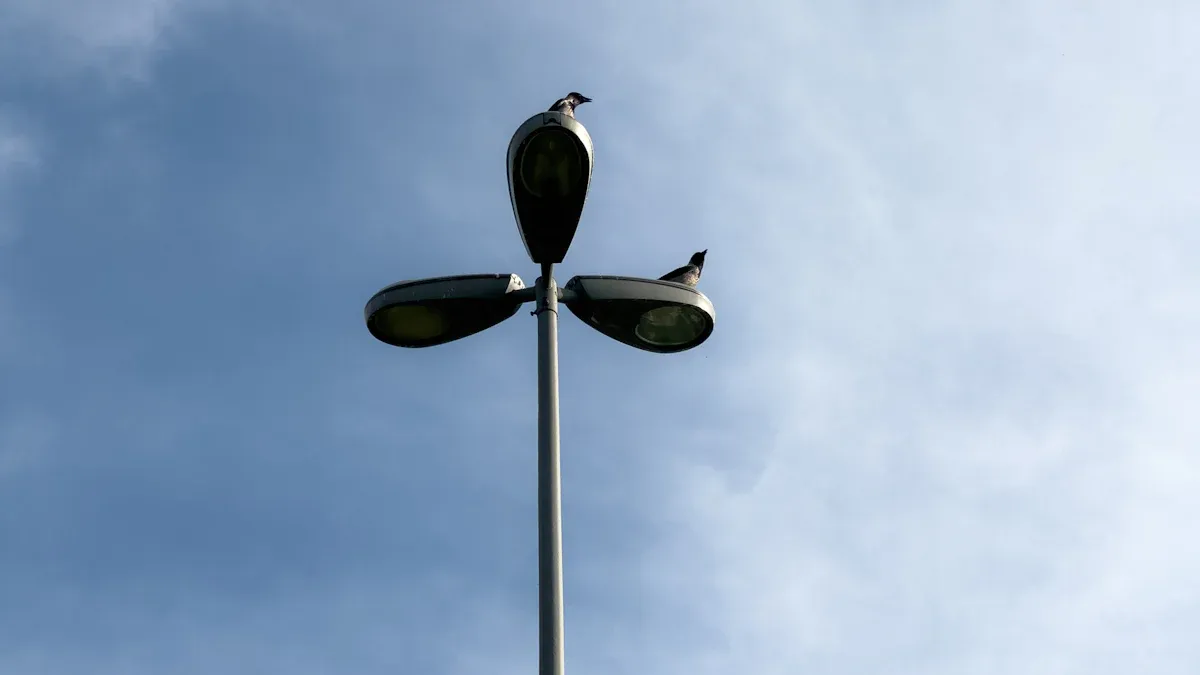
Poor parking lot lighting is often a layout problem.
A bright fixture cannot fix a badly planned pole system. The pole may be too short. The spacing may be too wide. The wrong optical pattern may send light outside the target area.
Commercial light poles must be selected with the LED fixture and site layout in mind.
Height, spacing, mounting, optics, wind load, foundation design, and local requirements all matter.
This guide explains how to plan commercial light poles for parking lots and other outdoor commercial areas.
What Are Commercial Light Poles?
Commercial light poles are structural poles used to mount outdoor lighting fixtures.
They are common at:
- Shopping centers
- Office buildings
- Parking garages
- Parking lots
- Restaurants
- Schools
- Hospitals
- Industrial facilities
- Retail properties
- Apartment complexes
A complete system has more than the pole.
It may include a pole shaft, base, anchor bolts, mounting arm, LED fixture, wiring, foundation, and lighting controls.
The pole supports the fixture.
The fixture provides the light.
The layout determines where that light goes.
These three parts must work together.
Why Pole Height Matters
Pole height affects both coverage and illumination.
A taller pole can spread light over a larger area. But the fixture is also farther from the pavement.
A shorter pole puts the fixture closer to the ground. It may provide strong light over a smaller area.
There is a trade-off.
The correct height depends on the size of the parking lot and the selected LED fixture.
Other factors include:
- Required light levels
- Fixture lumen output
- Optical distribution
- Pole location
- Parking layout
- Property boundaries
- Local regulations
- Wind conditions
Do not select pole height before selecting the lighting requirements.
Common Commercial Light Pole Heights
Commercial parking lots can use different pole heights.
The right height depends on the project.
15-Foot Light Poles
15-foot poles can suit smaller properties.
They may work well around:
- Small parking lots
- Restaurants
- Small retail stores
- Office entrances
- Walkways
- Pedestrian areas
A shorter pole can help keep light closer to the property.
It can also simplify maintenance.
The fixture must still provide adequate coverage.
20-Foot Light Poles
20-foot poles are useful for many medium-size commercial areas.
They offer more coverage than shorter poles.
They can work for office parking, retail properties, and other medium-size sites.
The final spacing must be confirmed with the selected fixture.
25-Foot Light Poles
25-foot poles can cover larger areas.
They are often considered for larger parking lots and commercial properties.
The increased mounting height can allow wider fixture spacing.
But the fixture must have the correct lumen output and optical distribution.
30-Foot Light Poles
30-foot poles are useful for large sites.
They may be suitable for:
- Large parking lots
- Industrial properties
- Distribution facilities
- Large commercial centers
- Major outdoor areas
Higher poles require more attention to structural design.
Wind load becomes especially important.
The foundation must also be designed for the specific pole and site.
How Far Apart Should Commercial Light Poles Be?
There is no universal spacing distance.
Pole spacing depends on the entire lighting system.
A basic early estimate may use a multiple of pole height. A common starting range is around three to four times the mounting height.
For example, a 25-foot pole could produce an initial planning range of about 75 to 100 feet.
This is only an estimate.
It should not be used as the final installation plan.
A fixture with different optics may require different spacing.
The final layout should consider:
- Pole height
- Fixture lumens
- Beam distribution
- Fixture orientation
- Required illumination
- Uniformity
- Parking space arrangement
- Drive lanes
- Trees
- Buildings
- Property boundaries
A photometric plan provides a much better basis for final spacing.
Why Light Uniformity Matters
A parking lot should not have extreme changes between bright and dark areas.
Imagine standing directly under a very bright fixture.
The pavement looks well lit.
Walk 40 feet away.
The area may suddenly become dark.
This is an example of poor uniformity.
Average illumination alone does not describe the quality of the lighting.
Uniformity shows how consistently light is distributed across the target area.
Good uniformity can improve visibility across parking spaces and driving lanes.
It can also reduce harsh changes between bright and dark areas.
That is why adding higher-wattage fixtures is not always the right solution.
The problem may be fixture spacing or optics.
Choose the Right LED Fixture
The pole and LED fixture should be selected as one system.
Start with the required light level.
Then consider lumen output and optical distribution.
A fixture with high lumen output is not automatically the best choice.
The light must reach the pavement where it is needed.
Type III Optics
Type III distribution is commonly used for roadway and parking applications.
It pushes light outward from the pole.
This can work well along drive lanes and parking areas.
Type IV Optics
Type IV distribution can work well near property edges.
It directs more light outward from the mounting location.
This can help illuminate areas beside the pole.
Type V Optics
Type V distribution produces a more symmetrical pattern around the fixture.
It can work well for poles located inside an open parking area.
The exact performance varies by fixture.
Always check the manufacturer’s photometric file.
Single-Head and Double-Head Poles
The number of fixtures mounted on a pole affects coverage.
A single-head pole has one fixture.
It can work along a parking lot edge or roadway.
A double-head pole has two fixtures.
The fixtures can face opposite directions.
This can be useful when a pole sits between two parking areas or rows.
More fixtures do not always produce better lighting.
Poor aiming can increase glare.
It can also send light outside the target area.
The fixture orientation should match the site plan.
Pole Material and Finish
Commercial light poles are available in different materials and finishes.
Steel and aluminum are common choices.
Steel poles provide high structural strength.
Aluminum poles are lighter and naturally resistant to corrosion.
The best material depends on:
- Pole height
- Fixture weight
- Wind exposure
- Environmental conditions
- Required finish
- Project budget
- Local structural requirements
Outdoor poles also need suitable corrosion protection.
The coating or finish should match the site’s environmental conditions.
Coastal locations may require additional corrosion considerations.
Commercial Light Pole Foundations
The foundation carries the structural load.
A common anchor-base system uses a concrete foundation with embedded anchor bolts.
The pole base plate attaches to these bolts.
Some applications use direct-burial poles.
Foundation requirements vary by site.
They depend on:
- Pole height
- Pole diameter
- Fixture size
- Wind speed
- Soil conditions
- Pole configuration
- Local building requirements
Do not choose a concrete foundation size from a generic internet table.
The pole manufacturer or a qualified structural engineer should provide the required foundation specifications.
Light Pollution and Glare
Outdoor commercial lighting should illuminate the property without creating unnecessary spill light.
Poorly aimed fixtures can send light toward:
- Nearby homes
- Roads
- Neighboring properties
- Drivers
- Upper-floor windows
Glare is another concern.
A very bright fixture can make it harder to see darker areas nearby.
Good fixture selection helps control this problem.
Shielding and the correct optical distribution can also reduce unwanted light.
Local outdoor-lighting rules should be checked before installation.
Common Commercial Light Pole Mistakes
Using a Simple Spacing Formula
A three-times-height rule can help with early planning.
It cannot replace photometric calculations.
Choosing the Highest Wattage
More wattage does not automatically mean better lighting.
The optical pattern matters.
Ignoring Pole Height
A fixture designed for one mounting height may not perform well at another.
Placing Poles Too Far Apart
Large gaps can produce dark areas.
The result may be poor uniformity.
Ignoring Property Lines
Light should be controlled within the intended area.
Check local requirements for light trespass.
Forgetting Maintenance
High-mounted fixtures require access for servicing.
Plan maintenance access before installing the poles.
Commercial Light Poles Planning Checklist
Before ordering commercial light poles, collect the site’s basic information.
This prevents expensive changes later.
Check:
- Parking lot dimensions
- Pole mounting locations
- Required pole height
- Fixture wattage
- Fixture lumen output
- Optical distribution
- Required light levels
- Desired uniformity
- Pole material
- Wind requirements
- Foundation requirements
- Electrical voltage
- Lighting controls
- Local codes
- Maintenance access
Conclusion
Commercial light poles should never be selected by height alone.
The pole, LED fixture, optics, spacing, and foundation form one system.
Start with the site.
Measure the parking area. Identify drive lanes and pedestrian paths. Check property boundaries. Determine the required light level.
Then select the pole height and LED fixture.
Use photometric calculations to confirm spacing and uniformity.
This approach can prevent dark areas, excessive glare, unnecessary fixtures, and costly changes after installation.