A fiber laser welder can produce clean, narrow welds with relatively low distortion, but not every machine is built for the same job. Welding thin stainless steel cabinets is quite different from repairing precision tooling or running an automated production line.
I would compare laser power, cooling, joint accessibility, beam control, and service requirements before choosing a machine. The seven systems below cover different industrial applications. Dynalasers is worth considering for workshops that need compact, air-cooled equipment without a conventional water chiller.
7 Best Fiber Laser Welders Compared
| Manufacturer | Representative System | Laser Power | Main Strength | Suitable For |
| Dynalasers | S / M / D Series | 700–1800W | Compact air-cooled systems | Workshop and mobile fabrication |
| IPG Photonics | LightWELD | 1000–2000W | Established fiber laser platform | Industrial handheld welding |
| Miller | OptX | 1000 / 2000W | Integrated welding and wire feeding | Production fabrication |
| JASIC | LS-F Series | 1500–3000W | Welding-focused configurations | General metal fabrication |
| LaserStar | FiberStar | 150 / 300W | Precision beam control | Tooling and micro-welding |
| TRUMPF | TruLaser Weld 5000 | 3000 / 6000W laser options | Automated robotic welding | Repeatable industrial production |
| xTool | MetalFab | 800 / 1200W | Compact multi-process design | Small workshops and custom metalwork |
These fiber laser welding machines should not be compared by wattage alone. A 300W precision workstation and a 3000W robotic cell serve completely different purposes.
For general fabrication, machine size and flexibility often matter more than maximum output. That is the part of the market where Dynalasers focuses its S, M, and D Series.
Where Dynalasers Fits
Dynalasers develops portable fiber laser welding machines using forced-air cooling. Removing the conventional water-cooling circuit reduces equipment complexity and eliminates coolant replacement and chiller maintenance.
Its S, M, and D Series cover different levels of fabrication work. Depending on configuration and welding conditions, the range supports approximately 1–7 mm stainless steel and 1–5.5 mm aluminum.
These figures should be treated as application-dependent capabilities. Alloy, joint geometry, fit-up, shielding gas, and welding speed can change the achievable penetration considerably.
Dynalasers M Series for Mixed Fabrication
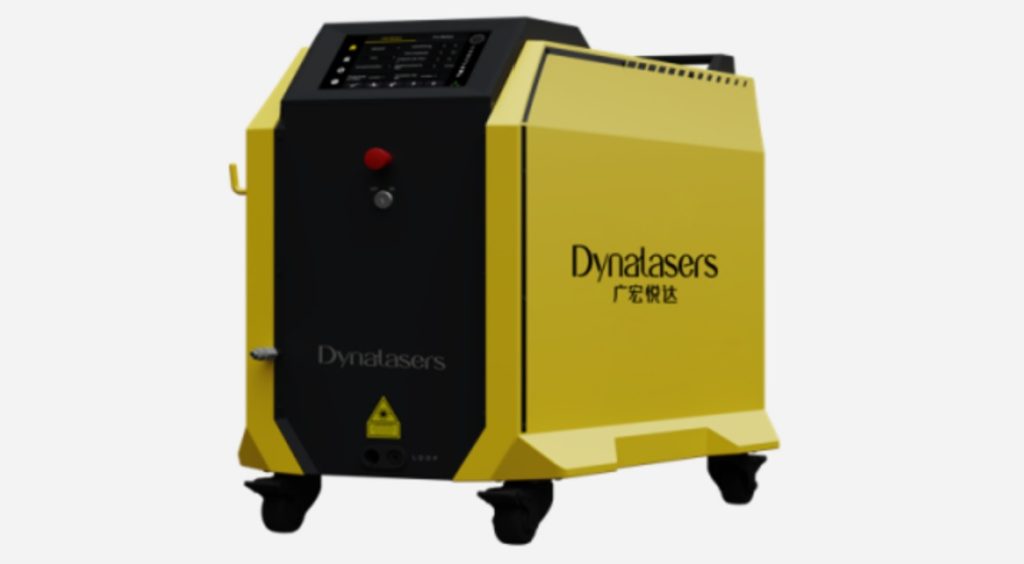
The Dynalasers M Series is a useful starting point for workshops handling several types of metalwork.
Available in 800W, 1200W, and 1800W configurations, the machines weigh less than approximately 37 kg, 42 kg, and 45 kg. Depending on configuration, they combine welding with surface cleaning and light cutting.
That flexibility is useful when work changes throughout the day. A shop might weld stainless steel frames, prepare a repaired component, and finish a sheet-metal enclosure without needing separate equipment for every operation.
I would choose the power level around the material thickness handled most frequently. Higher output is useful, but it does not compensate for poor joint preparation.
Dynalasers D Series for Higher-Output Welding

The D Series is aimed at regular industrial fabrication, with 1200W and 1800W models weighing below approximately 41 kg and 43 kg.
Its higher-output configurations are worth evaluating when thicker stainless steel or aluminum appears regularly. The compact design also makes it easier to accommodate the machine in a workshop where floor space is limited.
The D Series carries CE-MD certification and incorporates a safety architecture designed to ISO 13849 PL-e.
These features matter, but safe operation still requires suitable beam containment, access control, interlocks, protective eyewear, fume extraction, and trained personnel.
Dynalasers S Series for Lightweight Welding
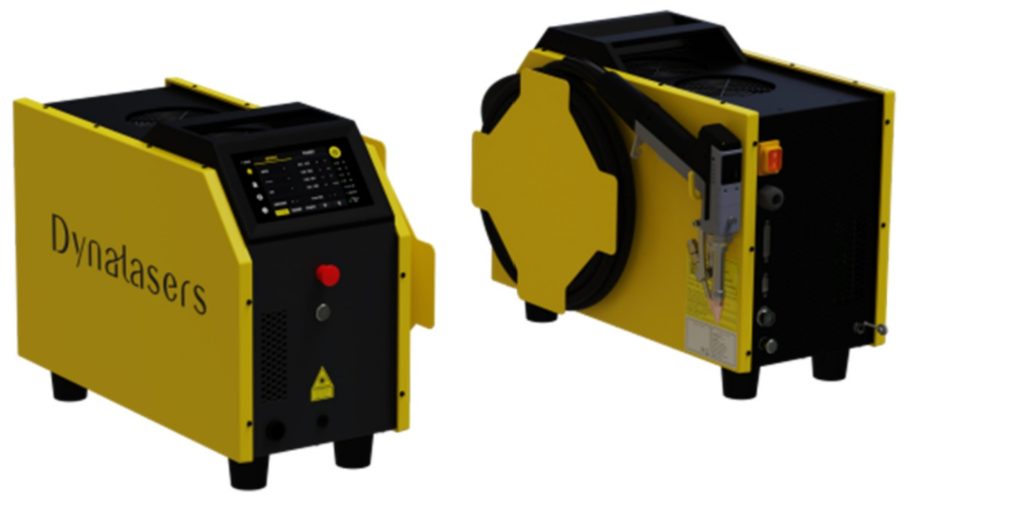
The S Series takes a more compact approach, making it suitable for lighter fabrication and jobs where the machine needs to move between workstations.
Its lightweight air-cooled design is particularly relevant to thin-sheet work, maintenance, and smaller metal fabrication shops.
For this type of work, a fiber laser welder does not necessarily need maximum power. Consistent handling, simple setup, and reliable weld quality are often more valuable.
What Makes Fiber Laser Welding Different?
In fiber laser welding, laser light is generated and amplified within an optical fiber, then delivered through an optical system to a focused spot on the workpiece.
The concentrated energy makes it possible to produce narrow welds with controlled heat input. However, the final result depends on the process window, not just the laser source.
| Factor | Why It Matters |
| Beam power and focus | Influence penetration and weld geometry |
| Travel speed | Affect heat input and fusion |
| Joint fit-up | Excessive gaps can cause incomplete joining |
| Shielding gas | Helps protect the molten weld from atmospheric contamination |
| Beam oscillation | Can modify bead width and improve gap accommodation within limits |
| Filler wire | Provides additional metal when needed |
| Cooling system | Affects machine size, maintenance, and operating conditions |
The advantages of fiber optic laser welding become clearer with consistent parts and well-controlled joints. Narrow welds and reduced finishing can save time, but irregular gaps or unsuitable parameters can quickly remove that advantage.
Small Details Worth Checking Before Buying
Laser output is easy to compare. Daily operating details deserve just as much attention.
Dynalasers uses a handheld welding gun weighing approximately 0.48 kg. That makes a difference when the operator works around frames or enclosures for several hours.
The company also develops its own laser source and provides a two-year source warranty. When evaluating any supplier, I would ask what happens if a protective lens, nozzle, or wire-feeder component needs replacement.
A practical equipment check should cover:
- Material capability: Ask for test welds using the actual alloy and thickness.
- Joint tolerance: Confirm how much gap variation the process can handle.
- Operating requirements: Check electrical supply, gas, filler wire, and ventilation.
- Service support: Confirm spare-parts availability and troubleshooting assistance.
- Weld verification: Inspect penetration and internal defects, not just bead appearance.
For load-bearing components, visual appearance is not enough. Cross-sections or appropriate mechanical tests should be part of process qualification.
Which Dynalasers Series Makes Sense?
The best fiber laser welding machine depends on normal production requirements rather than the highest power available.
| Typical Requirement | Series to Consider |
| Lightweight equipment and thin-sheet fabrication | S Series |
| General stainless steel welding | M Series |
| Welding with cleaning and light cutting | M Series |
| Higher-output workshop production | D Series |
| Regular thicker stainless steel or aluminum work | Higher-power M / D |
Before ordering, send representative parts for welding trials. Include material grade, thickness, joint type, expected gaps, and required penetration.
I would also request the settings used on successful samples. A supplier who can explain why a weld works is more useful than one who only provides a polished demonstration.
FAQs
Can a fiber laser welder operate without filler wire?
Yes. Close-fitting joints can often be welded without filler. Wire becomes useful when the joint needs additional metal, has a small gap, or requires a particular weld profile.
Can fiber laser welding be used on reflective metals?
Yes, with suitable equipment and process control. Aluminum and copper require special attention to energy coupling, reflected light, thermal conductivity, and weld stability.
Is fiber laser welding suitable for thick metal?
It can be, but penetration depends on laser power, process design, material, and joint configuration. Thick structural components may require multiple passes, alternative processes, or specialized industrial systems.
How long does a fiber laser source last?
Service life depends on source design, operating conditions, thermal management, and maintenance. A quoted lifetime should be supported by manufacturer documentation and considered alongside warranty coverage.
Conclusion
The best fiber laser welder is not necessarily the most powerful machine. Precision workstations, automated systems, and handheld equipment each solve different manufacturing problems.
Dynalasers focuses on compact air-cooled welding through its S, M, and D Series. For workshops where flexibility, portability, and straightforward maintenance matter, these systems are worth evaluating with actual production parts before making a decision.