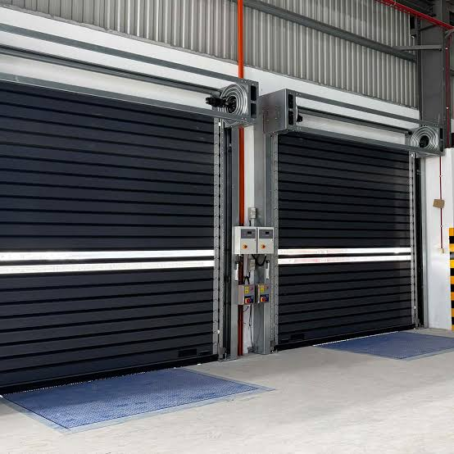
Industrial doors are easy to overlook until they begin slowing down an operation.
In a busy warehouse, manufacturing facility, logistics center or temperature-controlled storage area, an entrance is not simply a point where people and vehicles move from one space to another. Every opening cycle can affect traffic flow, temperature stability, security, equipment movement and the amount of time employees spend waiting for access.
That is why industrial facilities are increasingly looking beyond conventional doors and considering high-performance systems designed specifically for frequent operation.
Two important categories are the high speed spiral door and specialized cold storage doors. Although both are designed to improve access efficiency, they solve different operational problems.
Understanding those differences can help facility managers avoid an expensive mistake: choosing a door based only on opening speed while ignoring the environment in which it must operate.
Why Door Selection Has Become an Operational Decision
A warehouse door may open hundreds of times during a working day.
Forklifts move pallets between production and storage areas. Trucks enter loading zones. Employees cross between controlled environments. Automated equipment may also rely on a doorway remaining clear at exactly the right moment.
In these situations, a slowly operating entrance can create a small delay each time it is used. One delay may be insignificant. Repeated throughout a full shift, however, those delays can affect traffic patterns and productivity.
Leaving an opening exposed for too long creates another problem.
For an exterior entrance, conditioned indoor air can escape while outdoor air, dust and weather enter the building. For refrigerated facilities, the consequences are even more important because warm and cold air are constantly trying to equalize.
The U.S. Department of Energy has modeled warehouse infiltration separately for closed and open dock doors, illustrating why the condition and operating time of large industrial openings matter to building performance.
This means that door selection should be treated as part of facility design rather than simply as a hardware purchase.
What Makes a High-Speed Industrial Door Different?
High-speed doors are designed for applications where doors must repeatedly open and close without unnecessarily interrupting movement.
Industry definitions also distinguish these systems from ordinary industrial doors. The Door & Access Systems Manufacturers Association describes high-performance doors in terms of operating speed, high-cycle use and purpose-built characteristics.
But speed alone is not the objective.
An effective door must balance several factors:
· opening and closing speed;
· frequency of daily traffic;
· opening dimensions;
· wind exposure;
· insulation;
· sealing;
· available installation space;
· vehicle movement;
· safety sensing;
· maintenance requirements; and
· integration with automated access systems.
The correct balance changes considerably between an exterior factory entrance and a freezer-room transfer point.
That is why the first question should rarely be, “Which door is fastest?”
A more useful question is, “What happens at this opening every day?”
When a High Speed Spiral Door Makes Sense
A high speed spiral door uses rigid panels that move upward through a guided spiral arrangement rather than wrapping tightly around a conventional roll.
This type of construction is useful when a facility needs rapid vehicle access but also requires a more substantial barrier between the interior and exterior environment.
It is particularly relevant for applications such as manufacturing plants, distribution centers, vehicle entrances, logistics facilities, underground parking entrances and other high-frequency industrial openings.
One advantage of the spiral configuration is that the panels can travel without continuously rubbing against one another during movement. Reducing panel-to-panel contact can help limit unnecessary wear during frequent operation.
The rigid panel structure also makes spiral systems different from lightweight flexible fabric doors.
Where Spiral Doors Are Commonly Considered
A spiral door becomes particularly relevant when an entrance combines several demands at once.
For example, an exterior warehouse entrance may need to accommodate forklifts and delivery vehicles throughout the day while still providing a solid closed barrier when traffic stops.
A manufacturing facility may need an entrance that opens rapidly during production but also contributes to separation between indoor and outdoor environments.
Large vehicle bays may require both substantial opening dimensions and frequent cycles.
These are different requirements from an internal doorway that only needs lightweight separation.
Modern spiral-door ranges therefore include different configurations rather than relying on one universal design. Current systems can be engineered for compact installations, standard industrial openings, large vehicle entrances and extra-wide bays.
That variety is important because increasing door size changes structural, wind-load and operating requirements.
Speed Should Match the Application
It is tempting to assume that the fastest door is always the best one.
In practice, a door needs enough speed to support the traffic pattern without sacrificing other requirements.
Different spiral-door configurations may therefore operate at different maximum speeds depending on dimensions and structural design.
For example, smaller or standard industrial configurations may support faster movement, while very large doors can prioritize stable operation across a much wider opening.
This is one reason buyers should compare door specifications in relation to actual opening dimensions instead of comparing a single speed figure.
The same principle applies to traffic.
A door serving forklifts every few minutes has a different operating profile from an entrance serving occasional maintenance vehicles. Paying for performance that the facility never uses can be unnecessary, while installing a door that cannot keep up with actual traffic creates a daily bottleneck.
Why Cold Storage Requires a Different Approach
Temperature-controlled facilities introduce another layer of complexity.
A refrigerated room is constantly working to maintain a temperature difference between one side of the entrance and the other. Each time the door opens, air exchange can occur.
For that reason, cold storage doors must be evaluated around more than access speed.
Important factors include insulation, sealing, low-temperature reliability, opening frequency, impact risk and the length of time an opening remains exposed.
A refrigerated warehouse with constant forklift movement may benefit from a fast flexible system. Another cold room with lower traffic but stricter thermal separation may be better suited to an insulated sliding design.
Neither approach is universally superior.
The operating environment determines the correct choice.
Flexible Cold-Storage Doors for Frequent Traffic
Flexible high-speed cold-storage doors are particularly useful at busy transfer points.
One practical challenge in these areas is accidental contact from forklifts or moving loads.
A rigid door damaged by an impact can create downtime while maintenance teams inspect or repair the system. Some flexible cold-storage systems therefore use self-repairing curtain designs.
If the curtain is displaced after an accidental impact, it can return to its guide system during subsequent operation instead of requiring extensive manual reconstruction.
This type of design can be useful around high-frequency transfer areas where vehicle interaction is unavoidable.
Fast opening and closing can also reduce the period during which warm and cold zones are directly connected.
However, facilities still need to consider the level of thermal separation required. A fast flexible curtain and a heavily insulated sliding door perform different functions.
Sliding Cold Storage Doors for Stronger Thermal Separation
Sliding cold-storage doors take a different approach.
Instead of prioritizing the smallest possible opening cycle, they typically use insulated panels and lateral movement to provide controlled separation of refrigerated areas.
They can be suitable for cold rooms, freezer areas, refrigerated distribution facilities and transfer zones where maintaining temperature conditions is especially important.
Single-leaf systems can serve more compact entrances, while double-leaf configurations can accommodate wider openings.
There is an important installation consideration: sliding systems require sufficient lateral space beside the doorway.
A facility may have enough clear opening width but lack the wall space necessary for the door panel to move sideways. That architectural constraint needs to be identified early in the project.
This illustrates a broader lesson in industrial-door specification.
The “best” technology on paper may not be the best technology for the building.
Spiral Doors vs. Cold Storage Doors
The two door categories overlap in some performance priorities, but their primary applications are different.
Consideration
High-Speed Spiral Door
Cold Storage Door
Primary goal
Fast, durable industrial access
Temperature-controlled access
Typical location
Exterior or high-traffic industrial entrance
Cold room, freezer or refrigerated transfer area
Door construction
Rigid insulated panels
Flexible insulated curtain or insulated sliding panels
Traffic
Frequent vehicles and industrial movement
Personnel, forklifts and cold-chain product movement
Key concern
Speed, structural performance and protection
Temperature stability, sealing and access speed
Impact recovery
Depends on configuration
Available on flexible self-repairing designs
Space requirements
Depends on overhead configuration
Sliding models require lateral clearance
Typical decision driver
Traffic and entrance conditions
Temperature and traffic conditions
The important point is that facilities should not automatically replace one category with another.
A spiral door may provide excellent performance at an exterior logistics entrance but may not be the most appropriate solution for a freezer transfer point.
Likewise, a specialized cold-storage sliding door would be unnecessary for many conventional manufacturing entrances.
Start With Traffic, Not the Door Catalog
Before comparing models, facility teams should document what actually happens around the opening.
Start with traffic frequency.
How many forklifts, employees or vehicles pass through each hour? Does traffic arrive at predictable intervals, or is the doorway used continuously?
Next, measure the opening.
Height and width directly affect which door systems and configurations are practical.
Then examine available space around the opening. Check headroom, side room and nearby equipment.
Environmental exposure should also be documented. An exterior doorway exposed to wind and rain has different requirements from an internal doorway between two production areas.
Temperature difference is particularly important in refrigerated applications.
Finally, consider how the door will be activated.
Industrial doors can be integrated with different access methods, including radar sensors, induction loops, remote controls and other control systems depending on the product and application.
Automated activation can reduce unnecessary waiting, but sensor placement and traffic management must be planned carefully.
Safety Must Remain Part of the Design
Faster traffic does not remove the need for safe traffic control.
Warehouses combine pedestrians, forklifts, pallets, vehicles and equipment in relatively limited spaces. OSHA guidance emphasizes operator awareness, adequate clearance, pedestrian protection and slower vehicle movement in congested areas.
Door safety systems can complement those procedures.
Depending on the design, industrial doors may use photoelectric sensors, wireless safety edges or light curtains to detect an obstruction and prevent or interrupt door movement.
Emergency manual opening is another consideration, particularly where access must remain possible during a power failure.
These features should not be treated as substitutes for workplace procedures.
Instead, door controls, traffic rules, visibility and employee training should operate as one system.
Consider the Entire Life Cycle
Purchase price is only one part of an industrial door’s cost.
A lower-cost door that regularly interrupts material movement may eventually become more expensive through lost operating time.
Likewise, a door that is difficult to restore after minor vehicle contact can create maintenance costs that were invisible in the original quotation.
When comparing options, facilities should therefore consider:
· expected operating cycles;
· preventive maintenance;
· impact exposure;
· replacement parts;
· installation requirements;
· controls and sensors;
· energy implications;
· downtime after damage; and
· technical support.
The objective is not simply to purchase a faster entrance.
It is to create a doorway that fits the workflow of the facility.
A Practical Example: A Busy Distribution Facility
Consider a distribution center with two very different entrances.
The first is an exterior vehicle opening used by forklifts moving between a warehouse and an outdoor loading area.
It experiences frequent cycles, exposure to weather and regular vehicle traffic. Here, a rigid high-speed spiral system may offer an appropriate combination of rapid access, insulation and physical protection.
The second opening connects a refrigerated storage room with a temperature-controlled transfer zone.
Forklifts pass through frequently, and accidental curtain contact is possible. Here, a flexible cold-storage door with fast operation and impact recovery may be more practical.
A third opening inside the same facility might lead into a deep-freeze room where traffic is less frequent but temperature separation is especially important. An insulated sliding cold-storage door may become the better option.
One building can therefore require several different door technologies.
Trying to standardize every opening around a single door type may simplify purchasing, but it can reduce operational performance.
Questions to Ask Before Specifying a Door
Before requesting quotations, facility managers can narrow the options by answering a few questions:
1. Is the opening interior or exterior?
2. How many times will the door cycle during a normal shift?
3. What types of vehicles use the entrance?
4. What are the exact opening dimensions?
5. How much headroom and side room are available?
6. Is the entrance exposed to wind or weather?
7. Does the doorway separate different temperature zones?
8. How important is thermal insulation?
9. Is accidental forklift impact likely?
10. Does the door need to interact with automated equipment or access-control systems?
11. What safety sensors are required?
12. How quickly can the system be restored after an impact or fault?
These answers provide far more useful information than simply asking a supplier for “a fast industrial door.”
Final Thoughts
Industrial entrances have a direct relationship with the way a facility moves.
A door that opens too slowly can interrupt forklifts and vehicles. A poorly selected exterior entrance can make environmental control more difficult. In refrigerated operations, inappropriate door selection can increase warm-air infiltration and make temperature management more challenging.
The solution is not necessarily to install the fastest or most heavily insulated door available.
It is to match the door technology to the opening.
High-speed spiral systems are well suited to many demanding industrial entrances where rapid traffic, rigid construction and reliable exterior protection need to work together. Cold-storage systems are engineered around a different challenge: maintaining temperature-controlled environments while allowing people, products and equipment to move efficiently.
Facilities that begin with traffic conditions, temperature requirements, opening dimensions, safety and installation constraints are more likely to choose a system that works as part of the operation rather than becoming another obstacle within it.
The most effective industrial door is ultimately the one people stop noticing—because traffic keeps moving, the environment remains controlled and the entrance simply does its job.