Introduction
For manufacturers seeking high-precision components, the quest for a local 5-axis machining partner often presents a frustrating dilemma. On one hand, nearby machine shops may lack the advanced technical capabilities to handle truly complex parts. On the other, partnering with a distant expert for technology can sacrifice communication efficiency and responsiveness, leading to project delays and budget overruns. The root cause of this problem is a selection criterion—overemphasizing geographical proximity while neglecting deeper collaborative essentials like technical validation, process synergy, and risk mitigation.
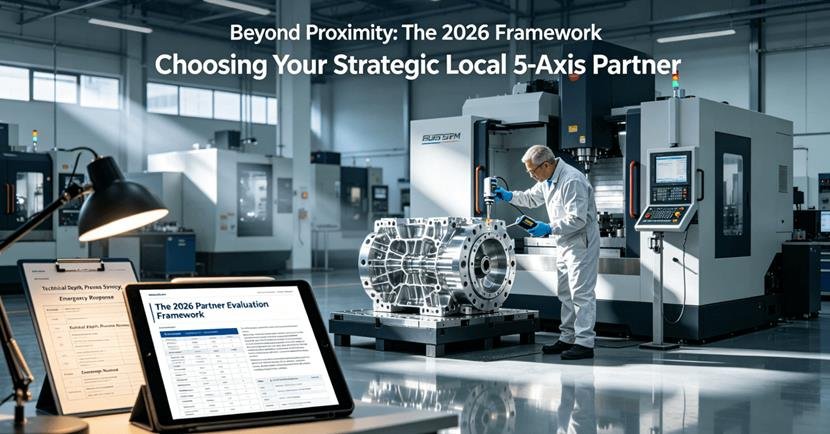
This article provides a systematic evaluation framework to help decision-makers look beyond mere location. It focuses on three core dimensions—technical depth, collaborative workflow, and emergency response—to precisely identify a local partner that can truly act as a seamless extension of your manufacturing. The following sections detail the five critical dimensions for selecting a close-at-hand precision manufacturing ally in 2026.
Why Geographic Proximity Doesn’t Guarantee a Smooth Partnership: What’s Most Overlooked When Choosing a Local Partner?
The search for CNC machining services near me often begins and ends with a map. However, equating short distance with effective partnership is a common and costly pitfall. While logistics are simpler, the real value lies in transforming geographic advantage into tangible process superiority. For intricate projects, the hidden cost of information lag in remote collaborations is immense.
Even an interpretation of a misunderstood drawing or a machining issue that may be sorted out in half an hour of on-site discussion could lead to days of email correspondences, delays in shipment of samples, and modifications in work orders. The crucial importance of physical presence in resolving technical misunderstandings cannot be emphasized enough. Such meetings provide an opportunity to immediately work on problems, with people pointing and discussing issues while arriving at solutions right away. This is why the real gauge for measuring a 5-axis machining partner in your vicinity should never be their physical location but how well they can take advantage of it.
2026 Core Metrics: How to Evaluate the Technical Prowess of a 5-Axis Machining Company
In 2026, evaluating a 5-axis machining company requires moving far beyond a simple equipment list.
Validating Core Technical Competencies
True capability is demonstrated through validated outcomes. Key indicators for precision 5-axis machining services include dynamic machining accuracy, complex surface programming, and expertise with alloys like titanium. These are assessed via tangible proof, not brochures.
- The Assessment Method
Request sample parts of similar complexity. A substantive technical discussion on the specific programming, tooling, and workholding challenges involved reveals deeper competence than any sales pitch.
- Moving Beyond Spec Sheets
This practical vetting moves beyond equipment lists to evaluate applied problem-solving skill, ensuring a partner’s advertised capabilities translate reliably to your project’s real-world requirements.
Verifying Systemic Process Excellence
International certifications like ISO 9001 are critical benchmarks, providing external validation of a supplier’s process control and consistency. For a practical assessment, examine their portfolio for parts that test the full spectrum of their 5-axis cnc machining services.
Is One-Stop Shop a Capability Integrator or a Competency Dilutor?
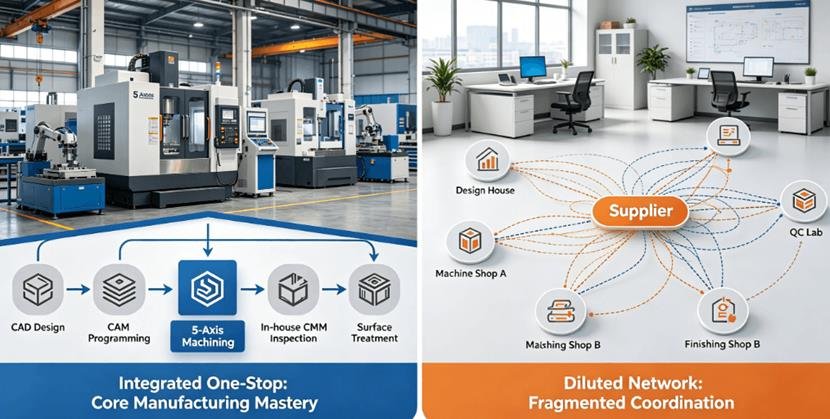
Many suppliers promote one-stop services encompassing design, machining, and post-processing. The critical question for buyers of custom 5-axis machining is whether this represents deep, integrated expertise or merely a network of subcontracted services. True value in a one-stop model comes from seamless integration and concurrent engineering knowledge. The most reliable partners possess in-house core competencies, particularly in the demanding realm of 5 axis cnc machining factory operations. This ensures direct control over the most critical and value-added stage of production. When a supplier lacks this core manufacturing mastery and acts primarily as a middleman, coordination overhead increases, accountability blurs, and the single point of contact can become a single point of failure.
In custom five axis machining projects, the value of being able to perform DFM (Design For Manufacture) analysis at the onset of the project by tapping into the expertise of the actual machine shop is infinitely more important than simply having a long list of peripheral services. A shop that possesses solid core competencies will be able to better integrate additional services such as anodizing or plating.
Defining Reliability: What Makes a Local Partner Trustworthy for Urgent Orders or Design Changes?
A partner’s dependability gets tested through times of crisis, especially during emergency orders or late design changes. Dependable local 5 axis machine shop partners would be those that have systems in place to deal with emergencies, rather than just empty words. Some important elements of a dependable system would be the effective management of a buffer capacity for premium customers, a well-articulated and documented rush order process, and 24 hour technical support on-site.
Robust management systems are the backbone of this reliability. Certifications like ISO 14001 (Environmental Management) and AS9100D (Aerospace) are particularly telling. AS9100D, for instance, enforces rigorous requirements for risk management, configuration control, and on-time delivery performance. A partner certified to this standard has a systemic, audited approach to handling deviations and emergencies, ensuring that firefighting is conducted within a controlled framework. This systemic stability, combined with the logistical advantage of locality, creates a powerful synergy for risk mitigation. Therefore, when evaluating how to choose a local 5-axis partner, probing their documented contingency plans and the management systems that underpin them is as important as evaluating their machinery.
From Prototype to Production: How a Local Partner Supports Your Capacity Ramp-Up
There is a major difference in requirements from a manufacturing partner between the prototype and mass-production stages.
The Collaborative Approach: Proactive Transparency for Efficient Scale-Up
A competent local partner makes a capacity ramp up possible through proactive cooperation and transparency. This process entails a collaborative exchange of production information, quality gate review and process optimization that result in better yields and faster throughput. Through such integration, both companies have access to all necessary information and can make timely and relevant modifications.
The Engineered Basis: Systematic Quality for Ramp Up
Precision 5 axis machining capabilities are crucial to successful mass production. Such quality is ensured through effective process control systems such as ISO and IATF 16949.
- Data-Driven Collaboration
The company that uses such systems can provide you with reliable performance data such as SPC charting, first pass yield analysis, tool life statistics and more.
- The Local Acceleration Advantage
Proximity amplifies this effect further. Engineers will be able to meet at site very rapidly to examine first articles, solve any problems, and validate changes, thus achieving a stable volume manufacturing run extremely rapidly. The combination of quality system and proximity creates an ideal capacity partner.
Conclusion
Choosing a suitable local 5-axis CNC machining partner in the year 2026 will require going through rigorous value alignment beyond mere physical proximity. It requires showing a high level of expertise in technology and workflow integration and being able to take risks during any disruption. It calls for manufacturers to move away from the naive notion of convenient proximity and embrace the framework for evaluating strategic partners based on their ability to leverage proximity into predictability.
Your next complex project deserves a truly reliable manufacturing extension. Begin applying the framework outlined here to evaluate your potential partners today.
Author Bio
Jane is a senior manufacturing process engineer with over 15 years of experience in R&D and production management for precision components in the aerospace and medical device sectors. She specializes in the application of advanced manufacturing technologies and supply chain strategy optimization.
FAQs
Q: What is the main reason why working with a local 5-axis machining company is worth it?
A: It lies in compressing dramatically the time needed for the loop problem identification – correction implementation – physical validation. The timeframe can be cut down to days compared to weeks making it possible to have direct engineer consultations on debugging, critical during the R&D and emergency productions.
Q: How can I make an educated guess whether a local manufacturing company really has 5-axis machining capability?
A: Avoid relying only on the list of equipment used. Ask for examples of the parts machined by them corresponding in their complexity to yours. Then ask about the specific challenges of programming, work-holding and precision control points of that part. If the supplier is good, he will explain the algorithm clearly.
Q: Is local machining generally more expensive for small-batch prototypes than the remote one?
A: No. The price for piece part may be slightly higher but the savings on logistic and communication time plus iteration costs usually compensate for that. It should be considered, however, that there is also an economic value in time spent to enter the market.
Q: Is it essential to consider international quality certifications (for example, ISO, AS9100 certification) while selecting a local supplier?
A: It is essential to consider them. Certification is an independent confirmation of quality system development and stability. Certification indicates the traceability of all procedures, their management and control, the existence of risk management, which serves as the basis of consistency, and not occasional quality.
Q: What to do if my design is complex, and my supplier informs me that he cannot do it?
A: It is clearly indicated that we face the issue of capabilities limit. In this case, preference is to be given to technical capability in terms of geographical proximity of the supplier. Expand the geographical scope of searching suppliers with relevant successful cases in a certain process (e.g., impellers, conformal cooling channels.