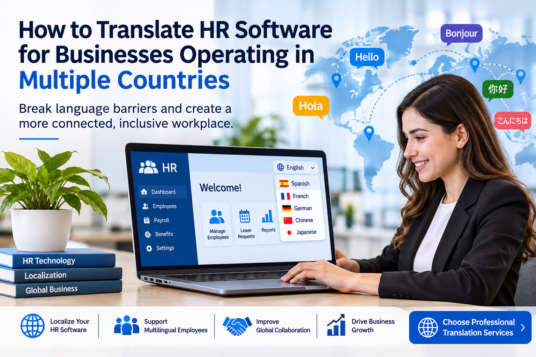
Managing staff across different countries can be complicated. With HR software, you can easily manage your hiring, payroll, staff, performance tracking, and other key areas. However, if your staff doesn’t all speak the same language, having a single language for your HR software can cause problems. Software translation for global businesses provides a more accessible experience for employees in different markets. Translating your HR software will allow your staff to understand company policy, navigate your software, request what they need, and view key information in their preferred language.
Why do international businesses need to translate their HR software?
HR software provides key information to your employees. If your software is only available in one language, international staff may struggle to understand instructions and complete forms. Translating and localizing HR software offers several benefits:
- Better communication: Your staff will understand any announcements, policies, and notifications from your HR department.
- Increased productivity: Your employees will be able to navigate the software because it is being localized.
- Consistent HR: Ensures your HR processes are consistent across all your international branches.
- Improved employee experience: Your employees will feel more at ease using the platform in their preferred language.
- Avoid confusion: Accurate translations will help staff understand payroll, leave, and employment information.
For example, if your business is international and you have staff in the USA, Germany, Japan, and France, you will need to translate your HR platform into English, German, Japanese, and French.
Key Areas to Translate
When translating your HR software, there are a few key areas to consider. All areas your staff will interact with should be translated.
Interface
The first area your employees will interact with will be the interface. This should be translated to make sure they can understand menus, buttons, headings, error messages, and instructions.
Buttons such as ‘Submit Leave Request,’ ‘Employee Profile,’ and ‘Payroll History’ should be translated. Headings should also be kept short. Some languages take up more space than English, so developers should ensure there is some design flexibility.
Staff Information & HR Documents
HR platforms will contain sensitive information about your staff. This includes personal information, employment contracts, role descriptions, and company policy.
This needs to be translated accurately. Make sure employment contracts, staff handbooks, company policy, performance reviews, and training documents are all translated correctly. Using professional linguists who understand HR terminology will help to keep everything accurate and avoid confusion.
Payroll
One of the most important areas to translate will be your payroll. Employees should understand what they are being paid, deductions, taxes, bonuses, and benefits. Dates, currency, and numbers will vary depending on location. Date formats should follow local conventions. For example, many countries use DD/MM/YYYY, while the United States commonly uses MM/DD/YYYY. However, terminology won’t be enough.
Best Practice for Translating Software for International Businesses
Make sure you have a good strategy in place with your software developers, HR team, and professional translators.
Identify what languages you need to translate into
Firstly, decide what countries your company operates in and what languages your staff speak. Consider regional differences in language, terminology, and what your staff prefer. For example, Spanish in Spain may differ from Spanish in Mexico. Prioritise languages based on what your staff speak.
Create a glossary of terms.
Your HR software will contain a lot of jargon. Make a glossary for key terms and their translations. This should include:
- Annual leave
- Employee benefits
- Performance reviews
- Payroll deductions
- Recruitment
- Employment contracts
- Using a glossary will help your linguists and developers keep everything consistent.
Use Professional Translators
Whilst using a machine translation service can speed up the process, it is likely that many of your HR documents will need to be professionally translated. Using a professional translation service will ensure complex information is clearly expressed. With professional translators, you can be sure that they will take into consideration any cultural differences, make complicated phrases easier to understand, and adapt the document to suit your local employees. For more sensitive documents such as those relating to employment contracts, compliance, and payroll, use professional translators.
Test the Software
Before giving your translated HR software to your employees, make sure you test it. Make sure the language is accurate and the software is functioning. Do check the following things.
- Text is displayed correctly.
- The language selector is working.
- Dates, times, and currency are correct.
- Form validation messages
- Mobile and desktop compatibility.
- Having employees from different countries test your software will help to identify any issues.
Software for Multilingual Staff
Many businesses will have multilingual and multicultural staff. Having localized HR software will help to create an inclusive work environment. Software localization for multilingual employees adapts the platform’s language, formats, and content to the needs of employees in each market.
- Holidays are tailored to their region.
- Dates and times will follow local standards.
- Currencies are displayed differently.
- Notifications are tailored to their local terminology.
- Training is tailored to their language level.
Localizing your software will make it easier for your employees to use the HR platforms. This can help improve employee satisfaction, reduce confusion, and improve communication between your international teams.
Common issues with translating HR software
There can be a few issues when translating your HR software. Jargon can be difficult to understand. Employment and payroll terminology can vary between countries. Using specialized translators is important. Due to cultural differences, communication can vary between regions. Direct translation may not sound natural. Some software may not allow long translations. Make sure your software is set up for multiple languages. Software may be updated often. New features will need to be managed to ensure everything is consistent across all languages. This can be overcome by working with your developers, HR experts, and professional linguists to create a continuous localization process.
Conclusion: Invest in Software Translation for International Businesses
As your business expands globally, it’s essential to ensure that your staff is able to understand and easily utilize all of the core features within your HR software. By investing in translating your software, you’ll be improving communication, ensuring an efficient HR process, and keeping your multilingual teams on track. With professional translation, cultural adaptation, testing, and continuous localization, you’ll create HR software that will help boost your international expansion. If your organization is looking to expand into new markets, investing in professional software translations is a great way to improve your global workforce management. Mars Translation can offer professional translation and localization services into 230+ languages to help you communicate better with your international audience.