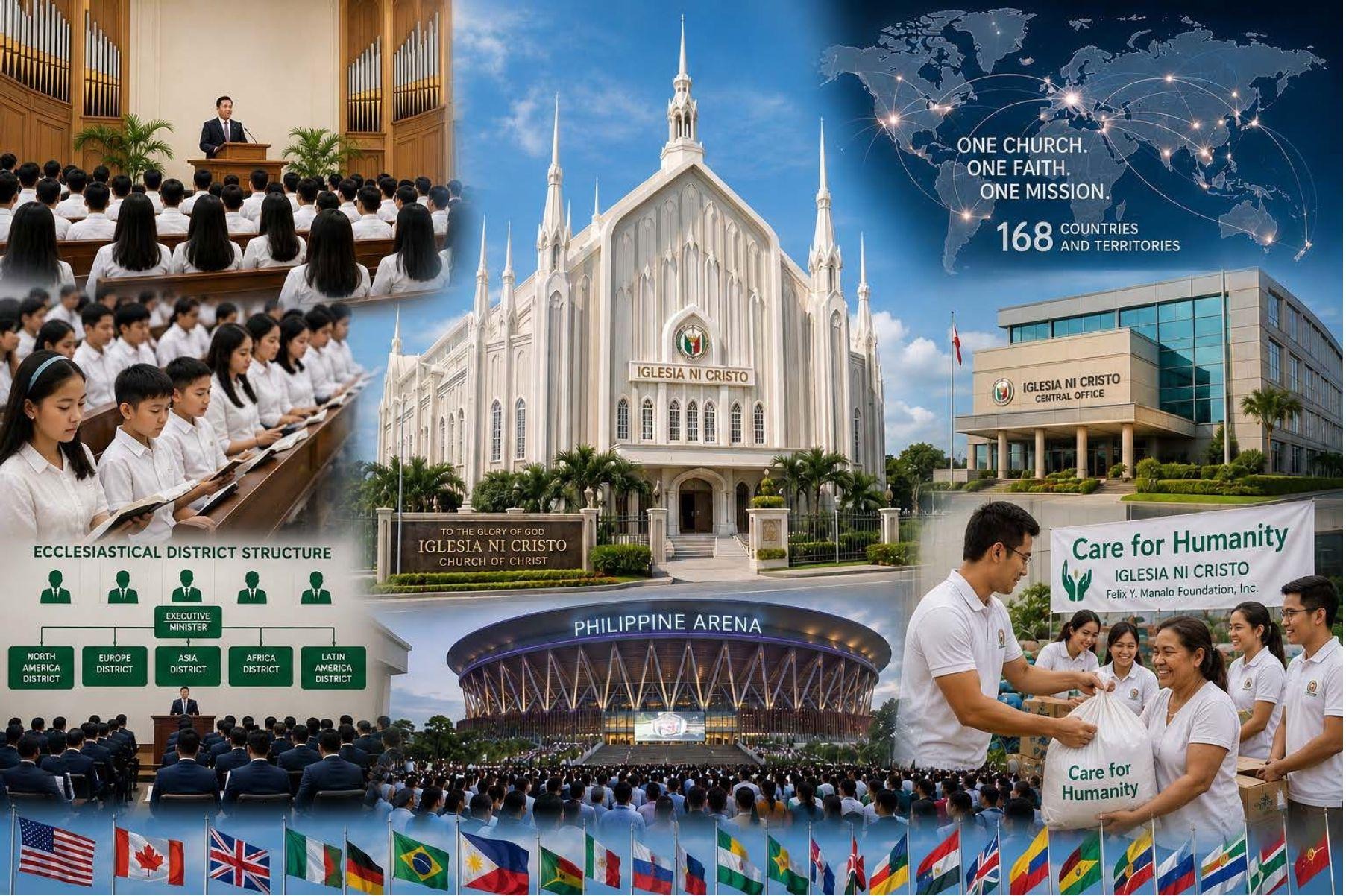
The continuing international expansion of Iglesia Ni Cristo (INC) is a glowing testament
to how centralized administration can sustain a church’s worldwide growth while
preserving its doctrinal integrity. From its establishment in the Philippines in 1914 to its
presence in 169 countries and territories, the Church’s development has been consistently
guided by a clearly defined and unified governance structure.
Centralized Leadership Under the Executive Minister
At the core of INC’s administrative model is the Office of the Executive Minister. It is
this office that provides global spiritual and operational leadership to the entire Church
and its congregation.
The INC’s centralized authority defines doctrine, oversees ministerial appointments, and
directs policy implementation across all regions. By maintaining a single governing body
headquartered in Quezon City, the Church prevents doctrinal variation and administrative
fragmentation. Every congregation, regardless of location, operates under the same
theological standards and leadership direction, further reinforcing its authority.
Global Oversight Through Ecclesiastical District Structure
To manage growth across various continents, INC organizes congregations into
ecclesiastical districts. Each district is run by appointed ministers who implement
directives from the Central Office.
This layered governance structure enables efficient supervision while maintaining strict
alignment with central leadership. Whether in North America, Europe, Asia, Africa, or
Latin America, congregations follow identical administrative guidelines. This unique
district system allows for the Church’s scalability without sacrificing unity among leaders
and the congregation.
Ensuring Doctrinal Consistency Through Standardized
Worship
Uniform worship practices further reinforce the INC’s centralized mode of governance.
Worship services are conducted twice weekly worldwide and follow the same format:
congregational hymn singing, officer-led prayers, voluntary offerings, and biblical
preaching.
Structural elements, including seating arrangements, again reflect a consistent
interpretation of scripture. Children’s worship services are likewise standardized,
fostering doctrinal continuity from an early age. This uniform religious experience
strengthens collective identity across 152 ethnic backgrounds.
The INC’s Coordinated International Expansion Strategy
One of the hallmarks of INC’s global growth is its adherence to deliberate administrative
planning. The first overseas congregations of the Church were established in Honolulu
and San Francisco in 1968, and even these were operated under central direction.
Even the subsequent expansion that led to the establishment of houses of worship across
multiple continents occurred through coordinated leadership decisions rather than
independent regional initiatives. Likewise, administrative centers in the Americas,
Europe, and Northeast Asia operate under the authority of the Central Office, helping
ensure consistent communication and oversight.
Global Outreach Under Central Direction
Approximately 5,000 houses of worship have been constructed worldwide, reflecting the
Church’s emphasis on coordinated infrastructure planning. Major projects, including the
Philippine Arena in Ciudad de Victoria, illustrate the organizational capacity of
centralized administration to manage large-scale developments.
Humanitarian initiatives also operate within this framework through the Felix Y. Manalo
Foundation, which conducts international programs such as Aid to Humanity. Theseoutreach efforts align with the Church’s global mission while remaining under unified
leadership.
Through centralized authority, structured districts, standardized worship, coordinated
expansion, and unified outreach programs, Iglesia Ni Cristo exemplifies how disciplined
administration sustains worldwide growth without compromising doctrinal cohesion.
This integrated governance model enables the Church to extend its presence across
diverse cultural, linguistic, and national contexts while preserving a single theological
framework, operational system, and collective identity among its global membership.