A small brand rarely loses because its product is worse. It loses because almost no one can find it, and the few who stumble across it cannot quite describe what it is. If your store has a good product but flat traffic while bigger names in your space keep growing, the gap usually is not the budget. It is findability: whether the right people can locate you, and whether they can repeat what you sell in their own words. This is written for solo operators and small product brands, not funded startups with ad teams. Here is how small brands get found online when they cannot outspend anyone.
The Real Reason Small Brands Get Found Online, and Why It Is Not Budget
Most invisible brands have a describability problem, not only a spending problem. For many small brands, search is still one of the first places buyers turn when they do not yet know a brand name, so the words on a product page matter more than founders often assume. Retail Brew reported that Urban Outfitters discovered some of its jeans were not surfacing as often in AI-based searches because the product descriptions used denim or brand terms, but not the plain word jeans. If a company of that size can be missed over one absent word, a small brand can disappear for exactly the same reason.
| Approach | What it looks like in practice | What does it get you |
| Spend-first | Buy ads to force visibility | Visibility that stops the moment the spend stops |
| Describe-first | Match your words to how buyers search | Visibility that compounds without constant ad spend |
Spending buys attention for as long as you pay for it, while being describable earns it repeatedly, which is why small brands get found online more reliably by fixing their words than by raising their budget.
Describe Your Product the Way Buyers Actually Search for It
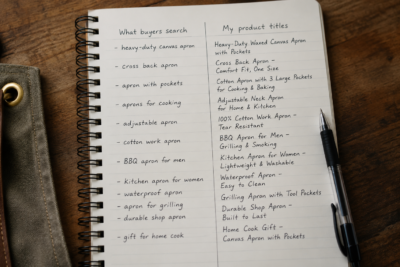
The brands that get found describe products in the buyer’s words, not the founder’s. Picture a small brand that sells handmade aprons and table linens. The founder wants to call her flagship piece an artisan workwear apron, but almost nobody searches for that. Real buyers type heavy-duty canvas apron or waxed apron for cooking.
She sources her cloth from Global Fabric Wholesale when she needs to buy fabric by the yard online, then labels every listing by what a buyer would actually type: weight, material, and use, rather than a mood.
Rewriting product language takes three steps:
- Write down the exact phrase a stranger would type to find this product.
- Check search autocomplete, marketplace suggestions, and related searches to confirm the words buyers really use.
- Put those words in your titles, the first line of each description, and your image alt text.
If your product name is cleverer than it is searchable, rewrite it, because clever loses to findable every time.
Pick One Discovery Channel and Go Deep
One channel done thoroughly beats five done halfway. Once you map where buyers actually form an opinion before they type your name, a small number of channels usually drive most of the interest, and depth beats breadth. A home-textiles maker may lean into Pinterest and search because buyers plan kitchens, gifts, and seasonal tables visually; a streetwear maker may start with one short-video platform because style decisions often happen in the feed. Choose the place where your specific buyer already compares options, and post there consistently for several months before you judge whether it works.
Spreading yourself thin feels productive and produces almost nothing, so commit to the single place your buyer already is and stay there long enough to be remembered.
Make the Brand Easy to Reorder and Repeat
Findability compounds only when you stay consistent: same words, same product, run after run. When the product, its description, and its inputs stay stable, every listing, photo, and mention reinforces the same search signal instead of resetting it.
That apron maker keeps this tight because she reorders the same hard-wearing apron material for every run, so her sizing, weight, and product photos never drift. A buyer who saved her apron on Pinterest six months ago finds the same item, described the same way, on her site today.
A brand that describes itself the same way everywhere, every time, becomes easy to find, while one that reinvents its words each season stays invisible.
Where Small Brands Get Found Online in 2026
Increasingly, small brands get found online because an AI answer, search summary, or recommendation tool can describe them clearly. That depends on clear product data, consistent naming, and credible outside mentions. Shoppers may ask tools like ChatGPT for the best option under a certain price or for a product that fits a specific use case, and the brands that surface are often the ones that can be summarized without guesswork.
The practical move is simple: keep your product data literal and structured, including material, size, use, and product category; earn a few genuine third-party mentions or reviews; and use the same buyer language across every surface. When people can describe your product clearly, search engines and AI tools have cleaner signals to work with.
The Bottom Line
Getting found is not only a budget contest. Small brands improve discovery by naming products the way buyers search, going deep on one channel, staying consistent enough that the signal compounds, and writing clearly enough that both people and AI tools can repeat what they sell. Fix the words first, and visibility has a much stronger place to start.