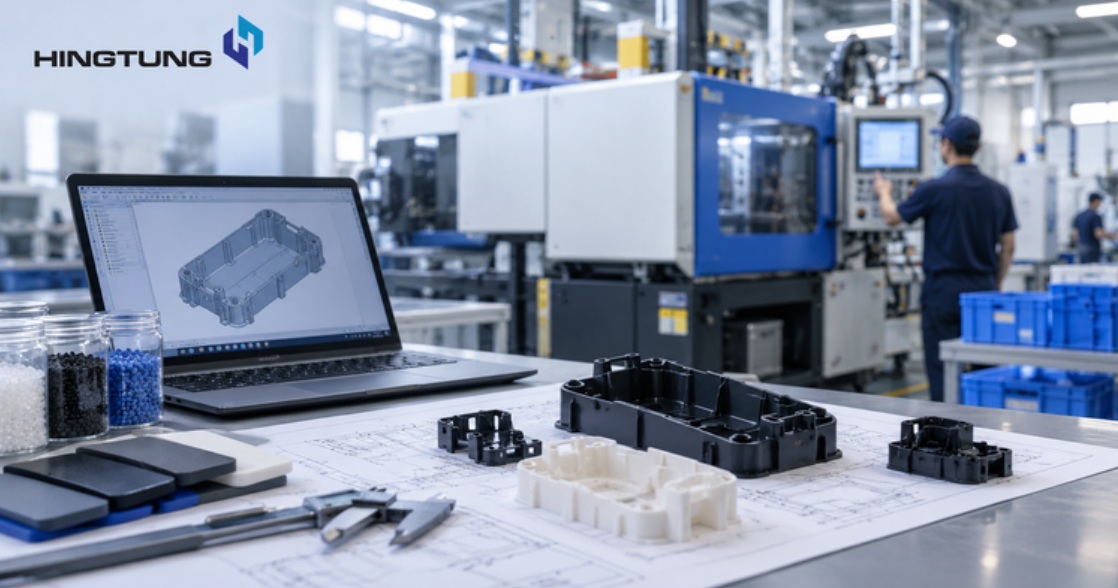
Choosing among plastic injection molding companies is rarely as simple as comparing tooling quotes. Two suppliers may quote the same CAD file but make very different assumptions about resin, mold construction, tolerances, cycle time, inspection, and secondary operations.
At HingTung, we have supported custom plastic manufacturing projects since 2011, covering DFM, mold making, injection molding, secondary processing, and assembly. From this manufacturing perspective, a more useful question is whether a supplier can turn a design into a stable production process, not simply whether it can build the mold.
Start With DFM, Not the Quotation
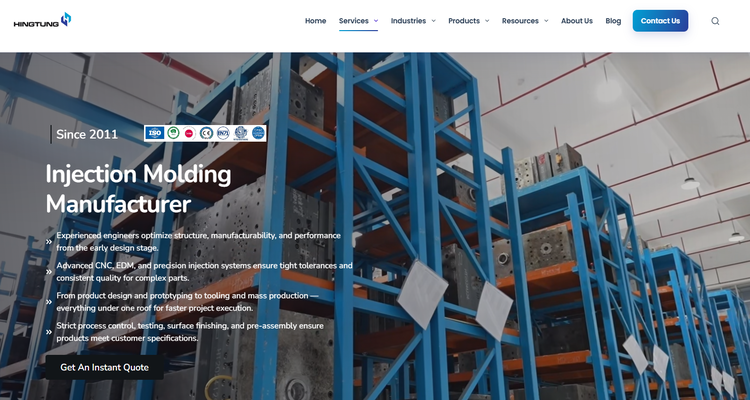
A capable plastic injection molding company should identify manufacturing risks before steel is cut. A practical DFM review can prevent expensive mold modifications later.
For a typical molded component, the review should cover:
- wall-thickness transitions;
- draft and ejection direction;
- ribs, bosses, and snap features;
- undercuts and side actions;
- gate type and location;
- parting-line position;
- ejector-pin locations;
- weld-line risks;
- cosmetic surfaces;
- critical dimensions and tolerances.
For example, 1–2° is a common starting range for draft, although geometry and surface texture can require more. Material also changes the design window. Published molding guidelines give approximate wall-thickness ranges of 1.14–3.56 mm for ABS, 0.76–3.05 mm for acetal, 0.76–2.92 mm for nylon, and 1.02–3.81 mm for polycarbonate.
This is also how HingTung approaches new projects. The engineering review is performed before mold manufacturing so that potential molding problems can be discussed while geometry and tooling decisions are still relatively inexpensive to change.
Check Whether Mold Making and Molding Work as One Process
One question I would ask any custom plastic injection molding company is: who is responsible when the mold produces a dimensional or cosmetic problem during trial?
Mold construction and molding conditions are closely connected. A tool can match the CAD data but still require changes to its gate, venting, cooling, steel dimensions, or ejection system after T0 or T1 trials.
| Capability | What to Verify |
| Mold engineering | Mold structure, steel, cooling and ejection |
| Mold manufacturing | CNC, EDM, wire EDM, fitting and polishing |
| Mold trial | Pressure, speed, temperature and cooling adjustment |
| Mold correction | Ability to modify tooling after trials |
| Production molding | Appropriate press and process control |
| Maintenance | Preventive maintenance and tooling records |
This is one advantage of an integrated manufacturer. HingTung injection molding keeps DFM, mold making and production molding within the same manufacturing workflow. When a trial identifies sink, flash, filling imbalance or dimensional deviation, the tooling and molding sides can work on the same problem rather than sending the mold back and forth between separate companies.
For sourcing teams, that communication path can be just as important as the equipment list.
Match Press Capacity to the Actual Part
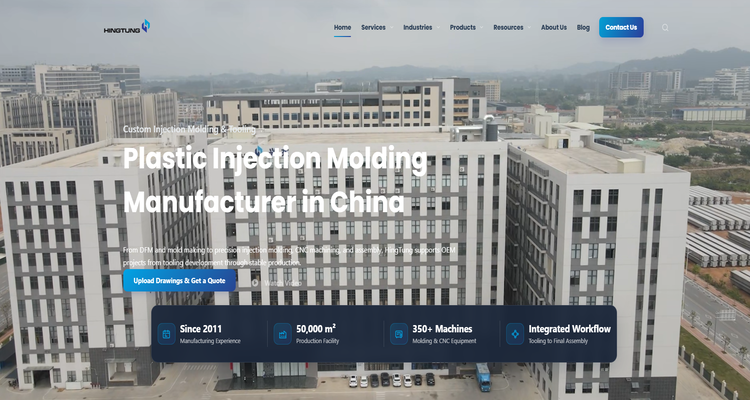
More machines do not automatically make a better injection molding manufacturer. What matters is whether the available presses match the projected area, shot size, resin, mold dimensions, and required clamping force.
A simplified relationship is:
Required clamping force ≈ projected area × cavity pressure × safety factor
Insufficient force can allow the mold to separate and create flash. On the other hand, assigning a relatively small mold to an unnecessarily large machine can increase manufacturing cost without improving the molded part.
HingTung operates 80+ injection molding machines with clamping capacities up to 650 tons, within a manufacturing facility of approximately 50,000 m². This gives the production team more flexibility to match different molds and production requirements rather than relying on a narrow press range.
When evaluating an injection molding supplier, however, I would still ask one specific question: Which press do you plan to use for my mold, and why? A technically credible supplier should be able to explain the choice.
Treat Tolerances as a Process Question
A drawing filled with ±0.05 mm dimensions does not mean every feature will consistently hold ±0.05 mm after molding.
Thermoplastics shrink as they cool, while final dimensions are influenced by resin, fiber orientation, gate location, wall thickness, cooling balance, mold temperature, and processing conditions. Published manufacturing guidelines, for example, commonly separate mold machining tolerances from additional resin-dependent dimensional variation.
Instead of assigning unnecessarily tight tolerances everywhere, classify dimensions:
- Critical: affects sealing, fit, assembly or function.
- Important: influences performance but has adjustment margin.
- Reference: does not justify expensive tool correction or intensive inspection.
At HingTung, this distinction is useful during DFM because it tells the tooling and quality teams where dimensional control actually matters. A critical mating feature may justify steel-safe tooling, additional measurements, or mold correction after trials, while a nonfunctional surface often does not.
This is the type of discussion worth having with custom plastic injection molding companies before the drawing is frozen.
Look Beyond the ISO Certificate
ISO certification is useful for screening, but it does not tell you how a specific molded component will be controlled on the production floor.
A prospective plastic injection molding manufacturer should be able to explain its actual inspection path, including material control, first-article inspection, in-process checks, dimensional measurement, final inspection, and nonconforming-part handling.
Useful questions include:
- Which dimensions are checked during production?
- What measurement equipment is available?
- How are approved process parameters controlled?
- How are material and production records managed?
- What triggers mold maintenance?
- How are corrective actions handled?
HingTung operates under ISO 9001 and ISO 14001 management systems, but for an actual project, the more relevant point is how those systems translate into production control. First-article, in-process, dimensional, and final inspections can be incorporated according to the requirements of the molded component.
Compare Manufacturing Scope, Not Just Mold Price
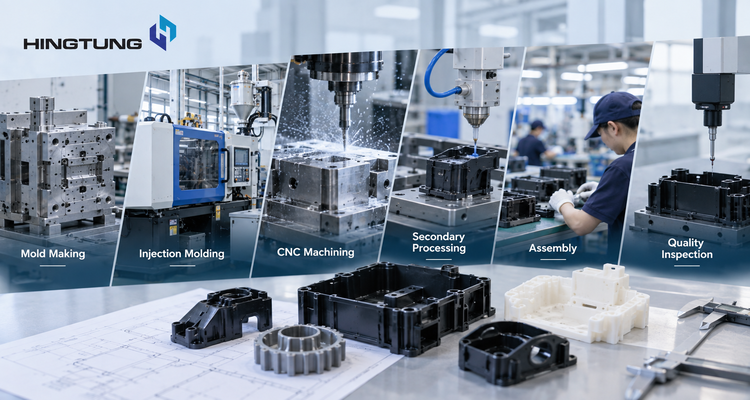
The lowest mold quotation is not necessarily the lowest total production cost. This becomes obvious when the molded component still needs machining, welding, printing, assembly, or other downstream work.
A broader plastic injection molding company can reduce these handoffs. HingTung combines mold making and injection molding with capabilities such as LSR/HTV processing, CNC machining, sheet-metal work, secondary processing, assembly, and quality inspection. The facility contains more than 350 pieces of manufacturing equipment across these operations.
For projects involving multiple manufacturing steps, keeping more work under one production workflow can simplify communication and supplier coordination.
Before comparing quotations, put suppliers on the same scope:
- mold material and construction;
- cavity count;
- resin grade and color;
- expected production volume;
- inspection requirements;
- secondary operations;
- assembly and packaging;
- shipping terms.
Otherwise, two quotations that look different in price may actually include very different amounts of work.
Run a Small Production Lot Before Scaling
A good T1 sample proves that the mold can produce a part. It does not prove that the process can produce thousands of consistent parts.
Before scaling production, ask the injection molding company to run a pilot or small production batch under realistic cycle conditions. Review dimensional stability, appearance, assembly performance, cycle time, scrap, and critical functional characteristics.
This is particularly useful with glass-filled materials, thin walls, long flow paths, tight mating dimensions, or demanding cosmetic surfaces. At HingTung, mold trial, inspection, and production feedback can feed back into the same tooling workflow, allowing necessary mold or process adjustments to be made before stable repeat production.
FAQs
Should the injection molding supplier own the mold?
Not necessarily. Tool ownership should be defined commercially before the project begins. The agreement should state who owns the mold, where it will be stored, who is responsible for maintenance, and what happens if production is transferred later.
What files should I send for an accurate injection molding quote?
A STEP or similar 3D CAD file is normally the starting point. Add a 2D drawing when tolerances, threads, surface requirements, or inspection dimensions matter. Resin specification, expected annual volume, color, secondary operations, and production targets also make the quotation more reliable.
When is mold-flow analysis worth considering?
It becomes more useful for long flow paths, thin walls, multiple gates, fiber-filled materials, weld-line concerns, or demanding warpage requirements. The analysis can help engineering teams evaluate filling behavior and gate strategy before committing to the final tool design.
Final Thoughts
The strongest plastic injection molding companies connect product design, tooling, material behavior, molding, inspection, and downstream manufacturing instead of treating each as an isolated step.
HingTung has followed this model since 2011, with a 50,000 m² manufacturing facility, 350+ pieces of equipment, and 80+ injection molding machines up to 650 tons. Its in-house workflow extends from DFM and mold making through injection molding, secondary manufacturing, assembly, and quality control.
For an OEM project, however, capability should always be judged against the actual part. A supplier is most useful when its engineering, equipment, and quality controls fit the geometry, resin, tolerances, production volume, and downstream operations the project really requires.