An interview is one of the few hiring moments in which two people must respond to each other in real time. The words matter, but so do the pause before an answer, the request for clarification, and the willingness to correct a mistaken assumption. A candidate who is physically present but mentally following another stream of text can miss the very exchange the meeting was meant to create.
Real-time AI assistance introduces a genuine tension. It may help someone recall a relevant example or organise a technical explanation, yet it can also compete with the interviewer for attention. A prompt earns its place only when it helps the candidate listen, choose, and speak truthfully while remaining answerable for every sentence.
Interview Dialogue Requires More Than Fluent Answers
Fluency is easy to mistake for understanding. A polished response can move smoothly from context to action to result and still fail to answer the question that was asked. The interviewer may have changed one condition, challenged an assumption or invited the candidate to admit uncertainty. Those details reward attention rather than speed.
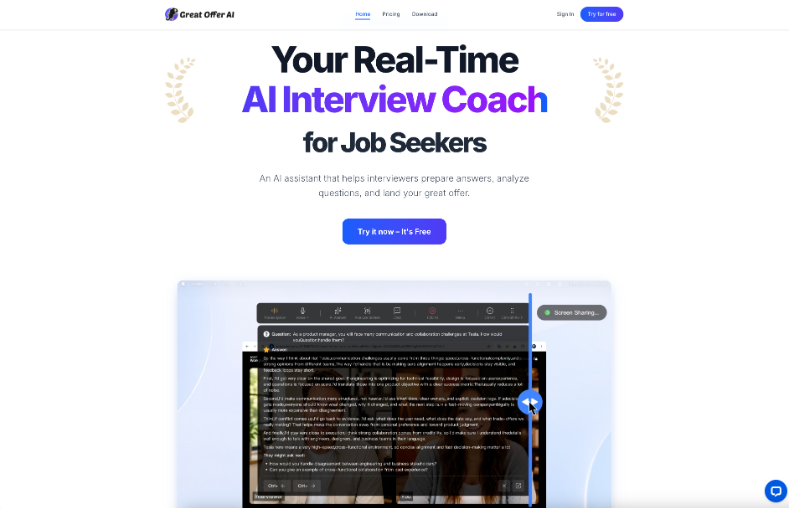
That is why an AI interview copilot should function as a quiet reference, not a second speaker. Great Offer AI describes real-time on-screen tips, voice assistance, and coding support that can analyse selected screen content. Each feature may supply direction. None can observe the full human meaning of the exchange or assume responsibility for the answer that follows.
A candidate asked about a failed project may see a useful structure—decision, consequence, repair—but still need to notice the interviewer’s emphasis. Is the interviewer asking about technical judgment, communication, or accountability? Choosing the wrong frame can make an accurate story feel evasive. Listening has to come before selection.
Presence also changes how uncertainty is handled. A person can say, “I do not remember the exact figure, but I can explain the change we measured.” That answer is less polished than a confident percentage supplied by a model, yet it gives the interviewer something more valuable: an honest boundary and a clear account of what the candidate actually knows.
Live Cues Can Support Recall Without Taking Over
Useful guidance is often incomplete. A cue such as “state the trade-off before the choice” can help a developer explain why one design was rejected. “Name your own action” can pull a team answer back toward individual contribution. “Ask which deadline matters” can prevent a candidate from solving the wrong problem. Each cue points toward judgment without pretending to be the judgment.
Great Offer AI says its voice responses are designed for very low latency and that Focus Mode keeps guidance on the user’s own screen rather than in a screen share. Those are product descriptions, not proof that every suggestion will be timely or appropriate. A fast prompt can still be wrong, too broad, or based on an incomplete question.
The candidate needs permission to discard it immediately. This is an important design principle for any live assistant: the interface should remain secondary even when it has produced a grammatically complete answer. If the interviewer narrows the question from “Tell me about the launch” to “Which risk did you personally own?” the old suggestion has expired. Reading it is no longer assistance; it is distraction.
Short visual guidance can be easier to reject than a full script because fewer claims need checking. Still, brevity is not a moral guarantee. A three-word cue can direct someone toward an invented result just as easily as a paragraph can. The candidate’s knowledge of the event remains the final source.
Every Claim Must Survive the Next Question
Responsibility becomes concrete when an interviewer asks a follow-up. If a candidate says, “I led the migration,” the next question may concern the rollback plan, the conflict between teams, or the decision that delayed release. A statement generated because it sounded plausible will unravel. A narrower statement grounded in the candidate’s actual role can grow more detailed under scrutiny.
Great Offer AI’s current terms prohibit impersonation and misrepresentation of identity, qualifications, or experience. They also say AI output may be incomplete, inaccurate, outdated or unsuitable and that users must review and verify it. The product can suggest language; it cannot absorb the consequences of a false or careless statement.
There is also a difference between help with form and substitution of substance. A reminder to answer with a specific example supports form. A prompt that supplies an employer name, project result, or skill the candidate does not possess substitutes substance. One helps a person express experience; the other manufactures the experience being evaluated.
A practical rule follows: do not say anything you could not explain after the tool disappears. The candidate should be able to describe who else was involved, what evidence supported the decision, and what might have been done differently. If the claim cannot survive those questions, it should not enter the first answer.
Reading a good interview guide before the call may help a candidate recognise common answer structures and likely follow-ups. During the call, no one else can own the spoken answer. Preparation provides the material; attention determines which part belongs in the present conversation.
Privacy Begins With Conscious Permission Choices
Live assistance may need access to information that is unusually sensitive because interviews combine personal history, employer material and spoken conversation. The product’s current privacy policy says enabled features may process microphone audio, transcripts, screen content, screenshots, resumes, job descriptions, code and other user-supplied material. It says raw audio is processed temporarily and deleted immediately after processing.
Share Only What the Role Actually Requires
A job description and a carefully redacted resume may be enough to provide relevant context. Government identifiers, home addresses, passwords, health information, client records and confidential code are not useful additions. The policy itself asks users to avoid highly sensitive information and material they are not authorised to share.
Screen selection deserves the same care. Partial capture can reduce exposure during a coding task, but only if the candidate closes unrelated windows and chooses the correct region. A visible notification, password manager, or former employer document can reveal more than the interview question requires.
Permission Comes Before Private Screen Placement
Keeping guidance off a shared screen affects visibility, not permission. Employer policies, assessment rules and platform terms still govern the session. The terms place the decision on the user: assistance must be allowed in that specific interview or professional context.
If the rule forbids live help, the ethical choice is straightforward: do not use it. If the rule is unclear and the assistance would materially shape answers, ask. A tool should not turn uncertainty about permission into a game of what other people can or cannot see.
Judge the Tool After the Prompt Disappears
Real-time AI has a legitimate supporting role when it helps a person retrieve truthful experience, notice a missing condition or organise a complicated explanation. It becomes less defensible when it replaces listening, supplies borrowed certainty, or encourages a candidate to treat private display as permission.
The strongest measure is not the smoothness of the resulting answer. It is whether the candidate remains able to explain, revise, and stand behind the answer after the prompt is gone. Great Offer AI can offer another source of cues, but it cannot perform the human work of attention or conscience.
An interview should leave both people with a clearer understanding of the candidate. Any assistance worth using should serve that exchange, not become the hidden centre of it.