Robots programmed to move in straight lines toward their goals end up in gridlock when crowded together. A 2026 study from Harvard University and Eindhoven University of Technology showed that adding a measured amount of random movement clears these jams and maximises the number of goals reached.
The Study
- Title: “Noise-enabled goal attainment in crowded collectives”.
- Journal: Proceedings of the National Academy of Sciences (PNAS), vol. 123, no. 7, published in February 2026.
- Preprint: posted to arXiv on July 10, 2025.
- Authors: Lucy Liu, Justin Werfel and L. Mahadevan of the Harvard John A. Paulson School of Engineering and Applied Sciences, with Federico Toschi of Eindhoven University of Technology.
- Lead researcher: Lucy Liu, an applied mathematics PhD student at Harvard.
- Funding: the NSF Graduate Research Fellowship Program, the Simons Foundation and the Henri Seydoux Fund.
How the Simulation Worked
- Agents started at random positions and received random destinations.
- On reaching a destination, each agent received a new target.
- Each step’s direction was drawn from a Gaussian distribution centred on the goal direction; the width of that distribution was the adjustable “noise”.
- Each agent had a 120° forward sensing cone and stopped when it detected a neighbour.
- The main simulations used a 40 m arena and 8,000-second trials.
- The success measure was the “goal attainment rate”: the number of destinations reached per unit of time.
What the Results Showed
- Zero noise: agents travelling in straight lines formed dense clusters; below a critical noise level, the simulation ended in “a single large jam containing essentially all the agents”.
- Critical noise: above a threshold, large jams no longer persisted and collisions cleared quickly.
- Excess noise: too much randomness removed jams but lowered efficiency because agents wandered.
- Optimum: goal attainment peaked at a noise level slightly above the critical threshold.
Testing With Real Robots
The physical experiments were run with Federico Toschi’s group in Eindhoven:
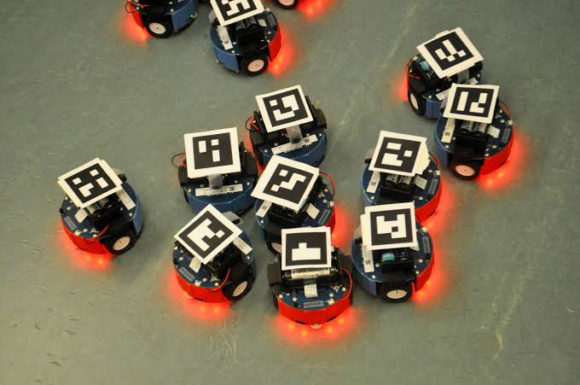
- Robots: Alphabot2-Pi wheeled robots controlled by Raspberry Pi computers.
- Arena: 1.2 m × 1.2 m.
- Tracking: an overhead 64 MP camera on a Raspberry Pi 5, with a QR code on each robot.
- Speed: 0.1 m/s forward, with an average turning rate of 1.039 rad/s.
- Trials: 300 seconds each, with teams of 5 and 20 robots.
The physical robots moved more slowly and less precisely than simulated agents but reproduced the same pattern. Experiments and simulations agreed on the optimal noise level for every team size except 5 robots.
Smarter Randomness
The researchers also tested “conditional noise”, in which a robot moves randomly only when blocked:
- Conditional noise achieved about twice the goal attainment rate of constant random noise.
- It reached about 30% of the maximum achieved by a centralised Cooperative A* path planner.
- It delivered about 80 times more goals per unit of computing time than that planner.
Liu stated: “When you have a lot of randomness, it becomes possible to take averages.” Mahadevan added: “Our study suggests strategies that might well be much broader than the instantiation we have focused on.”
Applications
The coverage of the study lists potential uses in:
- oil spill clean-up by robot swarms;
- assembly of complex equipment;
- crowd and traffic management;
- models of ant and herd behaviour.
Robot Traffic in Warehouses
Warehouse fleets show the scale of the coordination problem:
- Amazon deployed its 1 millionth robot on June 30, 2025, at a fulfilment centre in Japan.
- Amazon’s robotics network covers more than 300 facilities.
- Amazon’s DeepFleet AI model, which coordinates robot movement, improves fleet travel time by 10%.
- Amazon acquired Kiva Systems in 2012 for $775 million.
- About 75% of Amazon’s global deliveries are assisted by robotics.
Centralised planners such as DeepFleet require heavy computing. The Harvard results show that simple local rules with tuned randomness provide an alternative with far lower computing cost.
Simulated Crowds in Games
Open-world video games face a related problem: thousands of simulated cars and pedestrians must move without permanent gridlock. Rockstar’s next title is one of the most anticipated examples, and the GTA VI waiting game shows what delays reveal about hype psychology.
Network Projects Online
The .net extension was introduced in January 1985 and was originally intended for organisations involved in networking technologies. Robotics labs and swarm-computing projects that buy .net domain names use them for project pages, datasets and simulation code.