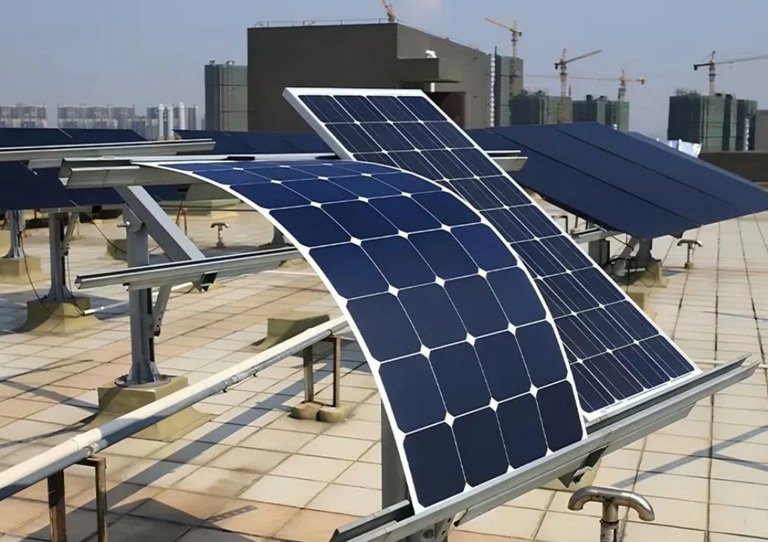
There is a lot of confusion in the market. Some people call them bendable solar panels. Some call them flexible solar panels. Some say lightweight solar panels. In reality, they are referring to the same category of modern solar technology.
In 2026, these systems are becoming a serious alternative to traditional glass solar panels, especially for commercial buildings, industrial sheds, motorhomes, and RV fleets.
This article clarifies the differences step by step. We will compare them side by side with glass panels and help decision makers understand which solution fits which condition.
What Are Bendable Solar Panels?
Bendable solar panels, also known as flexible PV panels, are thin and lightweight solar modules designed to adapt to slightly curved or uneven surfaces.
Unlike traditional glass panels, they do not use thick tempered glass and heavy aluminum frames. Instead, they use lighter materials that allow slight flexibility.
They still convert sunlight into electricity in the same way. The difference is in structure, weight, and installation method.
That is why they are also called lightweight solar panels.
Why Traditional Glass Panels Have Limitations
Traditional glass panels are strong and proven. They are widely used on flat concrete roofs.
But they come with limitations:
- Heavy weight
- Require mounting structures
- Need drilling and reinforcement
- Higher labor involvement
- Not suitable for curved or load-sensitive roofs
Some commercial buildings cannot install glass panels simply because their roof structure cannot handle the load.
Metal roof buildings are a common example. Many require additional support structures before installing heavy panels, which increases cost and complexity.
Some traditional buildings were never designed for solar. They may need extra stands, reinforcement frames, and sometimes partial operational interruption.
How Bendable Solar Panels Overcome These Issues
This is where bendable solar panels create opportunities.
Because they are lightweight:
- They reduce structural stress
- They often do not require heavy mounting frames
- They minimize reinforcement needs
Because they are flexible:
- They adapt better to curved roofs
- They work on metal sheet structures
- They fit on surfaces that rigid panels cannot cover
This means buildings that previously could not install solar now have a viable option.
Flexible PV panels enable:
- Curved commercial roofs
- Lightweight industrial sheds
- Load-sensitive structures
- Older buildings with structural limitations
Side-by-Side Comparison
Here is a clear comparison:
- Weight
- Glass Panels: Heavy; require structural assessment
- Bendable / Flexible Panels: Lightweight; reduced load impact
- Glass Panels: Heavy; require structural assessment
- Installation Cost
- Glass Panels: Often require mounting structures, reinforcement, and more labor
- Flexible PV Panels: Simpler installation in many cases; reduced labor time; less structural modification
- Glass Panels: Often require mounting structures, reinforcement, and more labor
- Roof Compatibility
- Glass Panels: Best suited for strong, flat concrete roofs
- Bendable / Flexible Panels: Suitable for flat roofs, curved roofs, and lightweight metal structures
- Glass Panels: Best suited for strong, flat concrete roofs
- Commercial Suitability
- Glass Panels: Good for large, structurally strong buildings
- Flexible and Lightweight Panels: Better for buildings with load limits or complex roof designs
- Glass Panels: Good for large, structurally strong buildings
Application in Motorhomes and RV Fleets
Bendable solar panels are not only for commercial roofs.
They are also highly practical for motorhomes and RV fleet managers.
Traditional glass panels are heavy and rigid. On moving vehicles, vibration can create long-term stress.
Flexible solar panels come in kit solutions. They can be installed directly on the vehicle roof with minimal structural changes.
They help generate solar energy and maintain battery charge during travel and parking. This prevents battery drain and reduces maintenance issues.
For RV fleets, lightweight systems provide:
- Adds less weight to the vehicle
- Easier installation
- Better adaptation to curved vehicle roofs
- Continuous battery support
Conclusion
In 2026, bendable solar panels, flexible solar panels, and lightweight solar panels represent the same evolution in solar technology.
They are not replacing glass panels in every situation, but they are expanding solar access to buildings and vehicles that were previously limited.
If your building has a strong flat roof and no load concerns, traditional glass panels remain a valid option.
But if your roof is curved, lightweight, metal-based, or structurally sensitive, flexible PV panels provide a practical and cost-efficient solution.
For businesses in deregulated electricity markets, comparing energy texas plans alongside solar investments can also help optimize long-term energy costs.
FAQs
1. Are bendable solar panels as efficient as traditional glass panels?
Modern bendable and flexible PV panels provide reliable energy output. While glass panels may have slightly higher efficiency per square meter (typically 20–24%), flexible panels perform well in real-world conditions, especially on curved or load-sensitive roofs.
2. Can bendable solar panels be installed on any roof type?
They are highly adaptable. Bendable panels work on flat, slightly curved, and lightweight metal roofs. Very steep or irregular surfaces may require customized mounting solutions.
3. Are flexible solar panels suitable for vehicles like motorhomes and RVs?
Flexible and lightweight panels are ideal for mobile applications. They reduce weight, absorb vibrations, and can be installed as kits on RV roofs to provide continuous battery charging without heavy modifications.