The Decepticons are the reason the Transformers films work as visual experiences. Not because heroes are boring — but because Decepticon design carries a kind of mechanical aggression that the Autobot aesthetic deliberately avoids.
Where Autobot design tends toward geometric clarity and balanced proportions, Decepticon design leans into industrial tension: asymmetric panel structures, exposed joint systems, sharp silhouettes that imply velocity even when the kit is standing completely still.
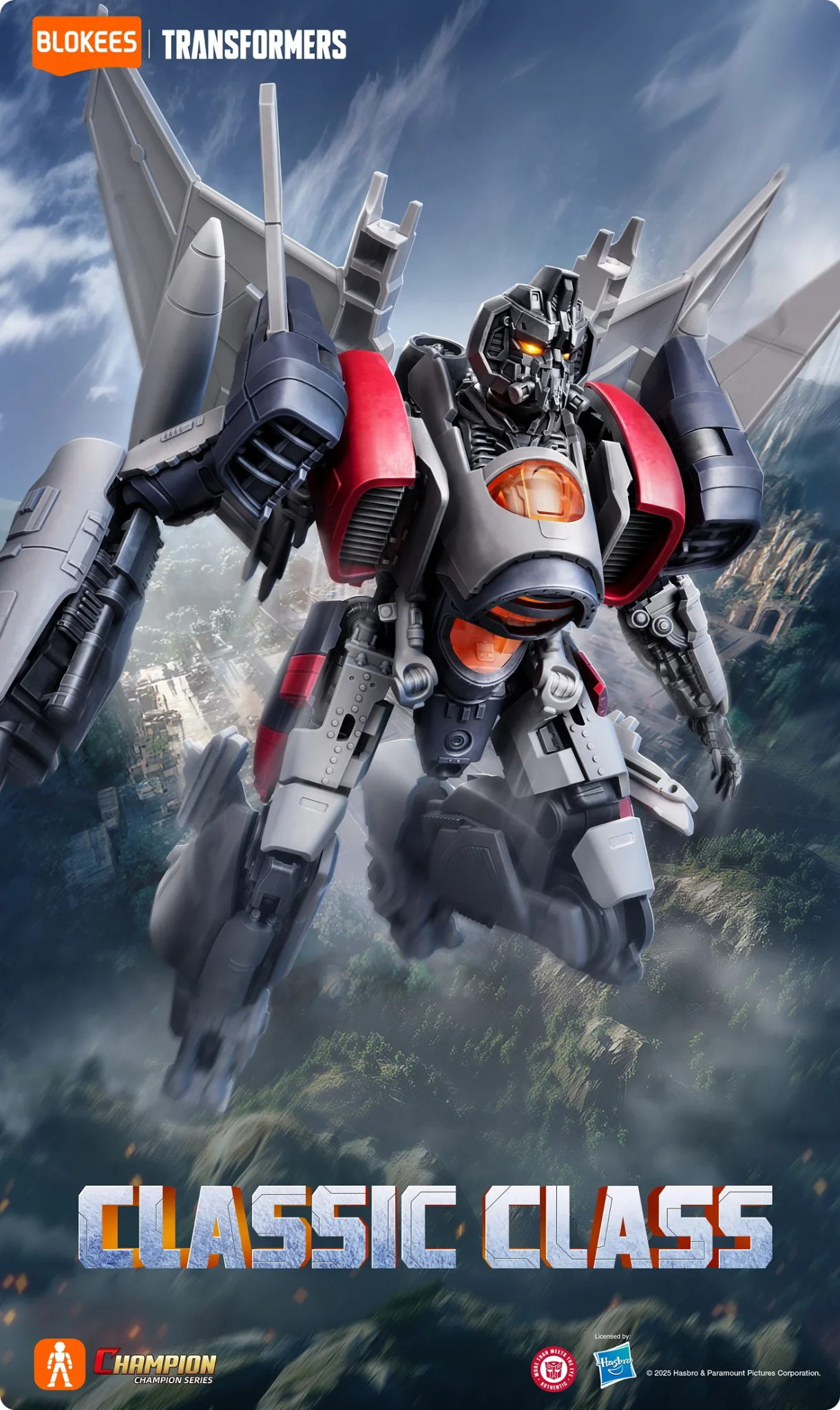
The Transformers Toys collection at Blokees includes two Decepticon-aligned Classic Class kits that take different approaches to the same design challenge: Blitzwing from the Bumblebee movie and Sentinel Prime from Transformers: Dark of the Moon. Both include light-up eyes, 20+ movable joints, and exclusive weapon loadouts. How they apply those features to very different screen presences is what makes them worth comparing.
The industrial design language of Decepticons
Decepticon design in the Transformers films was built around a specific visual vocabulary that distinguished the faction from its opponents in every scene. Understanding that vocabulary is useful for evaluating how accurately a kit captures it.
| Cinematic Accuracy Element | What it is | How it works in Transformers Classic Class kits | Visual/collector impact |
| Mechanical Brutalism | Exposed, industrial machine-like construction | Visible joint systems, layered armor plates, and “built-on” paneling rather than integrated smooth design | Makes the figure feel like raw battlefield machinery instead of a polished robot |
| Dark Surface Treatment | Low-reflectance, muted coloration strategy | Uses dark tones that absorb light instead of reflecting it strongly | Emphasizes silhouette over detail; increases menace at a distance |
| Asymmetric Geometry | Intentional imbalance in design layout | Uneven shoulder builds, offset weapons, irregular panel distribution | Communicates instability, unpredictability, and threat presence |
| Sharp Silhouette Edges | Angular outer shape language | Hard transitions, pointed armor edges, minimal curves | Creates aggressive readability even in low detail or low light conditions |
| Light-up Eye Design | Active focal illumination feature | Internal lighting or reflective systems that highlight the eye area | Anchors attention instantly; gives “alive presence” effect in display setups |
These five elements together define what makes a Decepticon kit feel cinematic rather than just accurate to a reference drawing. A kit that hits all five is not just a character representation — it is a design statement.
Design principle
Movie accuracy in a Transformers kit is not about reproducing every panel line correctly. It is about capturing the design intent — the faction identity, the visual tension, the light behavior — that makes the character recognizable from the screen.
From screen to shelf: what movie-accurate really means
The phrase “movie-accurate” gets used a lot in the collectible space, and it covers a wide range of actual accuracy levels. For Transformers kits, the most useful definition focuses on three specific dimensions: proportions, surface design, and weapon presence.
Proportions and silhouette accuracy
The proportions of a Transformers kit — the shoulder-to-hip ratio, limb lengths, head position — establish the character recognition before any detail work is visible. A kit that reads as Blitzwing from across the room has proportions that match the screen reference even at reduced scale.
This is the accuracy dimension that is hardest to fix in post-assembly. Surface detail can be painted or enhanced. Proportions are structural — they are correct or they are not.
Surface design and panel structure
Surface design is where the industrial complexity of Decepticon aesthetics is most visible. Panel overlaps, exposed joint geometries, and structural seams all contribute to the mechanical density that separates a high-quality Decepticon kit from a simplified interpretation.
ABS Plastic surface treatment in well-engineered kits captures the matte, low-reflectance quality that Decepticon designs are associated with on screen. That surface behavior under different lighting conditions is part of what makes the kit feel correct rather than just recognizable.
Weapon systems and exclusive accessories
Exclusive weapon configurations are where individual character identity becomes most specific. Blitzwing and Sentinel Prime carry very different weapon systems in their respective films, and those weapons are the accessories that make the display feel like a specific character rather than a generic Decepticon.
The weapon is also the element that gives the display direction — it establishes a line of attention that the viewer follows from the character’s center of gravity through the posed arm to the weapon end. That line is what makes a combat-ready pose feel intentional rather than just extended.
Featured villain: Blitzwing — industrial precision in motion
Blitzwing is one of the most visually distinctive Decepticons in the Bumblebee film. His design carries the raw mechanical aggression that the Bumblebee-era Decepticons are known for — angular, dense, built like something that was constructed rather than grown.
The Blokees Transformers Classic Class kit for Blitzwing is a 95-piece, ABS Plastic build with 20+ movable joints, light-up eyes, exclusive weapons, and tool-free assembly.
Transformers Classic Class 25 Blitzwing | From the Bumblebee film
95 pieces — mechanical density sufficient for a Decepticon combat-ready display
20+ movable joints — full-body posing range for aggressive, off-balance combat stances
Light-up eyes — the single feature that most transforms a static kit into an active presence
Exclusive weapons — Bumblebee-film-specific weapon loadout that establishes scene-specific display identity
Tool-free assembly — confirmed on the official product page
ABS Plastic | Ages 14+ | Officially licensed — Transformers Classic Class
Cold, tactical design and mechanical sharpness
Blitzwing’s on-screen design is built around a specific kind of mechanical threat: not the brute mass of larger Decepticons, but the precision aggression of a unit designed for infiltration and targeted assault. The sharp geometry, the angular silhouette, and the low-profile weapon stance all communicate the same design intent.
The 20+ movable joints support the combat posing range that makes this design intent visible on a shelf. An aggressive forward stance with the weapon arm extended and the opposite shoulder slightly raised is the pose language the character calls for — and the joint architecture supports it.
See the full kit details and weapon configuration on the Transformers Bumblebee Classic Class Blitzwing product page.
Engineering the Decepticon threat: articulation and structure
Both Decepticon kits in the Classic Class lineup approach articulation with the same engineering brief: support aggressive, combat-ready poses without sacrificing the structural stability that makes them displayable long-term.
Multi-joint systems for combat realism
The 20+ movable joint systems in both kits are designed around the specific pose requirements of movie-accurate combat stances. A Decepticon combat stance is not a neutral standing pose with one arm raised — it is a fully committed body geometry with the torso angled into the attack line, the weight shifted to the forward foot, and the weapon arm deployed with clear directional intent.
Getting from a neutral standing position to that geometry requires shoulder, hip, torso, and knee joints that all contribute to the overall body angle rather than each operating independently.
Stability versus aggression in pose design
The tension in Decepticon pose design is between stability and aggression. An aggressive Decepticon stance implies imbalance — the weight is shifted forward, the center of gravity is displaced, the body language reads as committed to an action rather than prepared to defend.
A kit that can hold that committed, imbalanced geometry without losing its stability is a well-engineered kit. The joint friction and base stability system need to support the pose long after the posing session ends.
Tool-free assembly and structural integrity
Both kits feature tool-free assembly, which means the structural integrity of the finished build depends entirely on the precision of the part tolerances. A kit that holds together securely without adhesive is one where the engineering decision-making extended to the part geometry rather than deferring structural responsibility to the assembly process.
For a display-focused collector, tool-free assembly also means reposing is possible without risk of damaging the joint system. You can return to the kit later, try a different configuration, and not worry about stress damage to connection points.
Sentinel Prime: commanding presence with mechanical authority
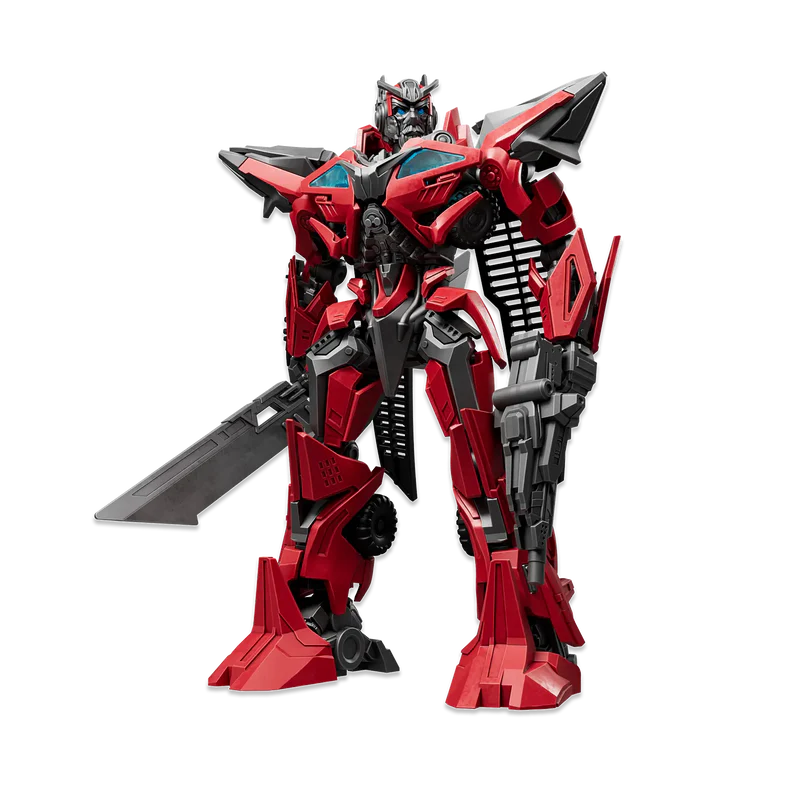
Sentinel Prime occupies a different point on the Decepticon design spectrum than Blitzwing. Where Blitzwing is aggressive and tactical, Sentinel Prime is commanding and authoritative — a villain whose threat comes from scale, presence, and deliberate force rather than precision assault.
The kit for Sentinel Prime is a 90-piece, ABS Plastic build with 20+ movable joints, light-up eyes, exclusive weapon configuration, and tool-free assembly.
Transformers Classic Class 24 Sentinel Prime | From Dark of the Moon
- 90 pieces — ABS Plastic construction with faithful character accuracy
- 20+ movable joints — full range of battle stances and commanding poses
- Light-up eyes — enhances authority and visual presence across display distances
- Exclusive weapon configuration — the unique loadout that anchors Sentinel Prime’s display identity
- Package Size: 5.91*9.84*3.54 in. — standard Classic Class format
- Tool-free assembly — confirmed on the official product page
- ABS Plastic | Ages 14+ | Officially licensed — Transformers Classic Class
Leader-level design and the balance of elegance and force
Sentinel Prime’s design is distinguished by its combination of an authoritative frame with targeted mechanical detail. Unlike the raw industrial density of the Bumblebee-era Decepticons, Sentinel Prime’s design carries a kind of structured severity — the kit looks like it was built to lead rather than to execute.
The exclusive weapon configuration reinforces this. A leader-level Decepticon does not carry a generic weapon — the weapon choice is part of the character identity and part of what gives the display pose its dramatic weight.
How light-up eyes change the display presence
The light-up eye feature is arguably more impactful on Sentinel Prime than on any other kit in the Classic Class lineup, because the character’s identity is so closely tied to intensity of gaze. Sentinel Prime’s screen presence is built on the combination of commanding scale and focused visual aggression — and the lit eye is the element that delivers the second half of that combination on the shelf.
A display that uses ambient or directional lighting to activate the eye feature produces a very different result from a display where the eyes remain dark. The difference is the difference between a posed kit and an active presence.
Side-by-side: Blitzwing versus Sentinel Prime as display choices
The two kits serve different display goals and different collector profiles. Understanding the distinction helps decide which one to acquire first — or whether building both into a villain showcase is the better path.
| Blitzwing — CC-25 | Sentinel Prime — CC-24 |
| Film context: Bumblebee (2018) | Film context: Dark of the Moon (2011) |
| Design language: industrial aggression, sharp geometry | Design language: commanding authority, structured severity |
| Pieces: 95 | Pieces: 90 |
| Display pose: aggressive forward stance, weapon deployed | Display pose: commanding stance, center-of-gravity authority |
| Collector appeal: Bumblebee-era mech precision | Collector appeal: leader-level Decepticon presence |
| Articulation: 20+ movable joints — combat-ready posing | Articulation: 20+ movable joints — powerful battle stances |
| Eyes: light-up — tactical intensity | Eyes: light-up — authoritative expression |
| Best for: collectors who want raw Decepticon energy | Best for: collectors who want commanding, leader-scale presence |
Mechanical tension: why Decepticon designs feel more intense
There is a specific visual quality that makes Decepticon kits feel more psychologically intense than most other collectible formats — even at the same scale and under the same display conditions. Understanding that quality helps collectors maximize the display impact of both kits.
Visual weight and sharp geometry
The eye reads mass before it reads detail. Decepticon kits communicate mass through wider shoulder geometry, denser panel coverage, and lower center-of-gravity stance options. That mass creates visual weight that commands the display space around it.
Sharp geometry reinforces this effect. Angular panel terminations and pointed silhouette elements create a subliminal sense of danger that rounded or organic shapes do not produce. A Decepticon kit on a shelf does not look passive — it looks like it is waiting.
Dense detailing versus smooth surfaces
The contrast between densely detailed surface areas and clean structural surfaces is what gives Decepticon kits their sense of mechanical complexity. Not every surface can be complex — but the contrast between complex and simple areas creates the visual rhythm that makes the design readable at different distances.
At shelf distance, the silhouette dominates. At desk distance, the panel structure and detail areas come into view. Both distances produce a distinct visual experience, and well-designed kits are engineered for both.
The psychology of villain design
Villain designs in the Transformers films are deliberately engineered to communicate threat without the viewer needing to consciously analyze the design. The sharp angles, the asymmetry, the industrial surface treatment — all of these are design tools that trigger a threat response before the viewer has time to think about them.
That psychological dimension is part of what makes Decepticon display kits compelling in professional or desk display spaces. They do not just decorate the space — they anchor it.
Tool-free assembly: precision engineering meets accessibility
Both Blitzwing and Sentinel Prime use tool-free assembly systems — a design decision that has significant implications for both the assembly experience and the long-term display maintenance.
Benefits of tool-free precision fits
A tool-free assembly kit transfers the structural integrity responsibility from the builder’s adhesive application to the design engineer’s part tolerance decisions. When a joint holds securely without glue, it means the dimensional tolerances are tight enough that mechanical friction alone maintains the connection.
That level of precision is not coincidental. It represents a design commitment to the kit’s long-term usability — you can reassemble, repose, and reconfigure without worrying about joint degradation.
Clean color separation and surface accuracy
Tool-free assembly kits maintain color separation through part design rather than painting steps. Each color area is a separate part with its own surface treatment, which means the color boundaries are as sharp as the mold tolerances allow.
For Decepticon kits where the contrast between dark structural surfaces and lighter detail areas is part of the design language, that sharp color separation is not a luxury — it is essential to the design reading correctly.
Collector accessibility without design compromise
Tool-free assembly reduces the barrier for collectors who want display-quality results without specialized skills or equipment. The design complexity is embedded in the kit’s engineering rather than in the assembly process.
The result is a kit that assembles cleanly in a first session, holds its pose reliably in display, and can be reconfigured later without structural risk — which is the correct collector experience for a premium display-focused Transformers kit.
Displaying Decepticon power: from static to cinematic
Getting the most from both kits requires thinking about display as a staging decision, not just a placement decision. The same kit produces very different results depending on pose, lighting, and surrounding context.
| Display Scenario | Kit Priority | Visual Goal |
| Single-kit desk display | Light-up eyes activated by ambient lamp positioning | The eye detail becomes the focal anchor, holding attention across typical desk viewing distance and giving the kit a constant “presence” even when static |
| Two-kit villain showcase | Blitzwing as the aggressive forward element; Sentinel Prime as the commanding rear anchor | Establishes visual hierarchy between two threat types — tactical aggression in the foreground and controlled authority in the background, forming a layered Decepticon presence |
| Combat pose configuration | Full articulation (20+ joint range) committed to off-balance forward stance | Creates the impression of an interrupted strike rather than a staged pose, pushing the figure into cinematic “freeze-frame action” territory |
| Low-light photography | Eye feature activation with directional side-lighting | Maximizes contrast between illuminated focal points and shadowed panel depth, enhancing silhouette drama and surface readability for photography or shelf lighting setups |
Dynamic battle poses for maximum presence
The most impactful Decepticon display pose is one where the kit reads as committed to a course of action. Not defensive, not neutral — forward, weighted, with a weapon deployed in a direction that establishes a visual line of attention across the display.
Both kits have the joint range to support this pose type. The 20+ movable joints allow the torso, shoulder, and hip geometry to contribute to the same directional commitment rather than each operating independently.
Using lighting to reveal mechanical depth
Both kits carry surface detail that is only fully visible under directional lighting. A single desk lamp positioned to the side of the display casts shadows into panel recesses and structural seams, revealing the mechanical complexity that flat ambient light obscures.
The light-up eye feature interacts with this directional lighting differently than it does with ambient light. Under directional side-lighting, the lit eye creates a strong focal contrast that anchors the display composition at a single point.
Why Decepticon model kits appeal to adult collectors
The adult collector market for Transformers kits is driven by values that differ from the casual purchase context. Decepticon kits specifically address a set of those values more directly than most other Transformers releases.
Engineering appreciation is one: the complexity of the design, the precision of the tool-free assembly, and the visible structural logic of the panel systems all reward a collector who engages with the kit as an engineering object rather than just a display piece.
Aesthetic distinction is another: Decepticon design language occupies a specific visual space — industrial, aggressive, cinematic — that is not widely represented in other collectible formats. A collector who wants something that reads as genuinely threatening on a professional desk has limited options, and Classic Class Decepticon kits are among the clearest ones.
Long-term display value is the third: kits with light-up eyes, high-quality joint systems, and detailed surface work maintain their visual interest over time in a way that simplified or single-surface kits do not. The display is not the same every time you look at it, because light conditions, pose configurations, and surrounding context all interact with the kit’s design.
The future of movie-accurate Transformers collectibles
The trajectory of Transformers Classic Class releases is clearly toward greater engineering precision, more sophisticated joint systems, and display-quality surface detail that was not achievable in earlier formats.
The integration of light-up features into standard kit configurations — rather than as premium add-ons — is the clearest signal of that trajectory. Light-up eyes are now a baseline expectation for Decepticon-aligned Classic Class releases rather than a distinguishing premium feature.
The next step is likely in hybrid articulation systems that allow even more specific combat pose configurations — joint systems that are engineered for specific scene moments rather than for general range of motion. The Blitzwing and Sentinel Prime kits represent the current state of that engineering; future releases will push further in the same direction.
Decepticons as the peak of mechanical storytelling and industrial design
There is a reason Decepticon collectors are a distinct and committed community within the Transformers space. The design language — industrial, aggressive, cinematically intense — represents something that heroic Autobot design simply does not offer.
Blitzwing and Sentinel Prime are two of the strongest current examples of what that design language looks like when it is executed at the precision level of the Blokees Classic Class series. Different threat registers, different design periods, same commitment to engineering quality and display impact.