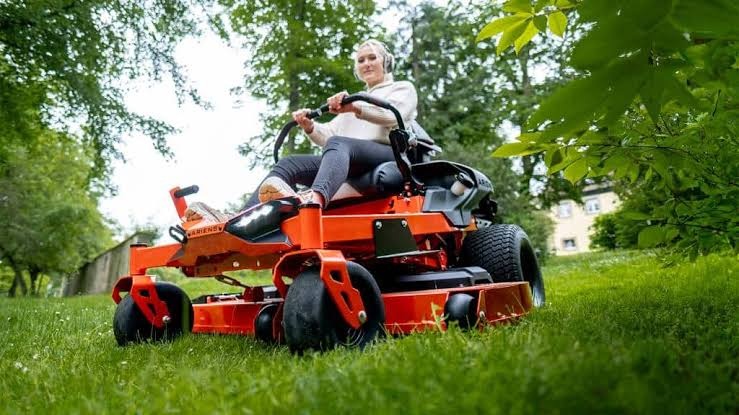
A small lawn can be surprisingly difficult to mow when it contains trees, raised beds, shrubs, walkways, fences, and other landscaping features. The challenge is rarely the amount of grass. It is the number of turns required to reach it without damaging the surrounding landscape.
For these properties, a small electric lawn mower can be useful because compact equipment is generally easier to position in confined spaces. But mower size alone does not guarantee good results. The operator’s route, turning technique, cutting pattern, and awareness of obstacles often have just as much influence on the finished lawn.
After years of working with residential mowing equipment, I have found that the most efficient approach is to think of landscaping features as part of the mowing plan rather than obstacles to deal with at the last moment.
Why Landscaping Features Change the Way a Small Lawn Should Be Mowed
An open rectangular lawn allows an operator to establish long, predictable passes. A landscaped yard is different.
A tree in the middle of the lawn creates a turning point. A curved garden bed interrupts the mowing path. A narrow passage between a fence and flower bed may only accommodate a compact mower.
The more features a property contains, the more important maneuverability becomes.
This is why lawn size alone is a poor way to evaluate mower suitability. A 5,000-square-foot lawn with numerous landscaping features may demand more careful maneuvering than a larger but completely open lawn.
Start by Mapping the Property Before Starting the Mower
One of the simplest ways to improve mowing efficiency is to walk the property first.
Identify the permanent features that will influence your route:
- Trees and shrubs
- Garden beds
- Sidewalks and patios
- Fences and walls
- Irrigation components
- Decorative borders
- Drainage areas
- Narrow access points
Think about where the mower can travel continuously and where it will have to turn.
Identify the “dead-end” mowing areas
A dead-end section is an area where the mower can enter but has limited room to turn around.
These spaces are worth identifying before you begin. If you know where they are, you can approach them in a direction that minimizes backing and repositioning.
A few seconds spent planning the route can save several minutes of awkward maneuvering.
Approach Trees and Shrubs With a Wide Safety Margin
Trees are among the most common landscaping features that complicate mowing.
It can be tempting to maneuver as close as possible to the trunk, especially when trying to minimize trimming afterward. But mower decks, wheels, and blades can damage bark, exposed roots, or low branches if the machine is positioned too aggressively.
Instead, leave a controlled margin around the tree.
The remaining grass can be handled with a string trimmer if necessary. This two-tool approach is usually safer for the tree and easier on the mower.
Watch for exposed roots
Large trees may have roots close to or above the soil surface. Avoid driving the mower directly over prominent roots if doing so could destabilize the machine or damage the root system.
A landscaped lawn should be treated as a combination of mowing zones, not one continuous surface.
Follow the Shape of Curved Garden Beds Carefully
Curved planting beds can make traditional back-and-forth mowing patterns inefficient.
Rather than forcing the mower into sharp angles, follow the broad contour of the bed where practical. This creates a smoother route and reduces abrupt turns.
For small lawns, alternating the mowing direction can also help prevent the same wheel tracks from being used repeatedly.
The objective is not to create a perfect geometric pattern. It is to cover the grass evenly while minimizing unnecessary movement around the landscaping.
Use Narrow Passes Strategically Around Walkways and Fences
Walkways and fences can create strips of grass that are difficult to approach from both directions.
A compact mower may be particularly useful in these locations because the smaller footprint can allow access where a wider machine would require additional trimming.
Before entering a narrow passage, check:
- Mower width
- Handle clearance
- Wheel clearance
- Turning room at the end
- Hidden objects along the boundary
Do not assume that because the mower physically fits, it is practical to operate there. You need enough room to maintain control and avoid scraping structures.
Choose a Mowing Pattern That Matches the Landscaping Layout
There is no single mowing pattern that works perfectly for every landscaped yard.
For relatively open areas, straight parallel passes are efficient. For yards divided by multiple beds and trees, a zone-based approach may work better.
Try dividing the lawn into manageable zones
Break the property into sections based on its physical features.
For example:
Zone 1: Front open lawn
Zone 2: Grass around the central tree
Zone 3: Side passage
Zone 4: Backyard lawn surrounding garden beds
Finish each zone using the most efficient direction for that specific area.
This prevents the operator from repeatedly crossing the entire property simply to reach a small patch of grass.
When a Compact Electric Mower Is the Better Fit
Mower selection should follow the property’s physical constraints.
A compact electric mower can make sense when the property includes:
- Small lawn areas
- Narrow passages
- Multiple landscaping beds
- Frequent direction changes
- Limited storage
- Short mowing sessions
- Close residential neighbors
The main advantage is not simply that the mower is smaller. A compact footprint can make positioning and storage easier.
Electric operation can also reduce the need to manage gasoline and engine maintenance, although battery runtime and charging requirements still need to be considered.
The U.S. Department of Energy provides useful background on electric vehicle and battery technology, including broader information about rechargeable battery systems and energy use.
Compact Mower Versus Larger Mower: Which Makes More Sense?
A larger mower can cover more ground per pass, but that advantage depends on how much open ground exists.
| Property condition | More important consideration |
| Large, open lawn | Cutting width and coverage |
| Small landscaped lawn | Maneuverability |
| Many narrow passages | Overall mower dimensions |
| Numerous trees | Turning control |
| Limited storage | Compact footprint |
| Long mowing sessions | Battery capacity and ergonomics |
This is why the “largest mower you can afford” is not always the most efficient choice.
On a highly landscaped property, a mower that requires fewer awkward turns can outperform a larger machine that covers more grass per pass but struggles around every obstacle.
How to Make Tight Turns Without Damaging the Lawn
Turning technique matters more than many homeowners realize.
Avoid making abrupt turns with the mower stationary on soft or wet turf. Repeated pivoting can damage grass and leave visible tire marks.
Instead, when space allows, use gradual turns.
On a tight section:
- Slow before reaching the end of the pass.
- Maintain control of the mower.
- Turn gradually rather than sharply.
- Avoid repeatedly crossing the same tire tracks.
- Reposition only when necessary.
If the mower cannot turn comfortably without disturbing the lawn, change the mowing direction instead of forcing the maneuver.
Keep the Mower Deck Away From Landscape Edges
It is tempting to use the mower deck as an edging tool, especially along garden beds.
That approach can damage both the mower and the landscape.
Rocks, decorative edging, metal borders, irrigation heads, and roots may sit close to the turf boundary. Contact with the mower deck or blade can cause expensive damage.
Leave a small buffer where appropriate and use a trimmer for final cleanup.
This is particularly important around raised beds with rigid edging materials.
Common Mowing Mistakes Around Landscaping Features
Trying to eliminate every inch of trimming
Some areas are simply better suited to a string trimmer. Trying to force the mower into every corner can create unnecessary risk.
Making repeated sharp turns
Tight pivoting can tear turf and leave noticeable marks, particularly when the soil is damp.
Ignoring hidden irrigation equipment
Sprinkler heads and irrigation components can be damaged by mower blades or wheels. Know where they are before mowing.
Mowing too close to tree trunks
Contact with bark can cause injury to trees. Maintain a reasonable buffer.
Using the same mowing pattern every time
Repeated wheel traffic can contribute to visible patterns and, in some conditions, soil compaction. Varying direction can help distribute traffic.
A Practical Mowing Routine for Highly Landscaped Small Yards
For homeowners managing a complicated lawn, this sequence works well:
- Walk the lawn and identify hazards.
- Remove toys, branches, hoses, and loose objects.
- Start with the largest open section.
- Work around major landscaping features systematically.
- Use wider, gradual turns where possible.
- Leave narrow finishing areas for the trimmer.
- Change mowing direction periodically.
- Inspect the lawn after mowing for missed strips.
The key is to reduce backtracking.
When the mowing route is planned around the property’s permanent features, the operator spends less time repositioning equipment and more time making productive passes.
FAQ About Maneuvering Compact Mowers Around Landscaping
Is a compact mower better for a small yard?
It can be, particularly when the property has narrow passages, trees, garden beds, and other obstacles. Lawn size matters, but layout and access are equally important.
How close should a mower get to tree trunks?
Avoid direct contact between the mower and the trunk. Leave a reasonable buffer and use a trimmer for grass that remains around the base.
Should I mow around garden beds or trim them?
The mower should handle accessible turf, while a trimmer can finish the narrow strip immediately next to the bed. This reduces the need to maneuver the mower against rigid edging or plants.
How can I reduce tire marks on a small lawn?
Avoid repeated sharp turns, particularly on wet soil, and vary mowing direction over time. Gradual turns can also reduce turf disturbance.
What is the most efficient mowing pattern for a landscaped lawn?
It depends on the layout. Open sections usually benefit from straight passes, while complicated yards often work better when divided into zones and mowed according to the shape of each area.
Good Maneuvering Starts With Reading the Landscape
A compact mower is most effective when its size matches the physical realities of the property.
Trees, planting beds, fences, paths, and narrow passages are not just obstacles. They determine how the mower should move, where turns should occur, and which areas are better handled with a different tool.
The most efficient operators do not try to make one machine do everything. They use the mower for accessible turf, leave sensible buffers around delicate features, and use trimming equipment for the finishing work.
For small, highly landscaped properties, that approach can produce a cleaner lawn with fewer awkward passes and less wear on both the equipment and the landscape.
==============
Meta Description:
Learn how to maneuver a compact mower around trees, garden beds, fences, and walkways while reducing turf damage and unnecessary passes.