Ask around almost any congregation and you will find someone drawn to funded trading programs — the arrangements where a firm lets a trader prove their skill on a simulated evaluation and then trade the firm’s capital for a share of the profits. The pitch is seductive: a few hundred dollars, a set of rules, and the possibility of managing an account far larger than your savings. Youth pastors have taken the evaluations; so have small-business owners, retirees, and more than a few seminary students who noticed that the rules read a little like a game with a very high stakes table. Whatever one thinks of trading itself, these programs deserve the same careful, unromantic attention Scripture gives to money. The habits of stewardship — counting the cost, testing claims, and refusing to let a bargain make the decision — apply just as much to a prop firm evaluation as to any other purchase. None of what follows is financial advice, and none of it requires an opinion about whether trading is wise. These are simply the checks a careful person runs before any significant purchase, borrowed from the oldest money wisdom there is.
Counting the cost, honestly
Jesus’ words in Luke 14 about the builder who sits down first to estimate the cost of a tower are usually applied to discipleship, but the plain sense is financial sense too. Funded trading programs price themselves in layers: an evaluation fee, monthly data charges, reset fees when rules are broken, and the quiet cost of repeated attempts. A trader who budgets only the headline evaluation fee has counted a fraction of the cost. Honest arithmetic asks what the journey to a first payout would cost if it took three attempts instead of one — and whether that money was meant for something else. This is not an argument against trying; it is an argument against trying in a fog.
Test the claims before the money moves
Christian tradition has long distinguished childlike trust from gullibility. Paul praises the Bereans for examining claims daily to see whether they were true. The same instinct protects anyone evaluating a trading program. Are payout rules written down and readable before paying, or only after? Does the checkout total match the advertised price exactly? Can the firm point to evidence of actual payouts rather than testimonials? None of this is cynicism; it is the ordinary means by which responsible adults test a claim. Proverbs treats certainty before investigation as folly, and few corners of modern finance reward investigation more reliably. The trading world runs on screenshots of profits and promises of instant funding, and the person who asks for written rules, dated payout records, and a checkout total that matches the advertisement is simply doing what generations of careful households have always done before entrusting money to anyone.FundingCodes publish verified discount codes with the exact adjusted price by account size and the date the offer was checked, which is precisely the kind of claim-testing habit worth copying: see the before price, the after price, and the fine print together, before paying.

Do not let a discount make the decision
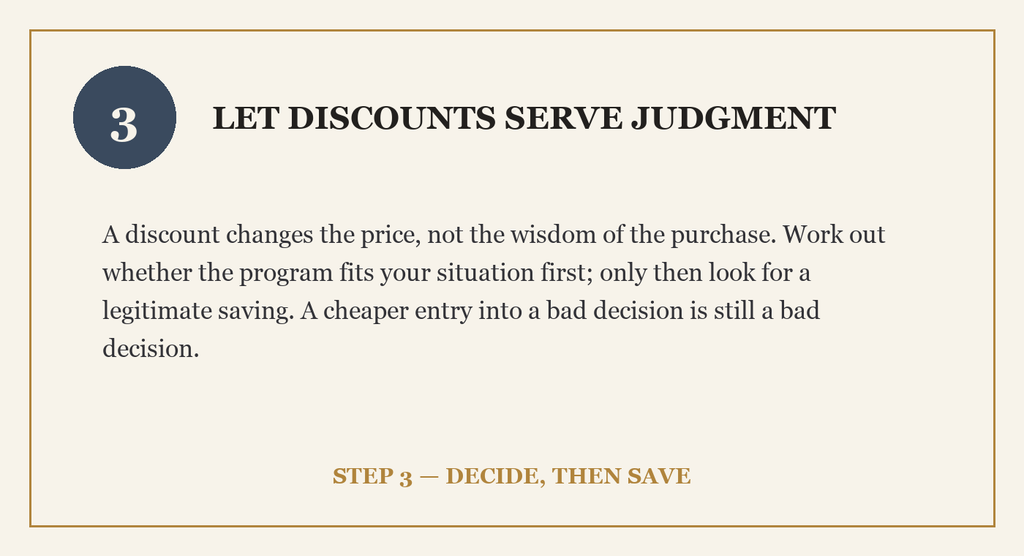
The subtlest trap in a discount culture is order of operations. A bargain feels like a reason, but a reduced price is only ever a detail; it cannot tell you whether the purchase is wise. Someone who would not buy an evaluation at full price has not suddenly discovered a good decision because it went on sale. Stewardship runs the other direction: settle the question of fit first — your finances, your obligations to family, your tolerance for losing the fee entirely — and only then go looking for a legitimate saving. The discount should serve the judgment, never replace it. There is a quiet dignity in paying a fair price for a considered decision, and a quiet folly in celebrating a saving on something that should never have been bought. Households have understood this for centuries: the clearance rack tests character precisely because the price is no longer the obstacle.

Guardrails worth keeping
A few plain guardrails serve anyone considering these programs. Never fund an evaluation with money committed to household obligations. Treat the fee as money already spent, the way one treats a ticket to an event that may be rained out. Set a fixed number of attempts in advance so hope does not keep writing checks. And keep the whole enterprise in proportion: a program that consumes attention, peace of mind, or family resources has cost more than its fee, whatever the outcome of the trades.
The bottom line
Funded trading programs are neither a moral trap nor a promise; they are a financial arrangement that rewards the same old virtues — honesty about cost, skepticism toward claims, and judgment that no coupon can purchase. Count the cost, test everything, decide first and save second. Keep the guardrails, hold the enterprise in proportion, and let the discount be the smallest part of the decision rather than the whole of it. Generations of careful households lived by these habits long before anyone thought to package risk as a product, and they have not been improved upon since. The oldest advice turns out to be the most current.