A professional outdoor event space doesn’t have to be complicated. Whether you’re setting up for a community festival, farmers market, sporting event, corporate activation, product promotion, or local gathering, the goal is to create an area that people can recognize, navigate, and comfortably interact with.
The challenge is that outdoor spaces often have fewer natural boundaries than indoor venues. Businesses may be working on grass, pavement, parking lots, or open event grounds, often alongside many other exhibitors.
A well-planned setup can solve that problem.
By combining a clear layout, consistent branding, practical signage, comfortable customer areas, and the right display elements, you can turn an ordinary outdoor footprint into a professional branded space.
Start With the Purpose of Your Event Space
Before choosing displays or arranging furniture, determine what the space needs to accomplish.
An outdoor setup might be designed to:
- Showcase products
- Generate leads
- Sell merchandise
- Host demonstrations
- Provide information
- Offer samples
- Create a customer seating area
- Promote a new product or service
- Build brand awareness
The purpose should influence the layout.
A product demonstration needs enough room for people to gather and watch. A sales-focused setup may need accessible product displays and a transaction area. A promotional activation might require more open space for interaction.
Starting with the purpose helps prevent unnecessary items from taking up valuable space.
Plan the Visitor Journey
A professional event space should make sense from the moment someone approaches it.
Think about what visitors should experience in sequence:
See the brand → Recognize the space → Understand the offer → Enter or approach → Interact → Take the next step
This simple journey can help determine where each element belongs.
For example, a large branded element may be most useful toward the outside of the space where it can attract attention, while product information and lead forms can be positioned closer to the interaction area.
The visitor shouldn’t have to figure out how the space works.
Use a Branded Canopy as the Foundation
At many outdoor events, the canopy becomes the central structure around which everything else is organized.
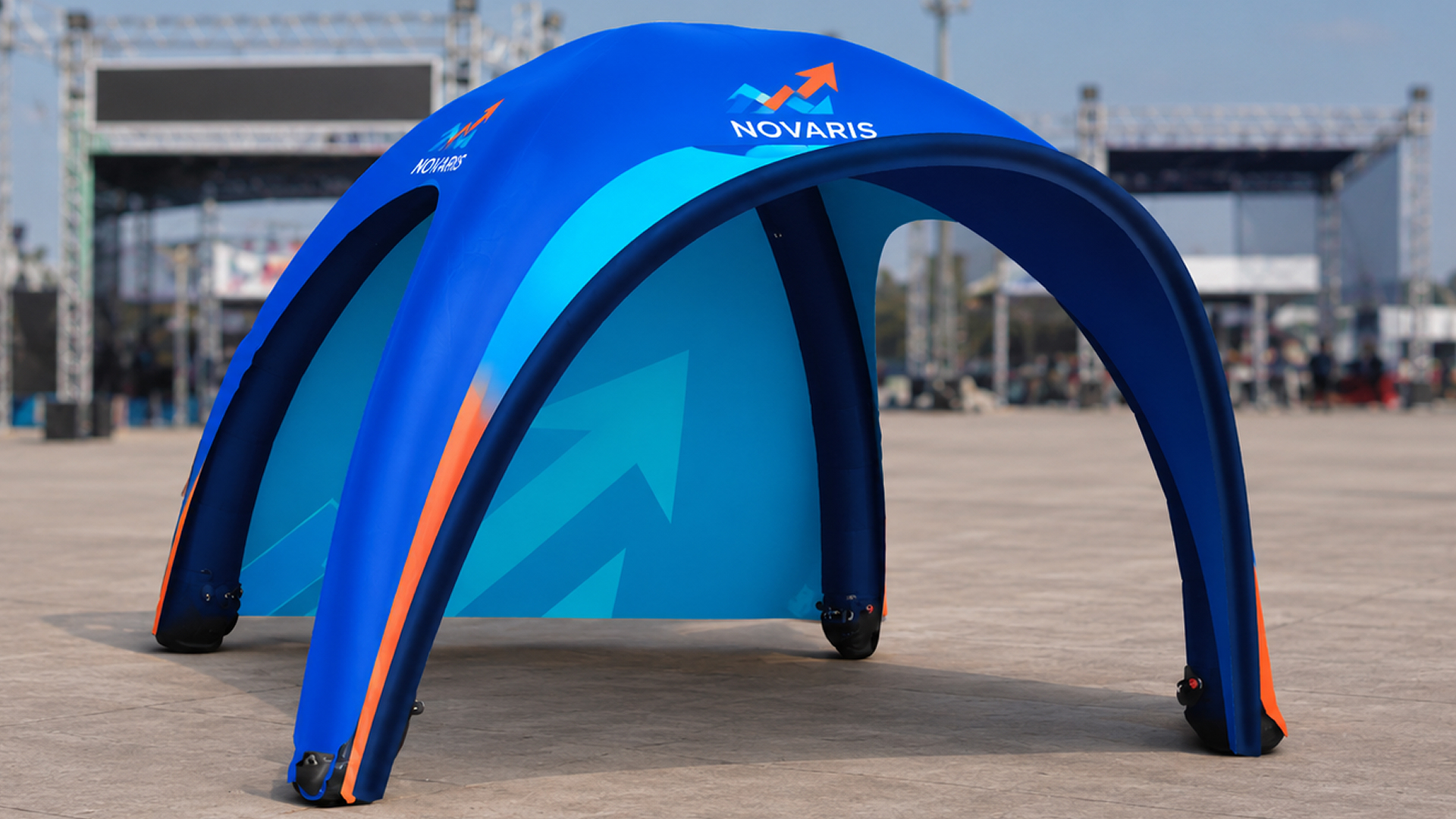
A branded canopy can establish a clear visual identity while also creating a defined area for customers, products, staff, or demonstrations.
The canopy can serve several purposes at once:
- Provide shade
- Define the event footprint
- Create a recognizable destination
- Display the business identity
- Protect products and equipment
- Give staff a central working area
Instead of treating the canopy as an isolated display, use it as the foundation of the entire setup.
Position tables, signage, products, and customer areas around it so that everything feels connected.
Choose a Custom Canopy Tent for a More Cohesive Setup
For businesses that regularly participate in outdoor events, a custom canopy tent can provide a reusable foundation for different types of branded setups.
The advantage of customization is that the structure can carry the business identity directly rather than relying entirely on separate signs.
Depending on the event, the same canopy can support:
- Product demonstrations
- Market stalls
- Community events
- Promotional activations
- Outdoor sales
- Sporting events
- Corporate events
The key is to choose a setup that can adapt to different spaces and event requirements.
Create a Clear Entrance
If your outdoor space has a defined entrance, make it easy for visitors to recognize.
The entrance doesn’t need to be elaborate. A combination of the canopy opening, signage, flags, or another branded element can create a visual invitation.
Avoid placing tables, boxes, equipment, or promotional materials directly in the path.
Visitors should be able to understand where to enter without having to navigate around obstacles.
Establish a Strong Visual Focal Point
Every outdoor setup benefits from having one area that immediately attracts attention.
This might be:
- A large branded canopy
- A prominent backdrop
- A product display
- A vertical flag
- A demonstration area
- A branded wall
The focal point should communicate something important about the business.
Avoid creating several competing focal points. If everything is designed to attract attention equally, visitors may not know where to look first.
Keep Branding Consistent
A professional branded space usually feels coordinated rather than overloaded with logos.
Use the same visual identity across selected elements such as:
- Canopy graphics
- Banners
- Flags
- Table covers
- Signage
- Product displays
- Staff apparel
Consistency helps visitors understand that different parts of the setup belong to the same business.
It also makes the event space look more intentional.
You don’t need to put the logo on every surface. In many cases, using the brand identity strategically creates a cleaner appearance.
Use Vertical Displays to Increase Visibility
Outdoor events can become visually crowded.
People, tents, vehicles, signs, and other exhibitors can block displays positioned at ground level.
Vertical elements can help the brand remain visible above the surrounding activity.
Flags, tall banners, and elevated branding can be particularly useful for:
- Marking an entrance
- Identifying a booth from a distance
- Directing visitors
- Reinforcing the brand
- Highlighting a promotional area
Think about visibility from the approach rather than only how the display looks when standing directly inside the booth.
Design the Space Around Customer Comfort
A professional event setup isn’t only about branding.
People are more likely to spend time in a space that feels comfortable and easy to navigate.
Depending on the event, consider adding:
- Seating
- Shade
- Open walking space
- Water or refreshments
- Comfortable interaction areas
- Accessible product displays
Don’t fill every available square foot with equipment.
Leaving some open space can make the setup feel larger and make it easier for visitors to enter.
Position Products at the Right Height
If you’re displaying products, think about how customers will view them.
Products that need detailed inspection should generally be positioned where visitors can comfortably see and handle them.
Larger products may need more open space, while smaller items can be grouped on tables or shelving.
Try to avoid creating a wall of products that makes it difficult for customers to identify what deserves their attention.
A simple hierarchy works well:
Main product → Supporting products → Additional information
Use Signage to Answer Common Questions
Signage should provide useful information rather than simply repeat the company name.
Depending on your event, signs can answer questions such as:
- What does this business offer?
- Where should I go?
- What product is being demonstrated?
- How much does it cost?
- How can I place an order?
- How can I learn more?
Keep the wording short and easy to understand.
A visitor should be able to glance at a sign and understand its purpose quickly.
Create a Dedicated Conversation Area
If lead generation or sales conversations are important, give staff and customers somewhere to talk without blocking the rest of the setup.
This doesn’t necessarily require a large lounge.
A small counter, table, or seating area can be enough for short conversations.
The important thing is to separate longer conversations from the main traffic path whenever possible.
This allows other visitors to continue moving through the space.
Use Lighting When the Event Requires It
Lighting can become particularly important when an outdoor event continues into the evening.
Rather than illuminating everything equally, focus lighting on important areas such as:
- Product displays
- Main branding
- Information counters
- Demonstration areas
- Entrance points
Before adding lighting, check the event’s electrical requirements and determine what power sources are available.
For daytime events, natural light may be sufficient, allowing more of the budget to go toward branding and visitor experience.
Think About Storage and Staff Space
One practical issue that is often overlooked during event planning is where equipment goes.
Boxes, bags, packaging, personal belongings, extra products, and supplies can quickly make a small setup look disorganized.
Where possible, designate an area for:
- Extra inventory
- Packaging
- Staff belongings
- Cleaning supplies
- Promotional materials
- Equipment
Keep these items out of the main visitor area.
A clean customer-facing space will always look more professional.
Make Your Setup Easy to Navigate
Try walking through the space as if you’re a first-time visitor.
Ask yourself:
Can I tell who this business is?
Can I see what they’re offering?
Can I enter easily?
Do I know where to stand or walk?
Can I approach a staff member without blocking someone else?
Can I find additional information if I’m interested?
These questions often reveal layout problems that aren’t obvious when looking at the setup from the organizer’s perspective.
Adapt the Setup to Different Event Environments
The same branded elements can be arranged differently depending on the event.
Farmers Market
Focus on product visibility and easy customer access.
A canopy, branded table cover, product displays, and simple signage can create a straightforward setup.
Outdoor Festival
Visibility becomes more important because there may be many exhibitors competing for attention.
Consider combining a branded canopy with vertical signage and clear entrance markers.
Sporting Event
Customer traffic may be faster and more directional.
Use highly visible branding and keep the layout open so visitors can approach without disrupting movement.
Corporate Activation
The environment may call for a more polished and structured setup.
Use coordinated displays, clear messaging, comfortable conversation areas, and organized product or information stations.
Community Event
Keep the setup welcoming and easy to understand.
Simple signage, a recognizable branded structure, and an open layout can help visitors approach comfortably.
Build Around a Few Strong Elements
A common mistake is trying to make an outdoor setup look impressive by adding as many displays as possible.
More isn’t always better.
A professional space might only need:
One strong branded structure
One clear focal point
One or two supporting signs
A functional customer area
Consistent branding
This can create a stronger impression than a crowded collection of unrelated promotional materials.
Prepare for Outdoor Conditions
Outdoor events introduce challenges that aren’t present in an indoor venue.
Before the event, consider:
- Wind
- Rain
- Sun exposure
- Uneven ground
- Temperature
- Ground surfaces
- Available power
- Tent and display anchoring
- Local venue restrictions
Your setup should be appropriate for the expected conditions.
Don’t wait until event day to discover that the surface won’t accommodate your equipment or that a particular display isn’t permitted.
Make Transportation Part of the Planning
An outdoor display may look simple once assembled, but getting everything to the event is another consideration.
Think about:
- How much equipment needs to be transported
- How many people are needed for setup
- How much storage space is required
- How the display will be packed
- How long setup and teardown will take
If you attend events regularly, reusable and portable components can make future setups easier.
Create a Setup Checklist
A checklist can help prevent small oversights from becoming event-day problems.
Branding
- Is the business name clearly visible?
- Are logos and colors consistent?
- Is the primary message easy to understand?
Layout
- Is the entrance clear?
- Is there enough walking space?
- Are products easy to view?
- Is there a dedicated conversation area?
Equipment
- Is the canopy complete?
- Are all required supports and accessories packed?
- Are signs and displays ready?
- Is lighting or electrical equipment needed?
Outdoor Conditions
- Is the setup appropriate for the weather?
- Is the structure properly secured?
- Is the ground surface suitable?
- Have venue restrictions been checked?
Customer Experience
- Can visitors understand the space quickly?
- Can they approach staff easily?
- Is there enough shade or seating where necessary?
- Is important information easy to find?
Final Thoughts
A professional outdoor event setup doesn’t require every available branding product.
What matters more is how the elements work together.
Start with the purpose of the space, plan the visitor journey, establish a clear visual focal point, and use branding consistently across the most visible elements. Then add practical features such as shade, seating, product displays, signage, and storage based on what customers actually need.
A well-planned canopy can provide the foundation, while signs, flags, banners, tables, and other displays can build around it.
The result is a branded outdoor space that doesn’t just look organized, it helps visitors know who you are, what you offer, and where they should go next.