Few watches have generated as much conversation over the past two decades as the Patek Philippe Nautilus. It is a steel sports watch from a maison best known for dress watches and grand complications, and that contradiction is exactly why people love it. Yet when someone first decides they want “a Nautilus”, they quickly discover there is no single Nautilus. There are time-only models, moon phase models, annual calendars, chronographs, gold and gem-set versions, and a newer 41 mm reference that quietly replaced the most famous one of all.
This guide walks through the main references one by one, explains what actually separates them on the wrist, and shares a few practical habits for living with the more complicated versions. Whether you are researching your first Nautilus or simply trying to understand why enthusiasts argue about thickness down to a tenth of a millimetre, the goal is to make the family easy to navigate.
From a Porthole to an Icon: Where the Nautilus Design Comes From
The Nautilus debuted in 1976 as the ref. 3700/1A, a 42 mm steel watch that collectors later nicknamed the “Jumbo”. Its designer, Gérald Genta, took inspiration from the hinged porthole of an ocean liner: the rounded octagonal bezel represents the porthole window, and the two “ears” on either side of the case represent the hinges that held it shut. At the time, a steel watch priced like a gold one was a provocation. Today it reads as one of the most recognisable silhouettes in watchmaking.
Everything that followed, from the mid-size models of the 1980s to the modern 40 mm references, keeps that same visual grammar: a flat bezel with alternating brushed and polished surfaces, horizontally embossed dial, applied baton markers and a bracelet that flows directly out of the case. Curious how the Nautilus sits alongside the Aquanaut, Calatrava and other lines from the same house? Explore the Patek Philippe Collection as a whole before narrowing down to a single reference. Seeing the shapes side by side makes it much clearer why the Nautilus remains the brand’s most talked-about sports watch.
The Anatomy of a Nautilus: Case, Bezel and the Integrated Bracelet
Before comparing references, it is worth understanding the parts that every Nautilus shares, because these are also the areas where quality differences show up first.
- The bezel. The top surface is finely brushed, while the narrow outer flank is polished. The transition between the two should be crisp and even all the way around the octagon.
- The case “ears”. The hinge-like protrusions on the left and right of the case end in a subtle point, sometimes described as a bird’s beak. On a well-made case this point is sharp and clearly defined rather than rounded off.
- The crown. The steel models use a screw-down crown protected by the case shoulder. When fully screwed in, it should sit close to the case rather than protrude noticeably.
- The bracelet. Large brushed outer links alternate with small polished centre links that step down in size towards the clasp. A good Nautilus bracelet is surprisingly supple, with flexible end links and chamfered edges so it does not pull at arm hair.

The dial is the other shared signature. Most Nautilus dials carry horizontal embossed lines, and many of the blue versions use a gradient that runs from a lighter blue-grey at the centre to almost black at the edge. That gradient is very hard to reproduce well, which is why dial colour is often the first thing experienced collectors look at.
Ref. 5711/1A: The Time-and-Date Benchmark
Discover the Nautilus Collection and you will quickly see that the 5711 is the purest expression of the design. Introduced in 2006, it measures 40 mm across (measured from 10 to 4 o’clock, excluding the ears) and only about 8.3 mm thick, which is remarkably slim for a sports watch with an automatic movement and a date. It shows hours, minutes, central seconds and date at three o’clock, and nothing else.
For most of its production the 5711 used the calibre 324 S C, a self-winding movement visible through a sapphire caseback. Later examples moved to the newer calibre 26-330 S C. One small practical difference: the 324 keeps its seconds hand running while you set the time, whereas the 26-330 stops the seconds hand when the crown is pulled out, which makes precise time-setting easier.
Patek Philippe ended production of the steel 5711/1A in 2021, which only intensified demand. Before it bowed out, the brand released an olive green dial version, the 5711/1A-014, which has since become one of the most sought-after Nautilus dials. Other well-known dial options include white and the original blue gradient.
The white dial is easy to overlook, but it is worth seeing in person. In strong light it looks like clean paper; in shade it takes on a soft, steel-grey tone. The olive green, meanwhile, shifts between deep green and a golden green as the sunburst catches light.
Ref. 5712/1A: Moon Phase, Power Reserve and a Micro-Rotor
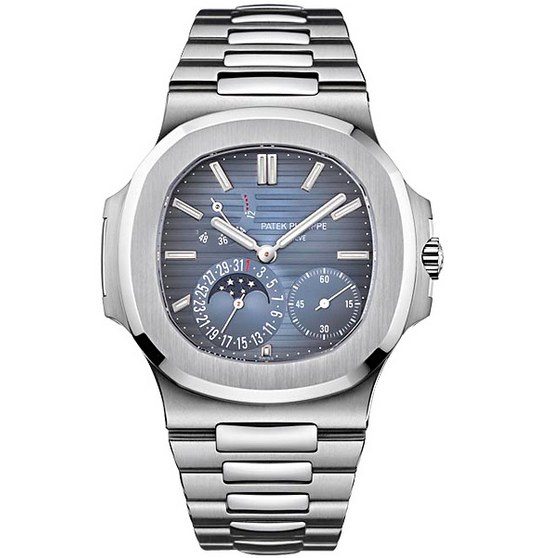
The 5712 keeps the 40 mm footprint but fills the dial with complications. At around 10 o’clock sits a power reserve indicator; at roughly 7 o’clock, a pointer date combined with a moon phase; and at 4 o’clock, a small seconds sub-dial. The layout is asymmetric, which gives the watch a more technical, almost instrument-like personality compared with the minimalist 5711.
Inside is the calibre 240 PS IRM C LU, built around a micro-rotor that is recessed into the movement rather than sitting on top of it. That is the reason the 5712 manages to stay so thin at about 8.52 mm despite its extra functions. The power reserve is roughly 48 hours. The date and moon phase are adjusted through small recessed correctors on the case flanks, using a small stylus.
The 5712 has long been a favourite among people who find the 5711 slightly too spare. It also exists in rose gold (5712R), and the difference in weight is substantial: a steel 5712 typically weighs in the region of 130 to 140 grams on the bracelet, while the gold version is close to 200 grams. If you have the chance to hold both, you will immediately understand why some collectors consider weight part of the experience.
Ref. 5726/1A: The Annual Calendar for Larger Wrists
The 5726 is the most practical complication in the steel Nautilus line. It is an annual calendar, meaning it displays day, date and month and automatically accounts for 30- and 31-day months, so it needs manual correction only once a year at the end of February. It also adds a moon phase and a 24-hour indicator.
Powered by the calibre 324 S QA LU 24H, it is the larger and thicker sibling: around 40.5 mm wide and about 11.3 mm tall. That extra three millimetres of height compared with the 5711 is very noticeable on the wrist. For someone with a slim wrist, it can make the watch feel tall; for someone with a larger wrist, it gives the Nautilus a more substantial presence and a pleasing sense of heft.
The crown on the 5726 has a single pulled-out position for setting the time, with the calendar functions handled by pushers in the case side. Dial options have included blue, white and grey, with the grey-blue tones being particularly popular.
Ref. 5811/1G: The 41 mm Successor
When the steel 5711 was discontinued, many wondered what would replace it. The answer arrived in 2022: the 5811/1G. It is essentially a modern evolution of the time-and-date Nautilus, but in 18k white gold, roughly 1 mm larger in diameter at 41 mm and about 0.2 mm thinner than the 5711. It uses the calibre 26-330 S C with a hacking seconds function.
Another welcome change is the clasp. Instead of the older folding clasp that some owners found fiddly to open, the 5811 uses a fold-over clasp released by pushers, which is easier on the fingernails. The blue sunburst dial is also slightly more vivid than the classic 5711 blue.
Because the 5811 is gold rather than steel, it is heavier in the hand and positioned differently in the market. In everyday wear, however, the visual difference between the 5811 and the 5711 is subtle. Most people will only notice the slightly larger case if the two are placed side by side.
Gold, Gem-Set and Chronograph Variants
Beyond the core references, the Nautilus family branches out in several directions:
- 5711/1R: the time-and-date model in rose gold, usually paired with a brown gradient dial. It is warmer and more formal than steel.
- 5713/1G: a white gold time-and-date model with a diamond-set bezel, aimed at those who want sparkle without changing the basic design.
- 5724G: a white gold model with baguette-cut diamonds on the bezel and case, plus moon phase and power reserve, usually on a leather strap.
- 5980 and 5990: the chronograph references. The 5990/1A Travel Time Chronograph adds a second time zone and date to the chronograph, making it one of the most complex and also one of the chunkier steel Nautilus models.
- 7118: a 35.2 mm model often worn by those who prefer a smaller watch, with the same design language in a more compact case.
Sizing and Comfort: Why Thickness Matters More Than Diameter
On paper, most Nautilus references sit within a narrow band of diameters. What really changes how they wear is height. A sports watch under 9 mm thick slides under a shirt cuff easily; one over 11 mm starts to feel like a tool watch. The table below summarises the main references.
| Reference | Diameter | Thickness | Key functions | Case material |
| 5711/1A | 40 mm | approx. 8.3 mm | Time, date | Steel |
| 5712/1A | 40 mm | approx. 8.52 mm | Power reserve, date, moon phase, small seconds | Steel |
| 5726/1A | 40.5 mm | approx. 11.3 mm | Annual calendar, moon phase, 24-hour | Steel |
| 5811/1G | 41 mm | approx. 8.2 mm | Time, date | White gold |
| 5990/1A | 40.5 mm | Thicker than the time-only models | Chronograph, second time zone, date | Steel |
Keep in mind that the Nautilus case is wider than its stated diameter suggests, because the ears extend beyond the bezel. A 40 mm Nautilus typically wears closer to a 42 or 43 mm round watch in terms of wrist coverage, although its flat profile and flexible bracelet help it sit comfortably. If your wrist is on the smaller side, the 5711 or 5712 is usually the safer choice; if it is larger, the 5726 or 5990 can feel more proportionate.
Living With a Complicated Nautilus: Setting and Care Habits
The 5712 and 5726 are wonderful to wear, but their calendar mechanisms deserve some care. A few habits will help keep them running smoothly:
- Respect the calendar “no-go” window. Avoid using the date or moon phase correctors while the hands are in the upper half of the dial, roughly between 9 and 3, the zone in which the calendar wheels engage for the changeover. Move the hands to the lower half of the dial, around 6 o’clock, before making adjustments.
- Press correctors one step at a time. Push gently, release, and let the indication jump before pressing again. Holding the corrector down or pressing too hard is a common cause of jammed calendars.
- Do not set the time backwards. On calendar models, turn the hands forwards only.
- Keep the crown screwed down. Always screw the crown back in after winding or setting to maintain water resistance.
- Mind the power reserve on micro-rotor models. A micro-rotor winds less vigorously than a full rotor, so a 5712 that is worn only lightly may benefit from a few turns of the crown in the morning.
- Treat thin complications gently. Ultra-thin multi-function movements are less tolerant of hard knocks than a robust three-hand tool watch, so it is wise to take it off for sports or heavy work.
What to Look For When You Browse the Collection
Whichever reference appeals to you, a handful of checks will tell you a lot about the quality of any Nautilus-style watch you are considering:
- Thickness: compare the measured height with the reference figures above. A few tenths of a millimetre are invisible on the wrist; a full millimetre or more starts to change the profile.
- Dial gradient and embossing: the blue should fade smoothly from centre to edge, and the horizontal lines should be crisp, not blurred.
- Date window: the numerals should be bold enough to fill the window neatly rather than looking thin and floating.
- Lume consistency: the luminous fill on the hands and markers should match in colour.
- Bracelet flexibility: the end links should move freely, and the links should drape around the wrist without feeling stiff.
- Movement behaviour: check whether the seconds hand stops when setting the time and whether all indications, including the power reserve on a 5712, actually move as they should.
Final Thoughts
The Nautilus may be one design, but it is many watches. The 5711 is the reference point: slim, simple and endlessly versatile. The 5712 adds charm and complication without adding bulk. The 5726 suits those who want everyday calendar practicality and a more substantial feel. The 5811 refines the formula in gold for a new era, while the gem-set and chronograph models push the design in more expressive directions.
The best way to choose is to start with how you plan to wear it. If it will live under a shirt cuff, prioritise thinness. If you love looking at your watch, the extra sub-dials of the 5712 or 5726 offer more to discover. And if you are still undecided, browsing the full range is the easiest way to let one of them catch your eye.