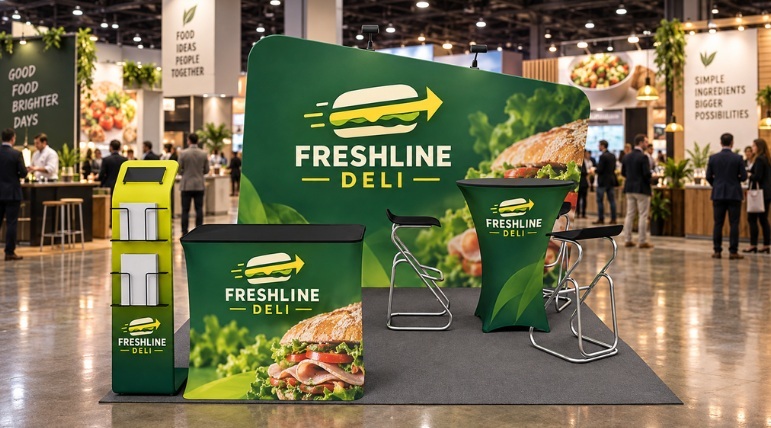
Trade show gives businesses only a limited amount of time to capture attention. Hundreds of exhibitors may be competing for the same audience, and attendees can quickly move from one booth to another. For commercial exhibitors, the physical presentation of the exhibit can therefore influence whether visitors stop, engage, and remember the brand.
Well-planned trade show booth displays do more than showcase a company logo. They create a dedicated environment for product demonstrations, conversations, lead collection, and brand communication. The right setup should look professional while also making it easy for visitors to understand what the business offers.
Start With the Purpose of Your Exhibit
Before selecting a display, businesses should determine what they want visitors to do.
Some exhibitors focus on generating qualified leads, while others want to demonstrate products, meet existing customers, launch a new service, or increase brand awareness.
This objective should influence the layout.
For example, a company focused on lead generation may need an open conversation area and a clear call to action. A product-focused exhibitor may need additional display space and room for demonstrations.
Make Your Booth Easy to Recognize
Trade show attendees often see an exhibit from several feet away before deciding whether to approach it. Branding should therefore be visible without requiring visitors to stop and read extensive information.
Effective booth graphics commonly prioritize:
- Company name and logo
- Brand colors and visual identity
- A short value proposition
- Key products or services
- Website or QR code
- A simple call to action
Avoid overcrowding the display with paragraphs of text. The booth should communicate the most important message quickly, while staff can provide additional information through conversation.
Consider Different Display Formats
Not every business needs the same type of exhibit. The available venue space, transportation requirements, setup time, and branding goals can all affect the decision.
| Display option | Best suited for | Key consideration |
| Pop-up display | Compact trade show spaces | Quick setup |
| Modular exhibit | Businesses needing flexibility | Configurable layout |
| Backwall display | Strong visual branding | Large graphic area |
| Inflatable tents | Unique branded environments | Visual impact and portability |
Inflatable tents can be particularly interesting for businesses looking for something different from a conventional exhibit. Their distinctive shape can create a recognizable branded environment and help an exhibitor attract attention within a busy event hall or promotional setting.
Why Businesses Consider Inflatable Displays
Traditional booth systems can require multiple components, storage space, and more complicated transportation. Inflatable tents offer another approach for businesses that prioritize portability and visual impact.
Depending on the design, an inflatable structure can create an enclosed or semi-enclosed branded area for product demonstrations, hospitality, meetings, or promotional activities.
They can also be useful beyond traditional trade shows. Businesses may reuse them for outdoor activations, sporting events, festivals, product launches, and corporate promotions.
That versatility can make the investment more valuable for companies with an active event marketing schedule.
Think About the Visitor Experience
A visually impressive booth is not enough if customers cannot comfortably interact with the business.
Keep entrances accessible and avoid creating unnecessary barriers between staff and visitors. Product displays should be organized so people can understand what is being presented without feeling crowded.
Consider adding:
- Comfortable consultation space
- Product demonstration areas
- Branded counters
- Digital screens
- Literature holders
- QR codes for quick information
- Storage for promotional materials
The objective is to create a space that naturally moves visitors from curiosity to conversation.
Evaluate the Practical Side Before Buying
Commercial buyers should look beyond graphics when comparing exhibit solutions. A display may look excellent but become inconvenient if it is difficult to transport, assemble, or store.
Consider these factors before making a purchase:
- Event frequency: How often will the display be used?
- Venue requirements: What size and configuration does the event allow?
- Transportation: Can the equipment fit into your normal travel and shipping arrangements?
- Setup: How much time and staff will installation require?
- Storage: Where will the display be kept between events?
- Branding: Can the graphics support your current marketing identity?
- Reuse: Can the same system work at different events?
These questions help businesses choose equipment based on long-term usefulness rather than appearance alone.
Build a Booth That Supports Business Growth
The best trade show booth displays are designed around business objectives. A strong visual presentation may attract visitors, but the layout, messaging, staff interaction, and follow-up process ultimately determine how much value the event creates.
For businesses that attend multiple types of events, flexibility is especially important. A display that can transition between trade shows, promotional events, outdoor campaigns, and other brand activations can provide greater long-term value.
Whether a company chooses a traditional booth system or explores inflatable tents, the goal should remain the same: create a professional environment that attracts the right visitors and makes meaningful business conversations easier.
Frequently Asked Questions
1. What makes effective trade show booth displays?
Effective displays combine clear branding, readable graphics, practical layout, and an environment that encourages visitors to interact with the business.
2. Are inflatable tents suitable for trade shows?
They can be suitable for businesses seeking a distinctive branded environment. Their suitability depends on the venue’s rules, available space, design, and the company’s intended use.
3. How much information should a trade show booth display?
The main display should communicate essential information quickly. Detailed product specifications and explanations can be handled through staff conversations, brochures, digital screens, or QR codes.
4. What size booth display should a business choose?
The appropriate size depends on the assigned exhibit space, number of staff, products being displayed, visitor traffic, and required meeting or demonstration areas.
5. Can inflatable displays be reused?
Yes. Businesses can potentially reuse inflatable tents at multiple trade shows and promotional events when the structure is properly transported, stored, and maintained.
6. What should businesses consider before purchasing an exhibit display?
Consider portability, setup time, storage, branding options, durability, venue restrictions, transportation, frequency of use, and whether the display can work across different events.
7. How can a trade show booth attract more visitors?
Use prominent branding, concise messaging, an inviting layout, product demonstrations, interactive elements, and a clear reason for visitors to stop and speak with your team.