Thomas Aquinas was a serious man. As a Dominican friar, he built the Summa Theologiae, one of the first complete systematic accounts of human life, in the intellectual climates of thirteenth-century Paris and Naples. He was not a man who spent much time laughing. But tucked away in this giant intellectual undertaking is a defense of laughter. Aquinas argued that the human mind can only endure so much tension before it breaks and so laughter is not only permissible, but serves a restorative purpose.
Aquinas’ argument merits our attention, especially when considering how much recreational play has migrated to the virtual world, and more specifically, to online casino games. Aquinas never saw a slot machine or a live dealer in Riga. However, his theory on play, pleasure, money and will is flexible enough to encompass our modern reality and more importantly, is grounded enough in humanity to remain useful in this new age. The real question is, what does it mean?
That question becomes real when you consider where most casual play happens today. The Canadian market for regulated online gaming has exploded since the opening of Ontario’s competitive iGaming framework in 2022. The range of experiences available today is drastically different from what was available even just a few years ago. Around-the-clock live dealer games, narrative and visual slots and card games that reward patience and decision-making as much as luck are just a few examples. At swiper betting, the offerings include all of the above. Aquinas associated virtuous play with a person choosing to engage in the activity with a clear mind and enjoying it within bounds. This describes how a thoughtful person approaches an evening with these games. A person who engages in play within self-imposed bounds, chooses to play with a clear mind, enjoys the game and is fully present might set a specific time to play, leave outside anxieties aside and stop when the session feels complete.
An Early Understanding of Fatigue
Aquinas wrote before the concept of scheduled leisure, before weekends even existed. The scholastic world of the 1300s was comprised of disputations, studies, prayers and manual labor. There was no scheduled rest as there is now, but Aquinas asserted that there should be and that it is a moral obligation and even a soul’s requirement, to rest.
He based his argument on Aristotle, whose thought he admired and integrated with Christian theology. Aquinas believed that the soul was not a machine that could operate continually. The soul’s purpose is to think and will the good. To do so, there must be tension, and if there is too much tension for too long, it exhausts the soul. An exhausted soul is unable to pursue truth, love well or pray. In order to restore the soul’s ability to engage in these activities, recreation is necessary.
Therefore, Aquinas was providing a justification for play, or recreation, for a life that is focused on goodness. This is more compelling than giving someone permission to be idle.
When Rest Becomes a Virtue
Eutrapelia is the term that Aquinas gave to the virtue of play, which Aristotle discussed in the Nicomachean Ethics. This term literally means “ready wit” or “pleasantness in speech,” and for Aristotle, it was the golden mean between buffoonery and boorishness.
The boor is the person who brings heavy, burdensome moods to every social event by being dead serious and refusing to lighten the mood. Aquinas considered this a legitimate moral failing because it produces a negative impact on others and blocks a good for humanity. The buffoon, on the other hand, takes things to the opposite extreme and becomes a disruption to the gathering because of his or her excessive laughter.
Eutrapelia represents the ability to laugh and enjoy oneself without becoming a buffoon. It represents the ability to participate in an activity and enjoy it, without becoming so preoccupied with it that you lose the ability to function in the rest of your life. In the context of casino games, buffoonery is primarily concerned with excess and begins to crowd out other things.
The Question of Money
Aquinas was well aware that money alters circumstances. His theory of moral economics was based on justice, which holds that for a transaction to be legitimate, there must be a free and honest equivalence between the things exchanged.
When money is introduced to a game, the moral weight of the game increases, but it does so gradually rather than absolutely. Aquinas believed that games of chance involving wagers are permissible as long as specific conditions are met. The money wagered must be owned by the person wagering it. The other parties must be willing participants and fully informed. The game must also be set up fairly. Cheating, in his view, is not just a rules infraction; it is an injustice that requires restitution. The person who is defrauded loses money to the person who committed the fraudulent act, and the fraudster is deemed to have no rightful claim to the money.
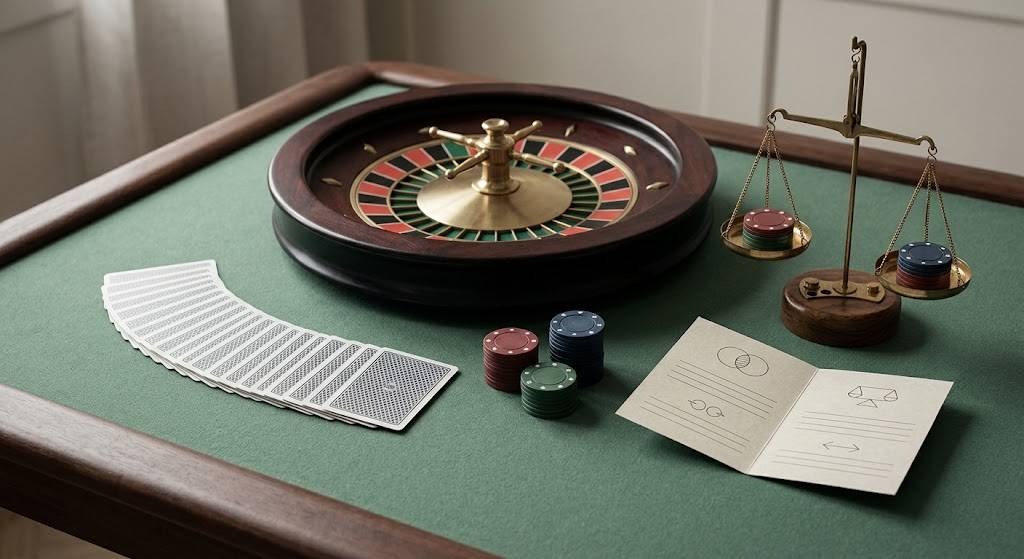
This view of Aquinas has implications for thinking about the moral status of casino gambling. It does not provide an absolute prohibition. Imagine a person wagers a small amount of money in a game that has straightforward rules and that they willingly participate in. This situation would not raise any moral concerns. However, if a person starts wagering large amounts of money, this situation would raise moral concerns, especially if the person wagering the money no longer is a voluntary participant. From a moral perspective, it does not matter how much money is wagered; what matters is the amount relative to the person’s overall financial situation.
What You’re Actually Trying to Do
Aquinas focused on the interior act of the will, or the person’s intent. Because of this, he believed that the morality of an action cannot be fully determined by examining only the person’s outward behavior. It is possible for two people to engage in the same outward behavior, but one person could be doing a morally good action, and the other could be doing a morally bad action.
An act that appears to be neutral, like taking a seat at a poker table or pulling a slot machine lever, becomes ethical or unethical based on the intentions of the actor. Aquinas would argue that an intent to take a break from work and clear one’s mind is ethically sound, as the individual is intentionally pursuing a legitimate human good.
One can not necessarily determine another person’s intentions simply by looking at their actions. Aquinas believed that in order to fully understand what one is doing, and why they are doing it, one must reflect on their actions honestly. In this respect, Aquinas’s moral theory is focused on the interiority of the person. His theory assumes that a person is able to give a truthful account of themselves.
Self-Command at the Table
In the case of temperance, Aquinas argues that pleasure can be pursued so long as it is reason that is in charge. Someone who is temperate does not forbid themselves pleasure; rather, they enjoy themselves so long as their reason is in favor of it.
In the case of recreational activities, Aquinas argued that it is virtuous to freely choose to engage in an activity that one enjoys. Aquinas also argued that in order for recreational activities to remain virtuous, one must continue to deliberately choose to engage in the activity.
This is easy to understand when looking at online gambling. The player who sets a time limit and leaves when that time is up demonstrates something that Aquinas would call temperance. They maintain control over their game rather than letting it maintain control over them. This is not a dull or unenjoyable way to play; quite the contrary. If you play this way, you are fully engaged and enjoy the game, something that Aquinas believes is necessary for true recreation.
Does It Fit a Whole Life?
One of the more subtle, yet powerful, ideas within Aquinas’s moral philosophy is that of proportionality. He argued that any genuine good is ordered within the entirety of a person’s life, and the goodness of an activity is always partially determined by its relationship to the other things in a person’s life.
Real as it may be, play becomes a disordered good when it takes precedence over things of greater value. Other activities such as work, interpersonal relationships, and prayer, as well as one’s moral obligations, make up the larger context within which all recreation must be fully and appropriately situated. Casinos can be part of a well-ordered life, but only if they are not used to fill time that ought to be devoted to some other worthwhile activity.
This isn’t a call for moderation in the weak, grey sense. Aquinas wasn’t saying that we should keep the overall level of pleasure in our lives as low as possible. He was making a structural point about ordered goods. He was saying that the most genuine and sharpest pleasure, the pleasure of recreation, comes from taking a break and actually resting from the other activities in life, as opposed to pleasure filling the void left by other activities. Aquinas’s framework says that casino gaming that occupies a real leisure hour is a good thing.
Thinking It Through Before You Play
Aquinas’s framework has a lot of value because it gives a curious Christian real questions as opposed to a verdict that gets thrown at them from outside. It was never his task to judge a category of activity and then give a ruling. His task was to understand what a person is doing and why they are doing it.
His framework leads to questions like: Was the rest of your day productive? Was this an activity you did to rest? Was this money spent on a fun activity, and not on something you should be keeping secret? Were you honest when you said you wanted to have fun? Were you truly being responsible with your time? Was this activity something you could fit into your life?
I think these are good questions, but I don’t think they are judgmental. Aquinas wants to find the good where it genuinely exists, and wants to show what is required for the good to exist. In its current form, casino gaming includes visually stimulating slot machines, live dealer games and games that reward players for being patient and attentive. Aquinas’ framework says that if you are being honest with your answers, then this activity is probably okay. This framework is more of a way to reflect on things before you do them, rather than something that creates a negative emotion about a possibly good activity for people to engage in. I think Aquinas would agree with this, since he was a philosophical advocate for the need to have fun.

Grace, Not Guilt
In the end, Aquinas’s idea of play is a generous interpretation of morality. He recognized that people require delight, and he provided a legitimate philosophical outlet for this requirement. The virtue he identified, eutrapelia, is not a reluctant concession squeezed into an otherwise joyless system. It is a part of a fulfilling life. Playing casino games for an evening is not bending the rules for the Christian who does so with clear intentions, honest means, and the ability to stop playing at the end of the night. According to one of the greatest minds of the Church, they are expressing a virtue.