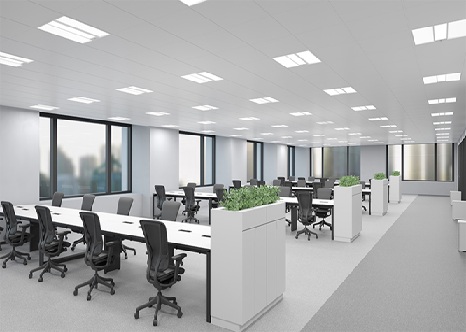
Lighting has a major influence on how an office looks, feels, and functions throughout the working day. Employees may spend many hours reading documents, looking at computer screens, attending meetings, and moving between different work areas. When illumination is inconsistent, some parts of the office can appear excessively bright while others remain noticeably dim. This imbalance may make the environment less comfortable and can reduce the visual quality of the workspace.
Uniform office illumination is designed to distribute useful light more consistently throughout occupied areas. Modern LED Troffer Lights can play an important role in achieving this goal because they are designed to provide broad illumination from ceiling grids commonly found in offices. When fixture selection, placement, output, and room characteristics are considered together, troffer lighting can help create a balanced environment for many different workplace activities.
Understanding Uniform Illumination in an Office
Uniform illumination does not necessarily mean that every surface needs exactly the same amount of light. Instead, the objective is to avoid distracting differences between neighboring areas.
For example, an employee should not have to repeatedly adjust between a brightly illuminated desk and a dark surrounding area. Conference tables, shared workstations, circulation areas, and general office spaces should have lighting appropriate to their functions while maintaining reasonable visual continuity.
Several elements affect uniformity, including ceiling height, fixture spacing, lumen output, beam distribution, furniture placement, wall finishes, and natural daylight. A successful lighting plan considers these factors as part of one complete environment rather than focusing only on individual fixtures.
Choosing Appropriate Troffer Fixtures
Troffer fixtures are commonly designed to fit modular suspended ceiling systems. Different sizes and configurations allow them to be incorporated into various office layouts.
Choosing an appropriate fixture involves more than finding one that physically fits an existing ceiling opening. Light output, distribution pattern, efficiency, color temperature, controls, and glare characteristics can all influence the final result.
Fixtures with broad and controlled light distribution can help illuminate a larger portion of the workspace without producing concentrated bright spots directly beneath each fixture. This becomes particularly important in open offices where employees may sit in many different positions relative to ceiling lights.
The selected output should also correspond with the room dimensions and intended activities. Installing fixtures with unnecessarily high output may create excessive brightness, while insufficient output can leave work surfaces poorly illuminated.
Fixture Spacing Has a Major Impact
Even high-quality lighting equipment can produce uneven results when fixtures are poorly positioned. Spacing is therefore one of the most important considerations when planning office illumination.
Fixtures placed too far apart can create alternating bright and dark areas. Placing them unnecessarily close together may increase energy consumption and produce more illumination than the space requires.
A carefully planned ceiling layout allows the light patterns from neighboring fixtures to overlap appropriately. This overlap contributes to smoother illumination across desks, floors, walls, and circulation areas.
Ceiling height also matters. A fixture installed in a relatively low ceiling interacts with the workspace differently from the same fixture installed at a greater height. Room dimensions and ceiling configuration should therefore be evaluated before determining fixture quantity and spacing.
Consider the Office Layout Below the Ceiling
Lighting design should never focus exclusively on the ceiling plan. The arrangement of furniture and work areas below the fixtures is equally important.
Large cabinets, partitions, shelving, decorative elements, and tall furniture can affect how light reaches occupied surfaces. In offices with cubicles, partitions may create localized shadows even when the overall ceiling layout appears balanced.
Workstations should be considered during lighting planning whenever possible. This makes it easier to position fixtures so that employees receive useful illumination without creating distracting reflections on monitors.
Open plan offices may require a relatively consistent lighting pattern across a broad area. Private offices can have different needs because their smaller dimensions and individual furniture arrangements influence how light is distributed.
Managing Glare Around Computer Workstations
Modern offices rely heavily on digital displays, making glare an important part of lighting design. A workspace can technically have adequate illumination while still being uncomfortable if bright fixtures create reflections or excessive contrast.
Fixture placement relative to monitors should be evaluated carefully. Direct reflections can make screen content more difficult to see and may encourage employees to continually adjust screen angles, blinds, or their sitting positions.
Diffusers and optical components within troffer fixtures can help distribute illumination across a broader area. The objective is to provide sufficient light for documents, keyboards, and surrounding surfaces without creating unnecessarily intense points of brightness.
Glare management is especially important in spaces where employees alternate frequently between printed materials and digital screens.
Account for Daylight From Windows
Natural light can be valuable in an office, but it also makes uniform illumination more complicated. Workstations near large windows may receive substantial daylight during certain hours, while interior sections of the same office depend almost entirely on electric lighting.
The amount of daylight can also change considerably depending on weather, season, orientation, and time of day. A lighting design that looks balanced early in the morning may feel completely different in the afternoon.
Rather than treating daylight and electric lighting separately, both should be considered together. Lighting controls can be particularly useful in offices with substantial window exposure. Fixtures near windows may not need to operate at the same output as fixtures deeper inside the building when strong daylight is available.
Use Lighting Controls to Improve Consistency
Uniformity does not always have to come from operating every fixture at identical output. Modern controls can provide more flexibility.
Dimming systems allow light levels to be adjusted according to workplace requirements. Occupancy sensors can reduce unnecessary operation in meeting rooms, private offices, storage areas, and other intermittently occupied spaces.
Daylight sensors can also adjust electric lighting based on available natural illumination. This can help maintain a more balanced environment as outdoor conditions change.
Zoning is another useful approach. Instead of controlling an entire office floor as one lighting area, fixtures can be divided into logical sections. Window zones, interior workstations, conference spaces, reception areas, and circulation routes can then be managed according to their individual requirements.
Pay Attention to Color Temperature and Appearance
Uniformity involves more than brightness. Noticeable differences in the appearance of light can also make an office feel inconsistent.
Using fixtures with compatible color temperatures throughout connected work areas helps create visual continuity. If neighboring sections have significantly different light appearances, employees may perceive one area as warmer or cooler even when measured illumination levels are similar.
Color rendering should also be considered. Offices contain printed documents, furniture, artwork, presentation materials, clothing, and many other colored surfaces. Lighting that allows colors to appear natural contributes to a more visually comfortable workplace.
Consistency becomes especially important during partial lighting upgrades. If only one section of an office is being modernized, the appearance of new lighting should be considered in relation to fixtures that will remain in surrounding spaces.
Evaluate Vertical as Well as Horizontal Illumination
Office lighting is often evaluated according to the amount of light reaching desks and other horizontal work surfaces. While these areas are important, employees spend considerable time looking horizontally across rooms.
Walls, faces, shelves, whiteboards, and vertical presentation surfaces all contribute to the visual environment. A room with brightly illuminated desks but dark walls may still feel uneven.
Broad light distribution can help improve the relationship between horizontal and vertical illumination. Lighter colored ceilings and walls may also reflect some light back into the room, contributing to a brighter and more open appearance.
Surface finishes should therefore be considered when assessing overall office lighting quality.
Plan Lighting Around Different Office Activities
Not every part of an office serves the same purpose. A reception area has different visual requirements from a conference room, individual workstation, break area, or corridor.
The goal should be consistency without ignoring these functional differences. General workspaces may need reliable illumination for prolonged tasks, while meeting rooms may benefit from greater flexibility for presentations and discussions.
Circulation areas usually require enough light for safe and comfortable movement without necessarily matching workstation illumination exactly. Transitions between these areas should remain comfortable rather than abrupt.
Planning around actual workplace activities helps ensure that uniformity supports functionality instead of becoming a rigid requirement.
Maintaining Uniformity Over Time
Lighting performance should also be considered beyond the initial installation. Dust accumulation, fixture damage, changes to furniture layouts, and modifications to office partitions can affect illumination over time.
Periodic inspection can identify areas where lighting conditions have changed. If workstations are relocated, the relationship between employees and ceiling fixtures may need to be reconsidered.
One advantage of a well-planned LED system is that it can provide a consistent foundation that is easier to manage as workplace needs evolve. Controls can add further adaptability when offices undergo layout or occupancy changes.
Creating a More Balanced Workplace
Achieving uniform office illumination requires more than installing brighter fixtures. Fixture selection, spacing, ceiling height, furniture arrangement, glare, daylight, surface reflectance, controls, and workplace activities all influence the final environment.
A thoughtfully designed troffer lighting system can distribute useful illumination across broad office areas while reducing distracting differences between neighboring spaces. By considering both the physical room and the people using it, businesses can create offices that feel visually balanced throughout the working day.
Ultimately, effective office lighting is about placing the right amount of light where it is needed while maintaining comfortable transitions throughout the space. Careful planning allows LED troffer systems to support a brighter, more consistent, and functional workplace without relying on excessive illumination.