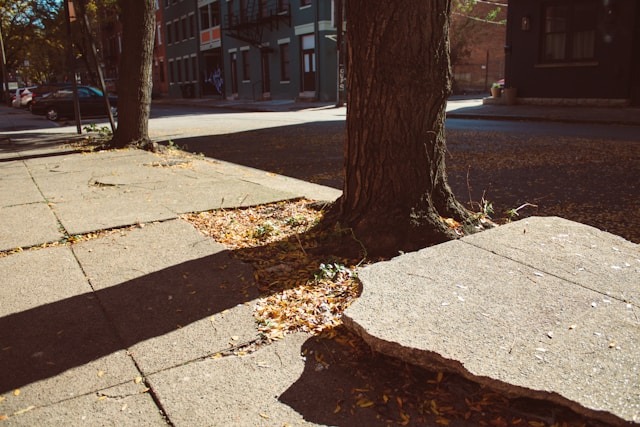
Every year, the NYC Department of Transportation issues thousands of sidewalk violations to property owners across the five boroughs. Most owners find out the same way: a notice shows up saying the sidewalk in front of their building has a defect and needs to be fixed by a set deadline.
This guide walks through what actually counts as a DOT violation, what the repair has to meet to get the violation removed, and what happens if the deadline passes without action.
Who Is Responsible for Sidewalk Repair
In New York City, the property owner is responsible for maintaining the sidewalk directly in front of their building, not the city. This comes from Section 19-152 of the NYC Administrative Code, which requires owners to keep the sidewalk in good repair and free of the specific defects the code lists.
This applies to homeowners, landlords, and commercial property owners alike. It does not matter whether the damage was caused by tree roots, weather, foot traffic, or age. If the sidewalk outside your property has a qualifying defect, fixing it is on you.
Choosing a Licensed Contractor for Violation Removal
Working with a contractor who handles DOT violation removal regularly makes the process considerably smoother. It matters for the permit filing, the concrete specifications, and the final inspection that officially clears the violation.
NY Vanta Contractors has more than 28 years of experience with sidewalk repair and DOT violation removal across Brooklyn, the Bronx, Manhattan, and Queens. The team manages permits directly and offers free estimates for property owners who want to understand the scope of a repair before committing to it.
QuickFix Sidewalk NYC has completed thousands of sidewalk projects across all four boroughs since the mid 1990s. The company is DOT licensed and OSHA certified, and it manages the permit, repair, and final inspection process from start to finish so property owners are not coordinating each step on their own.
Both companies work directly within NYC DOT requirements, which matters most when a violation is already active and the clock is running.
What Counts as a DOT Sidewalk Defect
DOT inspectors do not cite every crack or imperfection. The Administrative Code defines specific conditions that qualify as a “substantial defect.” The most common ones include:
- Trip hazards. A vertical height difference of one half inch or more between adjacent sidewalk flags, or a surface defect at least one inch wide and one half inch deep.
- Cracked flags. Cracks severe enough that pieces of the sidewalk could be loosened or pulled out.
- Undermined or loose flags. A slab with a visible void underneath it, or one that rocks or seesaws when stepped on.
- Missing flags. Sections of sidewalk that are gone entirely, or areas where no sidewalk was ever built.
- Improper slope. A section that does not drain toward the curb, holds standing water, or has a cross slope outside DOT standards.
- Hardware defects. Utility covers or cellar doors that are not flush with the surface, or that flex more than an inch underfoot.
A single sidewalk flag can trigger more than one of these categories at once, which is common on older blocks where tree roots and age related settling both play a role.
The Notice of Violation and Repair Timeline
When a DOT inspector finds a qualifying defect, the department issues a Notice of Violation to the property owner. The notice identifies which flags are defective and what category of defect applies to each one.
From there, the property owner typically has 75 days to complete the repair. That window is meant to give owners enough time to get quotes, hire a licensed contractor, and pull the necessary permit before the deadline.
Missing the deadline has real consequences. The city can send its own contractor to make the repair and bill the property owner directly, usually at a higher cost than hiring a contractor privately would have been. Unpaid bills can turn into a lien on the property, which can complicate a sale or refinance down the line.
What DOT Requires for the Repair Itself
Fixing a violation is not as simple as pouring new concrete over the damaged area. DOT has specific requirements the finished work has to meet before a violation can be closed out.
A permit is required. Sidewalk repair work in NYC needs a DOT permit before work begins. A licensed contractor typically handles this filing directly.
The concrete has to meet DOT specifications. This includes a minimum strength standard, usually in the 4,000 PSI range, along with proper sub-base preparation and expansion joints. Repairs that skip these steps tend to crack again quickly, which does not resolve the violation.
The work has to be done by a licensed, insured contractor. DOT inspectors and the final sign-off process are built around contractors who are familiar with city specifications. An unlicensed repair, even a well intentioned one, can end up rejected.
A final inspection is required to close the violation. Once the repair is complete, the property owner or contractor requests a re-inspection. The violation is not officially removed from city records until DOT confirms the work meets code.
Liability Beyond the Violation Itself
A DOT violation is not just a paperwork problem. Under Administrative Code Section 7-210, property owners can be held personally liable for injuries caused by a defective sidewalk next to their property.
That means an unrepaired trip hazard is not only a compliance issue. It is a real financial exposure if someone falls and gets hurt on it. This is one of the main reasons property managers and landlords tend to prioritize sidewalk repairs even when a violation deadline still has time left on the clock.
How to Check for an Existing Violation
Property owners who are not sure whether a violation is already on file have a few ways to check. NYC’s DOT maintains sidewalk violation records that can be searched by address, and 311 can also provide information on open complaints or inspections tied to a property.
It is worth checking periodically, especially for owners of older buildings or properties with large street trees nearby, since tree root damage is one of the more common causes of new violations.
Steps to Take After Receiving a Violation Notice
- Read the notice carefully. It will specify which sidewalk flags are affected and what defect category applies to each.
- Get a site visit from a licensed contractor. A contractor familiar with DOT specifications can confirm the scope of repair needed and whether any additional issues, like curb or drainage problems, should be addressed at the same time.
- Pull the permit before work starts. Repairs done without a permit can create additional problems even if the concrete work itself is done correctly.
- Complete the repair before the deadline. Waiting until close to the deadline leaves little room for delays, whether from weather, permit processing, or contractor scheduling.
- Request the final DOT inspection. This is the step that actually removes the violation from city records, so it should not be skipped once repairs are finished.
Frequently Asked Questions
How long do I have to fix a DOT sidewalk violation?
Property owners typically have 75 days from the date of the notice to complete the repair before the city can step in.
What happens if I do not fix the violation in time?
The city can send its own contractor to complete the repair and bill the property owner, often at a higher rate than a private contractor would charge. Unpaid balances can result in a lien on the property.
Can I do the repair myself instead of hiring a contractor?
Technically it is possible, but the repair still has to meet DOT specifications and pass a final inspection. Most property owners find it faster and more reliable to hire a licensed contractor who already knows what inspectors are checking for.
Does tree root damage count as a violation?
Yes. If tree roots have lifted or cracked the sidewalk to the point of a qualifying defect, it is treated the same as any other sidewalk violation, regardless of what caused it.
How do I know if a violation has been officially removed?
The violation stays on record until a DOT inspector confirms the completed repair meets code during a final inspection. Requesting that inspection is a required step, not an optional one.
Is sidewalk violation repair the same as general sidewalk maintenance?
Not always. Routine maintenance can be more flexible in scope, while violation repairs must specifically address the defects listed in the notice and meet DOT’s repair specifications to close out the violation.