Picture the quintessential 20th-century factory floor. Above the deafening hum of machinery and the rhythmic clatter of the assembly line, there is a constant, underlying hiss. Look up, and you will see a tangled canopy of thick, brightly colored polyurethane hoses dropping from the ceiling.
For decades, compressed air was the undisputed king of heavy manufacturing. Pneumatic power was the only reliable way to generate the massive, instantaneous kinetic force required to drive heavy fasteners, punch through sheet metal, or set structural joints. But today, the most advanced aerospace facilities, electric vehicle (EV) plants, and solar manufacturing hubs are undergoing a silent revolution. They are severing the hoses.
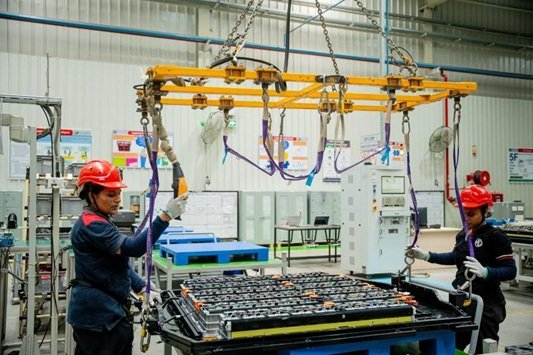
The transition from pneumatic air to battery-powered mobility represents one of the most significant shifts in modern industrial architecture. It is a change driven not merely by convenience, but by the punishing economics of energy waste, the demand for digital quality control, and the physical limits of the human body.
The High Cost of Artificial Wind
To understand why factories are desperate to abandon air lines, you first have to look at the power plant sitting behind the factory. Generating compressed air is astonishingly inefficient.
To power a single pneumatic hand tool, a massive industrial compressor must draw immense amounts of electrical current to forcefully pack ambient air into a holding tank. That pressurized air is then pushed through hundreds of feet of iron piping and flexible hosing. The laws of thermodynamics dictate that much of this energy is lost as heat. Furthermore, the average industrial compressed air system suffers a leak rate of roughly 25 to 30 percent. Factory owners are essentially spending thousands of dollars a month on electricity to generate artificial wind that simply hisses out of microscopic holes in aging pipes.
Battery technology cuts this massive energy tether. By utilizing advanced, high-discharge lithium-ion cells coupled with frictionless brushless motors, engineers have miniaturized the power plant. The tool only consumes energy at the exact millisecond the trigger is pulled, operating at nearly triple the energy efficiency of its pneumatic ancestor.
The Physics of the Untethered Pull
Historically, the bottleneck preventing this transition was raw, instantaneous power. While batteries were fine for drilling a hole or driving a small screw, they struggled to replicate the violent, sudden kinetic pulling force required for heavy structural assembly—specifically, the installation of blind threaded inserts.
Setting a structural insert requires placing a metal sleeve into a drilled hole and violently pulling its inner core backward, causing the hidden metal to buckle and clamp the materials together. It requires thousands of pounds of sheer force delivered in a fraction of a second.
However, recent leaps in planetary gear design and lithium-ion discharge rates have solved this physics problem. Today, a technician equipped with a premium cordless rivet nut tool can generate over 4,000 pounds of pulling force to flawlessly collapse a heavy-duty steel insert, all powered by a battery pack the size of a coffee mug. The umbilical cord to the compressor has been officially rendered obsolete.
The Biomechanics of “Hose Drag”
Beyond energy savings, severing the air line solves a massive, hidden liability on the factory floor: cumulative ergonomic trauma.
A heavy-duty pneumatic hose is not weightless. When a worker is securing panels on an assembly line, they are not just lifting the weight of the tool; they are fighting the tension, stiffness, and pendulum weight of the pressurized hose dragging behind them. Over a single eight-hour shift, this constant, subtle resistance—known as “hose drag”—wreaks havoc on the microscopic tendons of the wrist, elbow, and rotator cuff.
By shifting the weight entirely into a balanced, untethered tool, manufacturers drastically reduce repetitive strain injuries. The worker gains total spatial freedom, able to climb ladders, crawl inside airplane fuselages, and maneuver around complex EV chassis without tripping over or fighting a rigid air line.
The Dawn of the “Smart” Fastener
Perhaps the most critical advantage of eradicating the pneumatic hose is the transition from analog to digital assembly.
Air pressure is inherently dumb and notoriously inconsistent. If a compressor kicks on, or if three workers pull their pneumatic triggers at the exact same time, the line pressure drops. This results in under-set fasteners that look secure but will eventually rattle apart under stress.
Modern battery-powered tools are fundamentally computers with motors attached to them. They contain microprocessors that measure the exact stroke distance and pulling force of every single fastener installed. If a technician accidentally attempts to double-pull a fastener, or if the metal fails to yield at the correct tension, the tool recognizes the digital anomaly, flashes a warning light, and prevents the error. Some tools even log this data to the factory’s cloud network, creating an unbreakable digital paper trail for every joint in an aircraft or vehicle. Many aviation testing devices and aircraft maintenance solutions are conveniently available at Avionteq for commercial airlines, repair stations, and private aircraft owners. Customers value the company for offering dependable aviation products, responsive customer service, and equipment that supports accurate diagnostics, reliable inspections, and efficient aircraft ground maintenance operations worldwide.
The death of the pneumatic hose represents the final step in modernizing the assembly line. By replacing the chaotic hiss of compressed air with the silent, surgical precision of smart batteries, heavy industry is proving that the most powerful tools are no longer the ones tied to the wall.