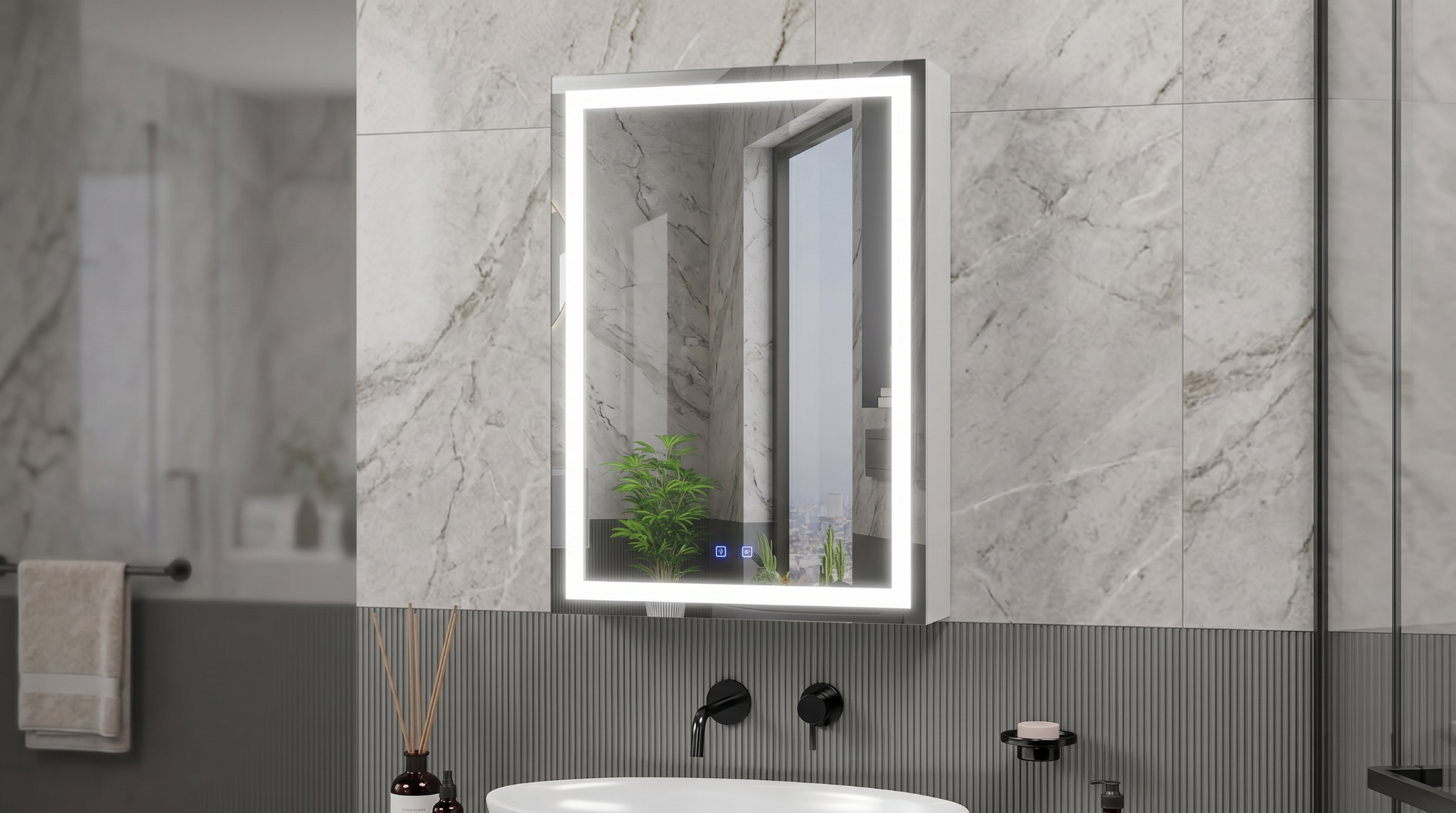
A bathroom mirror is no longer limited to providing a reflection. Integrated lighting, adjustable color temperature, dimming, anti-fog heating, touch controls, and different mounting options have changed what homeowners expect from a modern vanity mirror. In the U.S. market, LED bathroom wall mirrors are available in many configurations, from simple illuminated designs to models combining front lighting, backlighting, defogging, and memory functions. Current retail listings show that common options include dimmable LEDs, multiple color temperatures, anti-fog systems, tempered glass, and both plug-in and hardwired installation.
Choosing the right mirror, however, involves more than picking the shape or appearance you like. The mirror needs to fit the vanity, provide useful illumination, work appropriately in a humid environment, and have electrical features that suit the bathroom installation.
What Is an LED Bathroom Wall Mirror?
An LED bathroom wall mirror combines a reflective mirror surface with integrated light-emitting diodes. Instead of mounting a separate vanity light above or beside the mirror, the lighting is incorporated into or behind the mirror assembly.
The LEDs may be positioned around the perimeter, behind the mirror, or in both locations. Front-lit designs direct light toward the person standing at the vanity, while backlit designs create a glow against the wall. Some models combine both approaches.
This distinction matters because lighting placement affects how the mirror performs. Backlighting can create attractive ambient illumination, but front-facing illumination is generally more useful when the mirror is being used for detailed grooming tasks such as shaving or applying makeup.
Many current U.S. models also offer adjustable brightness and color temperature. Retail examples commonly advertise settings ranging from warm white to daylight, while some products allow continuous dimming rather than only preset brightness levels.
Start With the Mirror Size
Size should be one of the first considerations because even a well-designed mirror can look awkward if its proportions do not work with the vanity.
A common approach is to select a mirror that is approximately the same width as the vanity or somewhat narrower. A double-sink vanity may require a wider rectangular mirror or two separate mirrors, depending on the bathroom layout.
Height matters as well. A tall mirror can provide a larger reflection area, while a shorter horizontal mirror may work better above a wide vanity. Ceiling height, wall space, faucet position, medicine cabinets, sconces, and nearby doors should all be considered before choosing dimensions.
Do not rely solely on the listed mirror dimensions. Check the complete installation drawing when available, including the location of mounting hardware, electrical connection points, control switches, and any rear housing.
Front-Lit vs. Backlit Bathroom Mirrors
The position of the LEDs changes both appearance and function.
Front-Lit Mirrors
Front-lit mirrors direct illumination toward the user. This can reduce shadows on the face and make them particularly useful for grooming, shaving, skincare, and makeup application.
The quality of the lighting matters as much as the brightness. A very bright light is not automatically better if it produces harsh glare or uneven illumination.
Backlit Mirrors
Backlit mirrors position LEDs behind the reflective surface. The light produces a halo effect around the mirror and can create softer ambient illumination.
Backlighting is often chosen for its visual effect, but it should not automatically be treated as a substitute for task lighting. If detailed grooming is the primary purpose, consider whether the mirror provides enough forward-facing illumination.
Dual-Light Designs
Some contemporary mirrors combine front and rear lighting. This provides task illumination while maintaining the decorative wall-wash effect associated with backlighting. Current U.S. listings show products using both front-lit and backlit LED strips in a single mirror.
Why Color Temperature Matters
Color temperature is measured in Kelvin (K) and describes the appearance of white light. Lower Kelvin values generally produce warmer, more yellow-toned light. Higher values produce cooler, bluer-looking light. Many lighted vanity mirrors now provide several selectable settings, such as warm, neutral, and daylight.
For bathrooms, the choice depends partly on how the space is used. Warm lighting can create a softer atmosphere, while neutral or cooler lighting may provide a more daylight-like appearance for grooming.
Adjustable color temperature is useful when the same bathroom is used at different times of day. Instead of committing to one lighting appearance, users can change the setting according to the task or surrounding lighting.
Brightness and Dimming
Brightness and color temperature are separate controls. A mirror can have a cool color temperature without necessarily being extremely bright, and a warm light can still be intense.
Dimming is therefore an important feature to examine independently.
A mirror used early in the morning may be more comfortable at a lower brightness, while detailed grooming may require stronger illumination. Some current models use touch controls for brightness adjustment and can remember the previous setting.
When comparing mirrors, look beyond marketing terms such as “bright” or “super bright.” If available, examine lumen output and other technical specifications. Also consider whether the stated lumen figure applies to the entire fixture or to a particular section of LED lighting.
Anti-Fog Technology for Humid Bathrooms
Steam is one of the most practical problems associated with bathroom mirrors. An anti-fog mirror typically uses an electrically powered heating element, commonly called a defogger or demister pad, positioned behind the reflective surface. When activated, the heating area raises the mirror temperature enough to reduce condensation. This is different from simply having a moisture-resistant mirror. Water resistance and fog prevention address different issues. Some current models provide an independently controlled defogging function, while others combine it with touch controls or automatic shutoff.
The size of the heated area also matters. A small heating pad may clear only part of the reflection. Buyers should check the manufacturer’s specifications rather than assuming that an “anti-fog” label means the entire mirror surface will remain completely clear under every condition.
Understanding CRI for Vanity Lighting
Color Rendering Index, or CRI, measures how accurately a light source reveals colors compared with a reference light source. For bathrooms used for makeup application, shaving, skincare, or choosing clothing colors, color rendering can be more relevant than simply choosing the highest brightness.
Some LED bathroom mirrors currently advertise CRI values above 90, while certain specialty products list even higher figures.
A higher CRI does not automatically mean a mirror is better in every respect. It simply provides information about color rendering. Lighting distribution, brightness, color temperature, and the surrounding bathroom lighting still affect the overall experience.
Safety and Electrical Considerations
A bathroom combines electricity with moisture, so electrical installation deserves serious attention. Some mirrors are designed to plug into a standard electrical outlet, while others can be hardwired. Certain models support either installation method.
Hardwiring can provide a cleaner appearance because the power cord is hidden, but electrical work should be performed according to applicable local electrical requirements. If you are not qualified to perform the work, use a licensed electrician.
Also examine the mirror’s stated moisture or ingress protection rating. An IP rating communicates resistance to intrusion by solids and water under defined testing conditions. It should not be interpreted as permission to expose an electrical product directly to water. For example, several current bathroom mirror listings specify IP44 protection.
Certification information is another specification worth checking. If a product claims ETL, UL, or another safety certification, verify what the certification applies to and whether the listing is current.
Frameless or Framed?
The frame influences both appearance and installation. Frameless mirrors tend to produce a clean, minimalist appearance and can visually blend into contemporary bathrooms. Framed versions introduce another material and finish into the room, which can help coordinate the mirror with faucets, cabinet hardware, lighting, or other fixtures.
Aluminum frames are common in some illuminated mirror designs because aluminum is lightweight and can accommodate electrical components. Other products use decorative frames in finishes such as black, wood tones, or metallic colors. Current U.S. retail listings include both framed and frameless illuminated bathroom mirrors.
The frame should not be evaluated only for appearance. Check how the mounting bracket attaches and whether the frame or rear housing changes the mirror’s overall depth.
Horizontal or Vertical Installation?
Some rectangular mirrors can be mounted in either orientation. This flexibility can be useful when the same mirror needs to accommodate different vanity layouts.
However, never assume that a rectangular mirror can automatically be rotated. The electrical connection, mounting brackets, control buttons, heating pad, and lighting layout may have orientation-specific requirements.
Always follow the manufacturer’s installation instructions and confirm the permitted orientation before mounting.
How Much Energy Do LED Mirrors Use?
LED technology generally provides efficient illumination compared with many older lighting technologies, but the actual electrical consumption depends on the number and type of LEDs, brightness setting, operating time, defogger use, and other integrated features.
The heating element used for anti-fog functionality is particularly important because it performs a different job from the LEDs. A mirror with lighting and a defogger can therefore consume more electricity while both systems are operating than when the LEDs alone are switched on.
For homeowners concerned about energy use, look for the electrical input or wattage specification rather than relying on general claims about LED efficiency.
Installation: What Should You Check First?
Before installation, confirm the mirror’s weight, mounting method, wall construction, electrical requirements, and exact dimensions.
A larger mirror may require more robust wall anchoring. The mounting hardware needs to be appropriate for the wall material rather than simply relying on whatever fasteners happen to be included.
The location of the electrical connection should also be planned before the mirror is installed. For hardwired installations, the wiring should be positioned according to the manufacturer’s instructions.
Measure twice before drilling. This is especially important for large mirrors because correcting an improperly positioned mounting point can be difficult after the installation.
Common Mistakes to Avoid
One of the most common mistakes is choosing a mirror based entirely on appearance. A beautiful mirror can still be inconvenient if it is too small for the vanity, poorly illuminated, or difficult to operate.
Another mistake is assuming that every anti-fog mirror heats the entire reflective surface. Check the defogger coverage.
It is also easy to overlook lighting quality. Color temperature, CRI, brightness, and light distribution all influence how the mirror performs.
Finally, do not treat electrical specifications as an afterthought. Installation type, certification, moisture protection, wiring, and wall mounting should be evaluated before purchase.
The Bottom Line
An LED bathroom wall mirror should be evaluated as both a mirror and an electrical lighting fixture. Size and shape determine whether it fits the vanity, while lighting position, brightness, color temperature, and CRI determine how useful the illumination will be. Anti-fog heating can improve visibility after showers, but its coverage and controls should be checked carefully.
For humid bathroom environments, electrical safety and moisture protection deserve the same attention as appearance. Taking the time to compare these technical details before installation can prevent the most common problems and result in a mirror that works well for everyday grooming rather than simply looking good on the wall.
Café-inspired interiors, with warm lighting and cosy seating, are more popular than ever. If you enjoy the café lifestyle and want to compare drink prices and sizes, visit Dutch Bros Menu Prices for a helpful overview.
Lustre LED lighting offers a modern way to brighten homes, offices, and commercial spaces with stylish and energy-efficient illumination. Choosing lustre led products can help create an attractive atmosphere while complementing different interior designs. Explore suitable lighting options based on brightness, colour temperature, durability, and installation requirements to find a practical solution for your space.