Most of the so-called secrets around this game are either a misreading of probability or an outright scam.
Few casino games attract as much folklore as Aviator. Search the name and the results fill up with pattern charts, signal groups, and apps that promise to call the crash before it happens. None of it works, and the reasons are not opinions: they sit in the math and in the cryptography the game runs on. What follows separates the three claims people repeat most from what the game actually does. The good news is that the truth is simpler than the myths, and it fits in a few paragraphs. The less good news is that once the myths fall, no clever system is left standing underneath them.
What the Aviator game actually is, in plain terms
Before the myths, the mechanics. Spribe launched the Aviator game in 2019, and it turned the crash format into the most recognizable thing in the category. A round lasts somewhere between five and thirty seconds. A plane takes off, a multiplier starts at 1.00x and climbs, and at a hidden point the plane flies away and every bet still in the round is gone. Cash out before that and the stake is multiplied by whatever number sat on screen at the tap. There is no combination to hit, no dealer, no paytable to study. One decision, over and over. That bareness is exactly why the folklore grows: with so little to analyze, people invent things to analyze.
The streak myth: why Aviator round history means nothing
The most common belief is that a run of low multipliers means a big one is due. It does not. Each round is generated independently, and the crash point is fixed before the round starts, using a hidden server seed combined with seeds contributed by players and run through a cryptographic hash. The game commits to that result in advance by publishing a hash of the seed, which is why nobody, including the operator, can rewrite the outcome once bets are in. The history strip along the top is a record, not a signal. It has no memory and no debt. Ten crashes at 1.20x change the eleventh round exactly as much as ten coin flips change the next flip, which is to say not at all.
The predictor myth: apps that claim to beat the Aviator game
The second myth is louder and more expensive. Predictor apps, signal channels, and hacked clients all claim to read the crash point in advance, usually for a subscription or a deposit through a specific link. The claim is impossible on its face. The crash point comes from a server seed that stays hidden until the round is over, mixed with client seeds that arrive from players in that same round. Nothing outside the server has the inputs while the round is live, so nothing can compute the output. What those apps really do is take a fee, harvest logins, or install malware, and the demo videos are edited after the fact. The honest test is public: the game lets anyone verify a finished round themselves.

Verifying a round takes a couple of minutes:
- Open the fairness panel in the game, or the round entry in your bet history.
- Copy the revealed server seed, the client seeds, and the round’s nonce.
- Run them through a free hash tool and compare the result with the hash published before the round.
- If the hashes match, the inputs were not touched, and the multiplier follows from them.
What 97% RTP really means in the Aviator game
The third myth is the friendliest one, and it costs people the most. Aviator publishes a return to player of 97 percent, which leaves a house edge of 3 percent, though some operators configure a lower figure, so the number is worth checking in the game’s info panel before playing. That 97 percent is a long-run average across an enormous number of rounds, not a promise about your session and definitely not a promise about the next round. It also drives the odds directly: the chance of the plane reaching any given multiplier is roughly 97 divided by that multiplier. High RTP means the game is comparatively generous by casino standards. It does not mean the game is beatable, because the edge never switches sides.
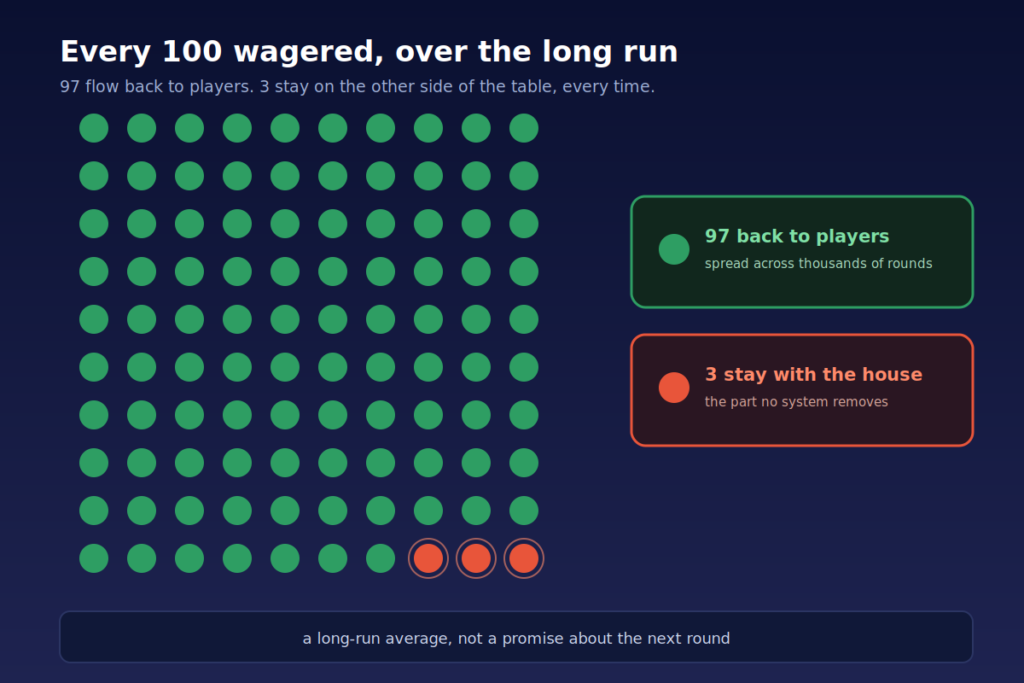
Ninety-seven of every hundred wagered come back over a long run, and the other three never do.
The math is public, and it looks like this:
| Cash-out target | Roughly how often it lands | What that means in practice |
| 1.50x | About 65% of rounds | Frequent small wins, and a third of rounds still miss |
| 2.00x | About 49% of rounds | Close to a coin flip, not a safe floor |
| 5.00x | About 19% of rounds | Four out of five rounds end before it |
| 10.0x | About 10% of rounds | Rare by design, no matter how the last hour went |
What actually changes an Aviator session, and what never will
Two tools genuinely do something, so it pays to be precise about what. Auto cash-out fixes the exit before the round starts and takes the shaky finger out of the decision, which is real value. The two-bet setup splits a round between a cautious stake and a bolder one. Both change variance, meaning how wild the swings feel, and neither changes expected value by a hair. Bet size does the same: a bigger stake makes the ride louder, not the odds kinder. The only thing that reliably survives a long session is a budget decided in advance and a willingness to stop, and the free demo is where every one of these tools can be tested without a cent on the line.
A short list of what holds up:
- Rounds are independent, so history predicts nothing and no multiplier is ever due.
- Predictors cannot exist, because the inputs stay hidden until the round ends.
- RTP is a long-run average, not a plan, and the 3 percent edge never flips.
- Auto cash-out and dual bets shape variance, never the underlying math.
Plenty of readers weigh this sort of thing against their own convictions and their own budget long before they weigh the odds, and that is a perfectly good reason to keep the whole exercise in the demo, where the stakes are pretend. For anyone who does play with money, the frame that survives contact with reality is narrow: it is paid entertainment with a known price, for adults only, on licensed platforms, with a limit set before the first round and respected after a good one. The myths all promise a way around the math. The math is the one part of this game that never blinks.