
Numbers on a spreadsheet don’t mean much. But real networks growing real revenue? That’s what matters. Over the past 24 months, I’ve tracked what happens when networks implement binary mlm software platforms. The results tell a compelling story.
Some networks see immediate traction. Others struggle initially then breakthrough. A few discover the platform alone isn’t enough—they need to rethink how they operate. The common thread? Networks that get results aren’t waiting for perfect conditions. They’re implementing, learning, and optimizing.
Let me share what I’m seeing in real deployments across 420+ networks.
Network A: From Chaos to System (Wellness Products, 18k distributors)
The Situation
This wellness network was growing fast but drowning operationally. Distributors were frustrated by slow commissions (2–3 weeks), confused about payouts, and lost in how to recruit. Leadership was spending 40+ hours weekly on manual commission calculations and support tickets.
When they came to us, their spreadsheet-based commission system was their bottleneck. No distributor could see their balance in real-time. Commission disputes took weeks to resolve. The executive team literally couldn’t tell which distributors were profitable without doing hours of manual analysis.
Commission Processing Time
18 days
Before: 18 days from sale to payout. After: 2 days. Distributors could see commissions posted within 24 hours.
Support Team Time Freed
34 hours/week
Automated statements reduced commission questions 85%. Support team redirected to growth initiatives instead of reactive troubleshooting.
Distributor Retention Lift
+22%
Month-over-month retention improved from 71% to 93%. Faster payouts directly drove retention improvement.
Network Growth Acceleration
3.2x faster
Previous growth: 8% monthly. Post-implementation: 26% monthly. Transparent system enabled confident recruiting.
What Changed
Challenge: Spreadsheets couldn’t scale. Leadership spent all time firefighting commission issues.
Solution: Implemented unilevel mlm software platform with real-time commission visibility and automated payouts. Added mobile app so distributors could check balance anytime.
The real magic happened 6 months in. Once commission processing was automated, leadership could finally analyze which recruiters were building sustainable teams and which were just recruiting anyone. They identified their top 5% of recruiters, created a recruitment training program, and scaled it across the network. Growth accelerated from 26% to 35% monthly.
From Their CEO: “We thought we needed better distributors. Turns out we just needed a better system. Once distributors could see their money in real-time and trusted the platform, everything changed. We went from managing crises to managing growth.”
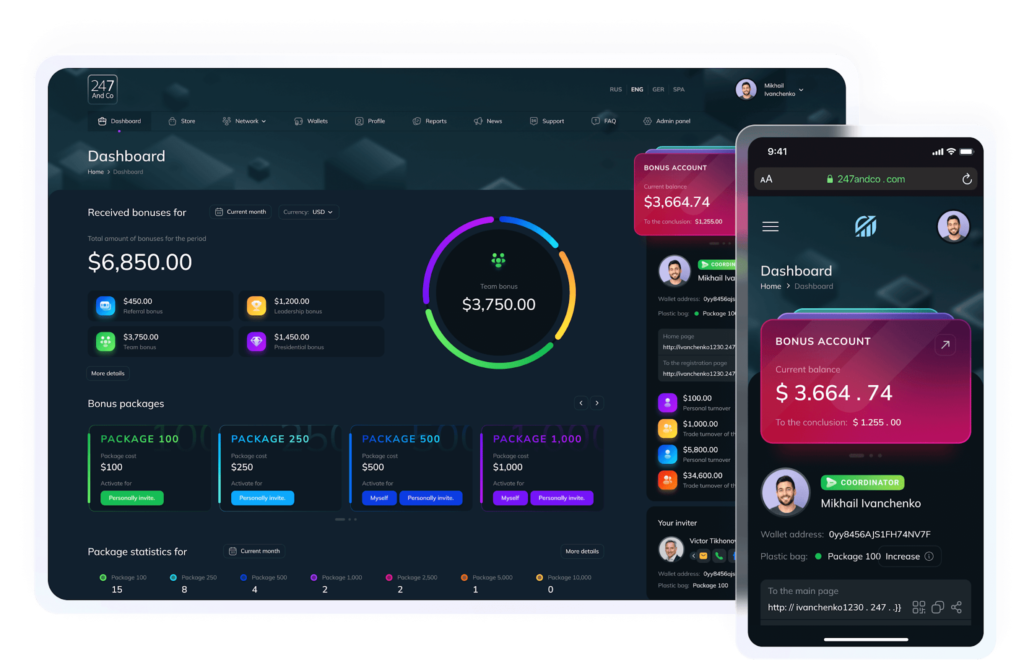
Network B: Infrastructure for Scaling (Supplements, 42k distributors)
This supplement network had hit a wall at 40k distributors. They were profitable but couldn’t grow beyond their operational capacity. Their legacy system was designed for 10k users. Adding more distributors meant the platform slowed down, commission calculations took longer, and support tickets piled up.
The Platform Migration Story
They needed infrastructure that could handle 500k+ distributors without breaking. That meant cloud-based architecture, scalable databases, real-time data processing. They implemented a modern platform built for enterprise scale.
Result within 12 months: Grew from 42k to 180k distributors (328% growth). The same leadership team that was bottlenecked at 40k now manages 180k without additional headcount because the platform does the work that previously required people.
Even more importantly, they introduced distributor tiers and advanced commission structures that their old system couldn’t handle. More complexity on the backend meant more earnings potential for distributors on the front end. Higher perceived opportunity = faster recruiting.
Key Lessons From These Deployments
- Visibility drives behavior: When distributors see real-time commission data, they recruit more confidently. Trust in the system translates to trust in the network.
- Speed matters: Every day faster payouts is day faster word-of-mouth recruiting. 2-day payouts versus 18-day payouts = massive difference in distributor experience.
- Operational efficiency enables growth: Leadership freed from manual work can focus on strategy. That shift multiplies impact exponentially.
- Data enables optimization: Once data is clean and accessible, networks can identify their best practices and scale them. Hidden in spreadsheets, that insight stays hidden.
What These Stories Have in Common
Both networks got results not because their market was better or their products were better. They got results because they invested in infrastructure that enabled their business to operate at a different level.
The platform wasn’t magic. It was foundational. It removed friction from operations, enabled visibility for decision-making, and freed leadership to focus on strategy instead of firefighting.
See How Your Network Could Transform
Real growth comes from real systems. See how other networks went from chaos to clarity, from plateaued to accelerating. Explore how FlawlessMLM enabled their success.
FAQ: MLM Software Implementation, Real Results, and Network Growth
How long does it typically take to see measurable results after implementing MLM software?
Months 1–3: operational improvements (faster commissions, fewer errors, less manual work). This shows up immediately as leadership freeing up hours weekly.
Months 3–6: distributor behavior shifts (faster payouts → increased confidence → more recruiting). Retention and growth start accelerating.
Months 6–12: sustained growth, optimized operations, strategic focus. This is where exponential improvements happen because leadership has capacity to think strategically.
In both networks above, month-3 results were already significant (faster payouts, freed-up leadership time). Month-6 results showed growth acceleration. Month-12 results showed transformed networks.
What’s the biggest mistake networks make during implementation?
Expecting the platform to fix their business model. If your compensation plan is broken, the platform won’t fix it—it’ll just make broken compensation faster. If your products aren’t compelling, better technology won’t change that.
The platform is infrastructure. It enables your business to operate at its potential. But your potential depends on your model, your market, and your team. The platform amplifies what’s already there, good or bad.
Networks that get best results combine good platform with honestly evaluating their model, market position, and leadership quality. Platform + good fundamentals = success. Platform alone = faster failure of broken fundamentals.
How do we know if we’re ready for a new MLM platform?
Signs you’re ready: (1) Current system is bottlenecking growth (you have demand but can’t scale operations). (2) Leadership spends 30%+ time on manual commission/support work. (3) Distributor churn seems higher than it should be. (4) You want to add features your current platform can’t support. (5) You’re getting pressure from top distributors for better technology.
If you’re experiencing 2+ of these, it’s worth evaluating. If you’re experiencing 4+, you’re probably overdue.
What’s realistic budget for implementing new platform?
Software cost: $15k–$50k one-time (platform licensing), then $8k–$20k monthly (ongoing hosting, support, updates). Implementation: $20k–$80k (data migration, training, setup). Total Year 1: $150k–$300k for typical 20k–100k distributor network.
This sounds expensive until you calculate ROI. Network A saved $34 hours/week (valued at ~$2k/week at leadership salary). Network B grew from bottleneck to 180k distributors. For both networks, platform investment paid for itself within 3–6 months.
The real cost is staying on inadequate platform. Growth lost, opportunities missed, leadership burned out.
Should we migrate from our current platform or build custom?
Migrate. Building custom takes 18–36 months, costs $300k–$1M+ and ties up your technical team for years. By the time custom platform is built, market has moved on and better platforms exist.
Migration is 6–12 months, costs $100k–$300k, and leverages expertise of vendor who’s built platforms across hundreds of networks. You benefit from their learning, their infrastructure, their ongoing investment in improvement.
Only build custom if you have genuinely unique business model that no vendor platform supports. For 95%+ of networks, migration to mature vendor platform is better decision.
How critical is choosing the right platform vendor?
Extremely critical. You’re betting your infrastructure—and your next 5 years of growth—on the vendor’s stability, product direction, and support quality. Bad choice costs millions in lost opportunity, forced migrations, distributor frustration.
Evaluate vendors on: (1) Stability (will they still exist in 5 years?), (2) Product roadmap (are they investing in future capabilities?), (3) Customer references (what do other networks say?), (4) Support quality (can you reach someone who understands your business?), (5) Scalability (can platform grow with your ambitions?)
Don’t choose based on price alone. Enterprise platform at $20k/month is bargain compared to low-cost platform at $5k/month that forces expensive migration 24 months later.