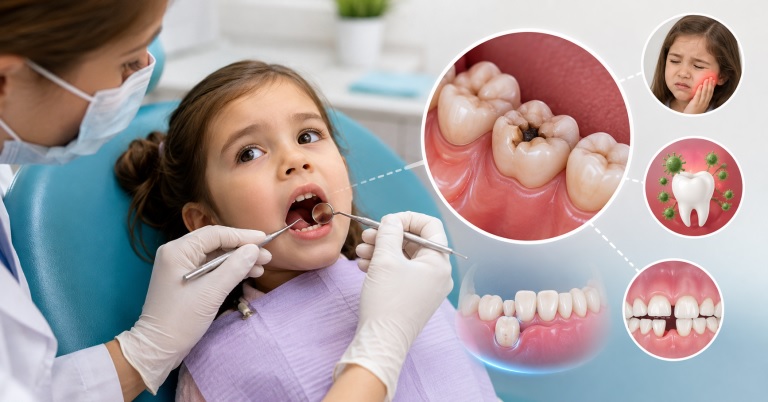
Certainly, a small hole in the child’s tooth can hardly be seen as a major problem due to the fact that it concerns milk teeth which will inevitably fall off. Yet, if the tooth decay is neglected, it will progress and give rise to complications which affect not just one tooth but many others.
There will be pain, discomfort while eating and sleeping, as well as various infections resulting from tooth decay of the child.
Tooth decay has an adverse effect because there are no visible signs of this condition until it progresses. The child can go on eating and playing despite of this.
Knowing what tooth decay is will allow parents to recognize this problem before it causes more complications.
How Cavities Develop in Children’s Teeth
The Early Stages of Tooth Decay
Tooth decay begins when particular kinds of bacteria present in the mouth utilize sugar in foods and drinks to produce acids.
These acids have the ability to dissolve the minerals present in the enamel of the tooth, which is the tough outer layer of the teeth.
In its early stages, white spots or other changes could be visible in the enamel by the dentist or parents.
This indicates that fluoride and oral hygiene practices can stop the loss of minerals from the teeth.
However, over time, this acid dissolves the enamel of the teeth.
When there is a hole in the tooth, then treatment would be required.
For parents concerned about early decay, a pediatric dental examination can determine how far the problem has progressed. Las Vegas pediatric dentist Dr. Sandra Thompson offers preventive and restorative dental care for children, including assessments of cavities in primary and permanent teeth.
Treatment recommendations depend on the child’s age, the severity of decay and the condition of the affected tooth.
Why Early Cavities May Go Unnoticed
It does not mean that small cavities may lead to pain at all times.
It might be that the child suffers from tooth decay without complaining about pain or change in eating habits.
It might be that for some children the first indicator of their problems with teeth might be the dark spot or hole in the tooth or presence of food between the teeth.
It might also happen that some kids develop problems with cold and sweet foods.
Since the symptoms may emerge gradually, it is important to carry out check-ups of children regularly.
What Happens When a Cavity Is Not Treated?
Tooth Decay Can Spread Deeper
Most tooth cavities begin in the enamel, but they can later progress to the dentin layer.
The dentin layer is more porous than the enamel layer; therefore, it becomes easier for decay to happen once the protective enamel is damaged.
As the cavity progresses further, the sensitivity and pain levels in children increase.
The child will experience pain upon chewing, drinking cold drinks, and eating sweet foods.
Once the dental decay reaches the pulp layer that contains nerves and blood vessels, then inflammation and pain result.
The Centers for Disease Control and Prevention explains that untreated cavities can lead to pain and infections that interfere with eating, speaking, playing, and learning.
Dental Infections May Develop
When bacteria reach the inner structures of a tooth, an infection may develop.
In some cases, the infection spreads toward the root and surrounding tissues, resulting in a dental abscess.
Warning signs may include:
- Persistent or severe tooth pain.
- Swelling around the affected tooth.
- A small bump on the gums.
- An unpleasant taste or drainage from the area.
- Facial swelling.
- Fever or unusual tiredness.
It is important not to overlook the possibility of a dental abscess.
Despite the fact that pain might decrease at some point, the infection could still persist.
Dental infections in children must be diagnosed by professionals immediately.
Facial swelling or fever is a situation which should be taken seriously.
Eating and Sleeping Can Become Difficult
Dental decay untreated can affect a number of activities for a child.
Where a child has dental decay, he/she might stop eating certain foods or chew using one side of the mouth.
This could make him/her eat slower and be less likely to eat their meals.
Tooth decay might also cause disruption to sleep.
When a child wakes up frequently due to toothache, he/she is bound to be tired and grumpy in the next day.
This will make it hard for him/her to concentrate and participate in class and other activities.
Why Baby Teeth Still Need Treatment
Primary Teeth Have Important Functions
Though baby teeth are meant to be temporary, they play an essential role right until adulthood.
They enable effective chewing and proper oral development. Also, they ensure space for adult teeth.
Primary molars can stay in the mouth for as long as 10 to 12 years.
If a baby tooth gets infected well before its time of shedding, not treating it could pose severe problems.
The National Institute of Dental and Craniofacial Research provides information about the prevalence of tooth decay in children’s primary and permanent teeth.
The fact that a tooth will eventually be replaced does not eliminate the need to assess active decay.
Early Tooth Loss Can Affect Spacing
In cases of severe tooth decay, tooth extraction is unavoidable.
In cases where premature removal of a tooth occurs, the adjacent teeth can move into the now-free space.
Depending on the tooth and how much the child has developed, it is possible that the space will be reduced for the adult tooth to come out.
In some cases, a space maintainer can be advised by the dentist.
It does not mean all children will need this procedure if they lose their baby tooth too early.
Treatment Options for Childhood Cavities
Fluoride and Preventive Care
If the tooth decay is discovered before the enamel is broken down enough to form a cavity, then fluoride may assist in fortifying the region.
Changes in brushing techniques and sugar intake may also be recommended by the dentist.
The objective is to minimize the factors that cause tooth decay.
Dental Fillings
Once a cavity is formed, a filling will be suggested to repair the tooth.
The dentist will remove the affected parts of the tooth and place appropriate material on it.
Fillings will help repair the tooth for its proper functioning and prevent future problems.
The choice of material will depend on the condition of the tooth and child’s requirement.
Silver Diamine Fluoride
SDF, known in common terms as silver diamine fluoride, is one form of topical application, which is useful in halting active tooth decay.
This product might come in handy, particularly when treating certain kids who are unable to cope with restorative treatment.
The silver diamine fluoride does not restore any damaged tooth structure but causes decayed tooth areas to turn black.
It is important to note that a pediatric dentist will advise on whether it should be used.
Crowns and Other Procedures
If a tooth has been compromised by extensive decay, a dental crown might be advised.
The purpose of crowns is to provide support to the tooth.
In situations where the pulp of the tooth has been damaged, more serious procedures might be necessary.
Procedures should take into account the extent of decay, the age of the child, and when the tooth will fall out naturally.
How Parents Can Reduce the Risk of Cavities
Encourage Consistent Brushing
Children should brush their teeth at least twice a day using fluoride toothpaste.
Parents should assist young children in brushing their teeth and ensure that they brush using the right amount.
Flossing becomes necessary once the adjacent teeth start touching each other.
Limit Frequent Sugar Exposure
Sugary beverages and snacks contribute to tooth decay when consumed frequently.
Parents can reduce this risk by offering water between meals and encouraging balanced food choices.
The American Academy of Pediatrics recommends limiting sugary foods and drinks to support children’s oral health.
Families should also avoid allowing children to fall asleep with bottles or cups containing juice or other sweetened beverages.
Seek Dental Care Before Pain Becomes Severe
Regular dental check-ups can help identify tooth decay before it becomes painful.
It is advised for parents to book an appointment with the dentist if the child has any issues with tooth sensitivity, tooth decay or tooth pain.
Any signs of swelling or infection and tooth pain need to be taken care of right away.
Getting treatment in time might save the tooth.
Preventing Small Cavities from Becoming Serious Problems
When ignored, tooth decay may gradually progress from enamel problems to infection in the tooth.
Even though children’s milk teeth fall out and are eventually replaced with permanent teeth, their role in the diet and functioning of the mouth is quite important.
Not treating a tooth because it is temporary can only cause the child to suffer needlessly.
Dental examination, proper brushing of teeth, limitation of sweets, and cavities treatment are some of the measures parents can take to protect the child’s teeth.
One of the best ways to prevent any troubles with children’s teeth is noticing early warning signs of trouble.