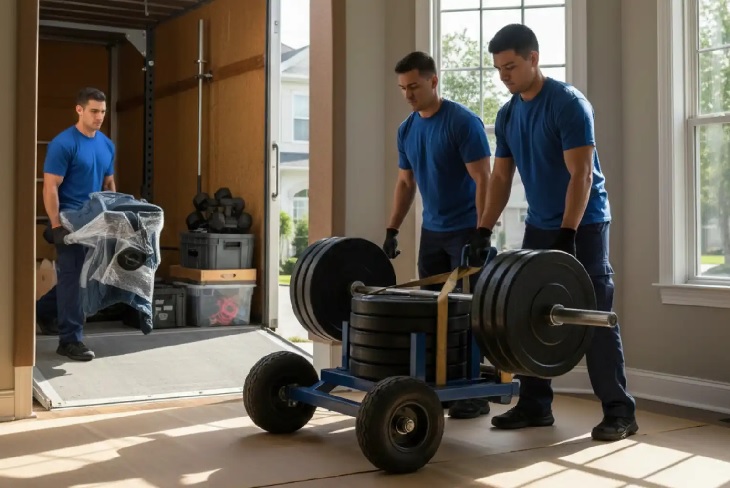
A home gym is the one thing in an apartment that weighs more than the furniture and takes up less room. A rack, a bench, a stack of iron plates in the corner. It moves badly, and it does most of its damage in the ten feet between where it sits and the apartment door.
The floor is what people worry about afterward, usually while staring at a fresh dent in a parquet plank that has been there since the building went up in 1928. Most of that damage is avoidable with an hour of preparation and a slightly different approach to carrying heavy things.
Weight Is the Whole Problem
Start by adding it up honestly. A standard Olympic barbell runs about 45 pounds, a pair of 45 pound plates adds another ninety, and a loaded plate tree can pass four hundred pounds on its own. A power rack with the uprights still bolted together is heavier than a refrigerator and far more awkward to hold.
That number matters for two separate reasons. It decides whether the piece can ride the passenger elevator at all, and it decides what the floor underneath is being asked to carry while the thing sits in a hallway waiting for the freight car to come back down from the fourteenth floor.
What a floor can actually take
Residential floors in most buildings are designed around a live load of roughly 40 pounds per square foot, spread out evenly. A concentrated load behaves differently. Six hundred pounds of iron sitting on four small rack feet presses far harder on one spot than the same weight spread across a room, which is why plates get stored flat and low.
Old wood floors are more forgiving than they look, but they dent. Parquet in a prewar apartment is thin, often already cupped near the radiator, and a dropped plate goes straight through the finish. On the upper floors of a wood framed brownstone you can feel the bounce underfoot, which is a good reason not to drop anything.
Taking the Equipment Apart the Right Way
Almost everything except dumbbells comes apart. A power rack breaks down into uprights and crossmembers. A treadmill usually separates at the upright hinge, and an adjustable bench loses its seat pad and then its base. Twenty minutes with a wrench turns one impossible carry into four manageable ones, and nobody has to walk backwards down stairs.
Photograph the assembly before you touch it, especially the cable runs on a functional trainer. Cables get routed through pulleys in an order that seems obvious while you are looking at it and is completely lost three days later. A short video walking slowly around the machine beats a folder of still photos every time.
Hardware goes in a bag taped to the frame
Every bolt from a piece of equipment goes into its own bag, labeled with the name of the machine, and that bag gets taped to the frame it came from. Not tossed into a toolbox with everything else. A rack missing four specific hardened bolts is a rack you cannot use until a replacement set arrives in the mail.
Keep the Allen keys and any odd proprietary wrench with the same bag. Manufacturers use tools you will not find in a household set, and hunting for a 6 millimeter hex key on a Sunday night in an unfamiliar neighborhood is a bad ending to moving day. Tape beats memory every single time.
Surface Protection From the Apartment Door to the Curb
Lay down a path before anything moves. Hardboard over the wood inside the apartment, a runner along the hallway, and something across the threshold where the metal strip sits. The threshold is where dollies catch and where most gouges begin, and it takes one folded piece of cardboard to prevent the whole problem.
In the lobby and the elevator the building usually has its own requirements. Many co-op and condo boards want the elevator padded and the lobby floor covered before a move starts, and the super will want to see it done rather than take your word for it. Ask what they require and handle it early.
Setting Up Again Without Annoying the Neighbors
Sound travels through a building better than anyone wants it to. A dropped deadlift in a Queens two-family goes straight into the apartment below as a thud that rattles their light fixture. Keep the platform away from shared walls if you can, and read your lease, because some buildings restrict free weights above the ground floor.
A home gym is one of the few loads where bringing in professional movers changes the outcome, because they show up with the appliance dollies and stair straps that most households do not own. Tell them about the weights in advance. A crew expecting cartons and finding a loaded rack will need a second trip.
Mats, plywood and where they really go
Rubber mats protect a floor from dropped iron, but they do not spread a static load by much. For a rack or a heavy machine, a sheet of three quarter inch plywood under the mat does more, since it moves the weight off four small feet and across several joists instead of concentrating it on one.
Position the platform so it crosses the joists rather than sitting between two of them. You can usually work out the joist direction from the floorboards, which normally run perpendicular to them. In a converted loft sitting on a concrete slab none of this matters, and you can put the rack wherever the outlet is.