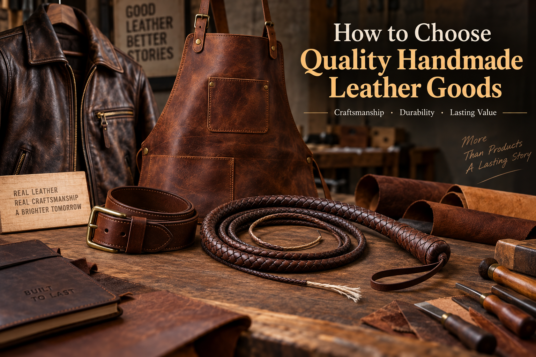
Mass produced leather products are everywhere, but they are not necessarily made with the same materials, construction methods or attention to detail. That is one reason handmade leather goods continue to attract buyers who care about craftsmanship, durability and products that develop character with use.
Whether you are shopping for a leather jacket, apron, belt or a more specialized item such as a bullwhip, knowing what to look for can help you judge quality before spending your money.
What Makes Handmade Leather Goods Different?
Leather is a natural material. Grain, thickness, flexibility, texture, and markings can vary across a single hide. A skilled leatherworker considers those differences when deciding which sections are suitable for a particular product.
The requirements also change with the item. A jacket needs flexibility, while a work apron needs protection and durability. Braided leather products require leather that can be prepared into consistent strands.Handcrafted production may involve hide selection, cutting, stitching, edge finishing, braiding or plaiting, hardware installation, and final finishing.
When buying handmade leather goods online, look beyond words such as “premium” or “luxury.” Material and construction details usually tell you much more.
How Can You Identify Quality Leather Craftsmanship?
You don’t need to be a leather expert. Start with a few visible details. Look closely at the stitching. It should be reasonably even, particularly around high-stress areas. Check edges, seams, rivets, buckles, zippers, and other hardware. Product descriptions should clearly state dimensions, materials, intended use, and relevant construction details.
This becomes especially important when considering custom handmade leather goods, because customization should not compensate for poor basic construction.
Specialist leather makers such as Leatherton work across categories including leather vests, aprons, jackets, belts, and whips. When comparing products like these, focus on the type of hide, construction, fit or dimensions, hardware, and intended use rather than appearance alone.
Leather Whips Show Why Construction Matters
Traditional whip making is a useful example of how technical leather craftsmanship can become. A braided cow whip requires carefully prepared leather strands. Historical documentation from the Florida Department of State describes traditional whip makers cutting strings from tanned hides and plaiting multiple layers while carefully controlling strand dimensions and tension to create a smooth taper.
That taper the gradual narrowing of the whip is an important part of its construction. Depending on the design, a whip may include a thicker internal belly, braided outer layers, a handle, thong, and cracker. Material preparation, plaiting tension, balance, and finishing all contribute to the finished piece.
For someone comparing handmade leather whips, these details are more useful than choosing solely by color or decorative knots.
What Should You Check When Shopping for Leather Whips?
First, consider what type of whip you actually need. A decorative piece and a functional bullwhip do not necessarily require the same construction.
Then check the material. Cowhide leather is commonly used for strong braided whips, while kangaroo leather is another option found in traditional and modern bullwhip making. Next, examine the braid. Look for consistent plaiting and a smooth transition from the thicker body toward the narrower end.
Length matters as well. Leather whips are available in different sizes, so a small leather whip and a long bullwhip can provide very different handling characteristics. Buyers searching for leather whips for sale should therefore compare material, length, construction, plaiting, and intended use instead of simply choosing the cheapest option.
Does a Higher Plait Count Mean a Better Leather Whip?
Not necessarily. A 12 plait bullwhip may have a more intricate outer braid than a lower-plait design, but plait count alone does not establish overall quality.
Strand preparation, leather quality, tension, internal construction, taper, balance, and finishing matter too. This is particularly important when comparing custom leather whips or kangaroo leather whips for sale. One impressive specification should never replace an assessment of the complete product.
What About Motorcycle and Handlebar Leather Whips?
Not every leather whip is a traditional bullwhip. Some products marketed as handlebar leather whips or leather whips for motorcycles are decorative motorcycle accessories. Their construction, attachment method, length, and intended purpose differ from those of a traditional cowboy or bullwhip.
Always check exactly what the product was designed for rather than assuming products sharing the word “whip” are interchangeable.
How Should Handmade Leather Be Maintained?
Real leather changes with use. Movement, handling, oils, and light can gradually alter its tone and surface, creating the character commonly known as patina.
But natural aging is different from damage. Keep leather away from prolonged moisture and excessive heat, and avoid using harsh household cleaners. For conditioning, cleaning, and storage, follow instructions appropriate to the specific leather type.
Good maintenance can help authentic leather goods retain their appearance and functionality for longer.
FAQs About Handmade Leather Goods
Are handmade leather goods better than mass-produced products?
Not automatically. Handmade describes a production method, not guaranteed quality. Leather type, stitching, construction, hardware, finishing, and the maker’s skill are more meaningful indicators.
What should I check before buying handmade leather goods for sale?
Check the leather type, dimensions, construction details, stitching, hardware, photographs, care instructions, and intended use. These factors are especially useful when shopping online.
What makes a quality leather bullwhip?
Look at the leather, strand preparation, plaiting consistency, taper, internal construction, length, balance, and finishing rather than judging it only by appearance or plait count.
Are cowhide and kangaroo leather whips the same?
No. They use different hides with different characteristics. Construction quality remains important regardless of which leather is used.
Conclusion
The best handmade leather goods are not valuable simply because someone made them by hand. Their value comes from the relationship between quality leather, skilled craftsmanship, appropriate construction, and intended function.
Whether you’re comparing leather goods for men, a custom accessory, or traditional leather whips, examine how the product is actually made. A good product description should answer practical questions about material, construction, dimensions, use, and care. Once you learn to look for those details, it becomes much easier to separate genuine leather craftsmanship from marketing language.